
Israel Election Results: Netanyahu Claims Fraud as Arab Parties Hold Key to Coalition

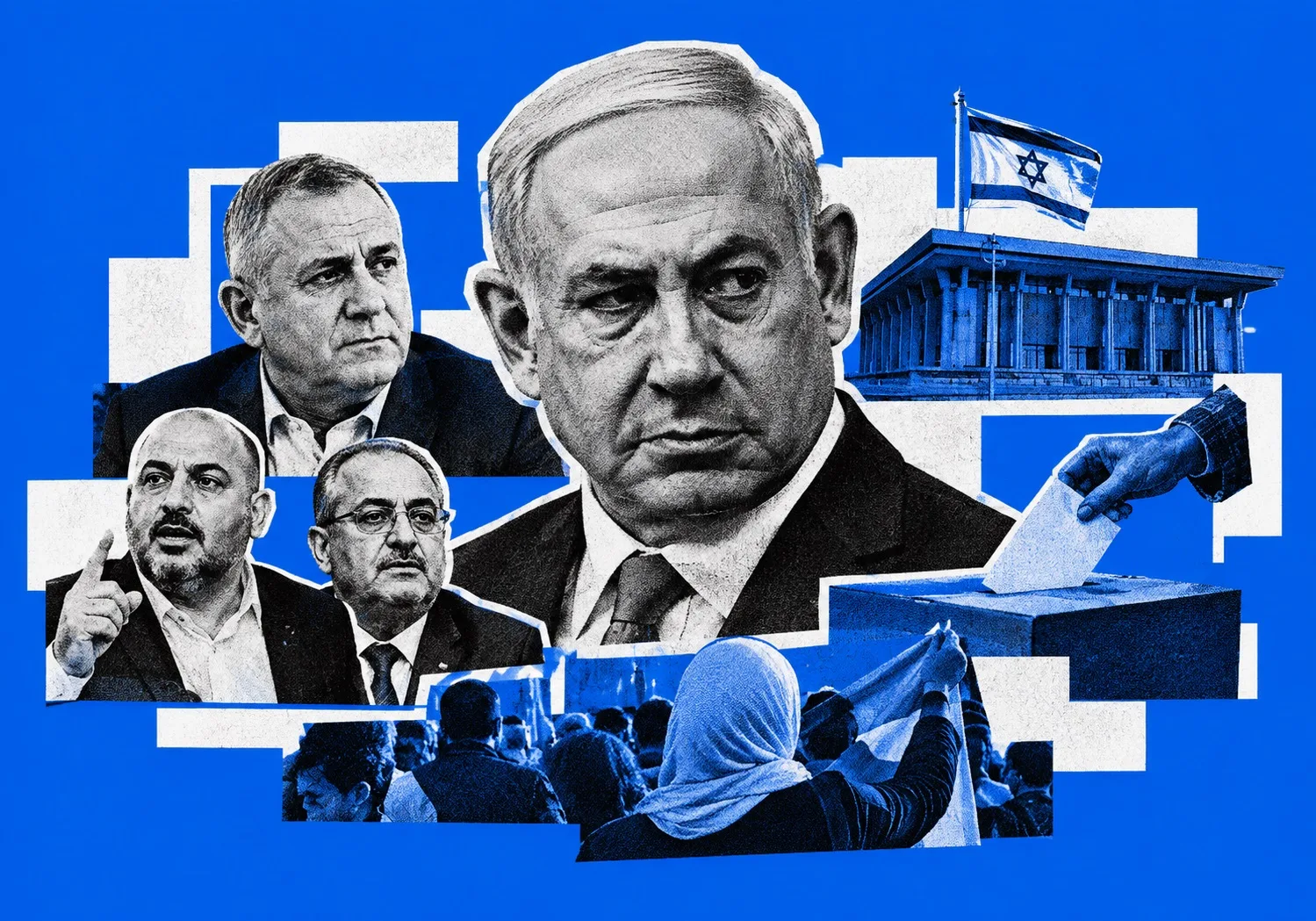
Israeli Prime Minister Benjamin Netanyahu has alleged election fraud following tight parliamentary election results, despite police statements finding no evidence of widespread manipulation. The controversy comes as Arab political parties secured a pivotal number of seats, leaving both Netanyahu and opposition leader Gadi Eisenkot struggling to assemble a governing coalition.
The numbers leave Netanyahu in a difficult position. His right-wing and ultra-right bloc won 53 seats in the 120-member Knesset, compared with 48 for Eisenkot’s opposition alliance. The Joint List secured 11 seats and Ra’am another eight.
No bloc has a majority. But the opposition has more room to negotiate.
If Eisenkot can secure support from all 19 Arab lawmakers, he would have 67 parliamentary votes behind him. That does not necessarily mean he could assemble a conventional coalition. The parties involved would have to overcome substantial political differences, and Arab support could come from outside the government rather than through ministerial participation.
Nevertheless, the possibility gives Eisenkot an opening that Netanyahu currently lacks.
The prime minister’s allies on the far right have ruled out depending on Arab parties. Itamar Ben-Gvir’s Otzma Yehudit and Bezalel Smotrich’s Religious Zionism have maintained that position while demanding an investigation into the alleged foreign financing.
Netanyahu therefore faces a problem that cannot be solved simply by persuading a few smaller parties to join him. The most significant pool of seats outside the two main blocs belongs to politicians whom his own partners refuse to accept as governing allies.
For Arab parties, this is a striking change from the previous election. In 2022, they won a combined 10 seats. Their new total of 19 gives them an influence that neither of the larger blocs can readily disregard.
Their electoral success has also made them the principal target of a dispute over how the election was conducted.
What the Investigation Actually Covers
On 29 October, Noam Solberg, the Supreme Court judge chairing the Central Elections Committee, instructed Shin Bet chief Ronen Bar to investigate suspicions involving foreign money and voter mobilisation.
The allegations, circulated by Israeli media outlets and Likud officials, concern funds supposedly transferred from Qatar and Turkey through currency exchange businesses and local organisations. Ra’am has been singled out in claims that such money was used to encourage Arab voters to participate.
Police have detained seven suspects in connection with the inquiry, which involves the Lahav 433 investigative unit.
That is the established extent of the case described by the authorities. The investigation concerns possible financial irregularities, not a finding that the election was fraudulent.
The Israel Police has said it possesses no investigative or intelligence evidence supporting allegations of a stolen election. Shin Bet has separately made clear that its inquiry is confined to particular financial suspicions and does not concern Arab voters as a group.
The governments accused of involvement have denied the claims. Qatar called them dangerous disinformation, while Turkey’s Center for Countering Disinformation, operating under the Presidential Communications Directorate, dismissed them as baseless.
There has been no official public statement on the allegations from either the United States or the European Union.
None of this precludes investigators from establishing wrongdoing. Questions about the origin of political funding and its use during an election are legitimate subjects for investigation.
But there is a considerable distance between examining suspicious payments and claiming that the parliamentary result has been stolen. Netanyahu has crossed that distance in his public statements without the support of findings from the police.
The timing makes the accusation particularly consequential. The parties are preparing to negotiate a government, and the politicians whose votes could remove Netanyahu are also those whose electoral success is being challenged.
Eisenkot’s Opportunity Comes With a Political Price
President Isaac Herzog is expected to give Eisenkot the first opportunity to form a government.
That would not guarantee his appointment as prime minister. He would still need to demonstrate that he can secure sufficient parliamentary support, whether through a formal coalition, a minority administration or an agreement involving Netanyahu’s bloc.
The first two options make Arab parties important. The third would require a compromise with the prime minister Eisenkot is seeking to replace.
For Eisenkot, working with Ra’am and the Joint List could provide the clearest numerical route to a government. It would also expose him to sustained criticism from Netanyahu’s allies, who oppose reliance on Arab parliamentary votes.
This is where the allegations of foreign financing acquire their political force.
Even without evidence of widespread electoral fraud, they give Netanyahu and his supporters a means of challenging any agreement involving Arab lawmakers. Rather than arguing only against the policies of a prospective coalition, they can question the circumstances in which some of its parliamentary support was obtained.
Mansour Abbas of Ra’am and Ahmad Tibi of the Joint List have rejected the allegations. Arab party leaders regard the accusations as a campaign intended to discredit their voters and prevent an alternative government from taking office.
The dispute has left little room for discussion of what the Arab factions might demand in return for supporting Eisenkot. No specific common set of policy conditions has been established in the available information.
That matters because 19 seats do not automatically translate into a unified negotiating position. Ra’am and the Joint List remain separate political organisations, and their willingness to support a particular government cannot simply be assumed.
Eisenkot needs their votes, but he also needs an arrangement that can survive the pressures of governing. A minority administration dependent on external support would face different constraints from a coalition in which Arab parties participated directly.
Netanyahu’s accusations make either arrangement harder to negotiate before its terms have even been settled.
The Remaining Ballots Are Unlikely to Rescue Either Bloc
The Central Elections Committee still has to certify between 430,000 and 480,000 ballots submitted through Israel’s double-envelope voting system.
These include votes from soldiers, hospital patients, prisoners and diplomats. Together, they represent roughly 10 per cent of ballots cast.
Their inclusion could alter the number of seats held by individual parties. Solberg has nevertheless indicated that the remaining count is unlikely to change the overall balance between Netanyahu’s bloc, Eisenkot’s alliance and the Arab factions.
The prospect of a decisive late reversal is therefore limited.
That leaves Herzog facing a political decision rather than waiting for the arithmetic to resolve itself. Eisenkot may be better placed to assemble a majority, but doing so would require agreements across divisions that the election controversy has made more difficult.
Netanyahu, meanwhile, has no obvious route to 61 seats while his partners maintain their refusal to rely on Arab parties.
The election has produced a parliament in which the traditional right-wing bloc cannot govern alone, but its opponents have yet to establish that they can govern together.
The Cost of Turning a Financial Probe Into an Electoral Dispute
The involvement of Shin Bet has raised the stakes for institutions that are supposed to operate independently of party competition.
Security and police investigations can establish whether suspected financial offences occurred. They cannot settle political disagreements about which elected parties should participate in government.
The distinction is especially important in this case because the allegations concern the mobilisation of Arab voters.
Israel’s right-wing parties have previously used warnings about Arab turnout to encourage their own supporters to vote. The current accusations go further. They associate increased Arab participation with possible foreign interference, at a moment when that participation has given Arab parties unprecedented leverage in coalition negotiations.
A finding of unlawful financing would have to be addressed on its evidence and legal merits. It would not automatically establish that every vote cast for the parties concerned was invalid.
Equally, the absence of evidence for Netanyahu’s broader allegation does not mean investigators should ignore credible suspicions about individual transactions.
For the police and Shin Bet, maintaining that separation will become increasingly difficult if political leaders continue to present the existence of an investigation as confirmation of electoral wrongdoing.
The institutions are already being drawn into a confrontation whose central question is political: whether the opposition can use the parliamentary support of Arab parties to form a government.
There is a further danger for the parties themselves. If allegations directed at specific funding arrangements become a general argument against Arab political participation, their electoral gains may be treated differently from those of other parties.
That would change the terms of coalition bargaining. Arab lawmakers would be expected not only to negotiate their support but also to defend their right to exercise the influence their seats provide.
Herzog’s anticipated decision on the first mandate will bring that conflict into the formal process of government formation. Eisenkot could have the parliamentary numbers to replace Netanyahu, yet still find that the legitimacy of his prospective majority is being contested through an investigation whose findings remain unknown.
For Israel’s investigative authorities, the immediate question is whether any foreign money was unlawfully used to influence voter mobilisation. For the next government, the more difficult question is whether 19 elected Arab lawmakers can exercise their parliamentary power without the validity of their representation becoming a condition of negotiations.
Sources: DW, Daily News, EFE, CBC