
Hubert Aiwanger, Bavaria’s Deputy Premier, Found Dead in Berlin Hotel

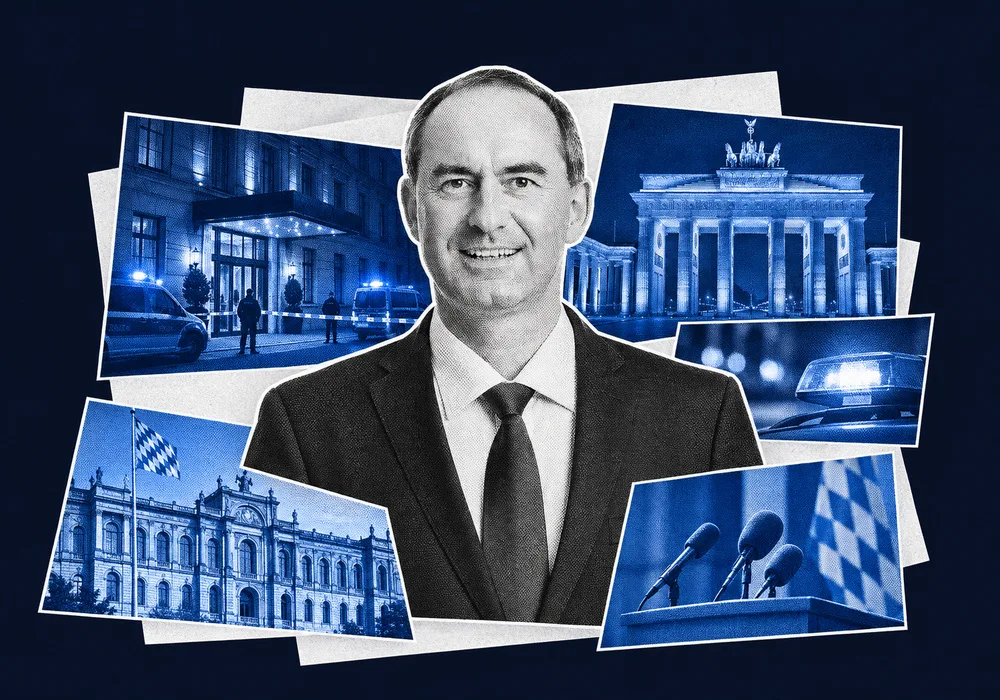
The 55-year-old leader of Germany’s Free Voters party was found dead in a Berlin hotel on Wednesday evening. Police and prosecutors have launched an investigation to establish the cause and circumstances of his death, leaving questions over the future leadership of one of Bavaria’s governing political parties.
Hubert Aiwanger, Bavaria’s Deputy Minister-President and Minister for Economic Affairs, Regional Development and Energy, was found dead in a hotel room in Berlin on Wednesday evening, 4 November. He was 55. Berlin police and the public prosecutor’s office confirmed his death and announced an investigation to establish its precise cause and circumstances, as well as to rule out possible third-party involvement.
Aiwanger had travelled to the German capital to attend the opening of a new Berlin office for his party, the Free Voters (Freie Wähler). However, he did not attend the event after reportedly feeling unwell. According to German media reports, he had also cancelled an earlier engagement for health reasons. His body was subsequently discovered in his hotel room in the Berlin-Mitte district.
Authorities have not publicly established the cause of death. The investigation is being conducted by the Berlin public prosecutor’s office and the State Criminal Police Office. Bavarian Minister-President Markus Söder described the news as an absolute tragedy, expressing shock and extending his condolences to Aiwanger’s family and children.
The Political Figure Who Reshaped Bavarian Politics
Aiwanger had been one of the most influential figures in Bavaria’s regional politics for nearly two decades. Born in Lower Bavaria in 1971, he entered politics through the Free Voters, a political movement with strong roots in local government and municipal politics. He became leader of the party’s Bavarian branch in 2006 and subsequently assumed its federal leadership in 2010.
His political breakthrough came in the 2008 Bavarian state election, when the Free Voters entered the state parliament. A decade later, the party became a junior coalition partner of the Christian Social Union (CSU), ending the latter’s ability to govern alone. Aiwanger was appointed Minister for Economic Affairs, Regional Development and Energy and Deputy Minister-President in the government led by Markus Söder.
The partnership between the CSU and Free Voters continued after the 2023 state election, securing the latter an established position in Bavaria’s governing structure. Although the party struggled to translate its regional popularity into representation in the Bundestag, it became a significant political force within Germany’s largest federal state.
Aiwanger’s influence extended beyond his ministerial responsibilities. He cultivated a political profile centred on rural communities, farmers, regional economic interests and opposition to certain federal government policies. His confrontational public communication style also helped make him one of the most recognisable politicians in southern Germany.
The 2023 Controversy and His Political Legacy
Aiwanger’s political career was also marked by controversy. In 2023, shortly before the Bavarian state election, he became the subject of a major public dispute after a report by the Süddeutsche Zeitung alleged that he had written and distributed an antisemitic leaflet while attending school in the late 1980s.
The leaflet contained references to the Holocaust and Auschwitz. Aiwanger denied being its author, while his brother subsequently claimed responsibility for writing it. Aiwanger acknowledged that copies of the document had been found among his school belongings and apologised for the incident, but rejected calls to resign from the Bavarian government.
Söder ultimately decided to retain him in office, arguing that the available information did not establish sufficient grounds for his dismissal. The controversy nevertheless generated considerable debate across Germany about political responsibility, antisemitism and the standards expected of public officials.
Despite the affair, the Free Voters retained their position in the Bavarian government following the 2023 election. Aiwanger remained a central figure in the party’s political identity and its efforts to expand beyond its traditional regional electorate.
Implications for Bavaria’s Political Landscape
Aiwanger’s death leaves a significant leadership gap within the Free Voters at both state and federal levels. His position as the party’s most recognisable political figure was closely connected to its electoral success in Bavaria, where its influence has depended on its ability to maintain a distinct identity alongside the much larger CSU.
The immediate question concerns the continuity of the coalition government. The Free Voters remain the CSU’s junior governing partner, and Aiwanger’s death does not automatically dissolve the existing coalition agreement. Nevertheless, the party will need to address the distribution of his ministerial responsibilities and establish who will represent it in negotiations with Söder’s government.
The consequences may also extend to the party’s broader ambitions. The Free Voters have sought to strengthen their presence in federal politics, using their Bavarian governing experience as a foundation for expansion elsewhere in Germany. A leadership transition now creates an additional challenge for an organisation whose national profile has remained closely associated with Aiwanger.
For the moment, the circumstances of his death remain under investigation, and the immediate political focus is on the response of the Bavarian government and the future organisation of the Free Voters. His departure marks the end of a political career that helped transform a locally rooted movement into a permanent participant in Bavaria’s governing coalition.
Sources: Berlin Police and Public Prosecutor’s Office, Bavarian State Government