
How Russia Uses AI to Fake Battlefield Victories in Ukraine

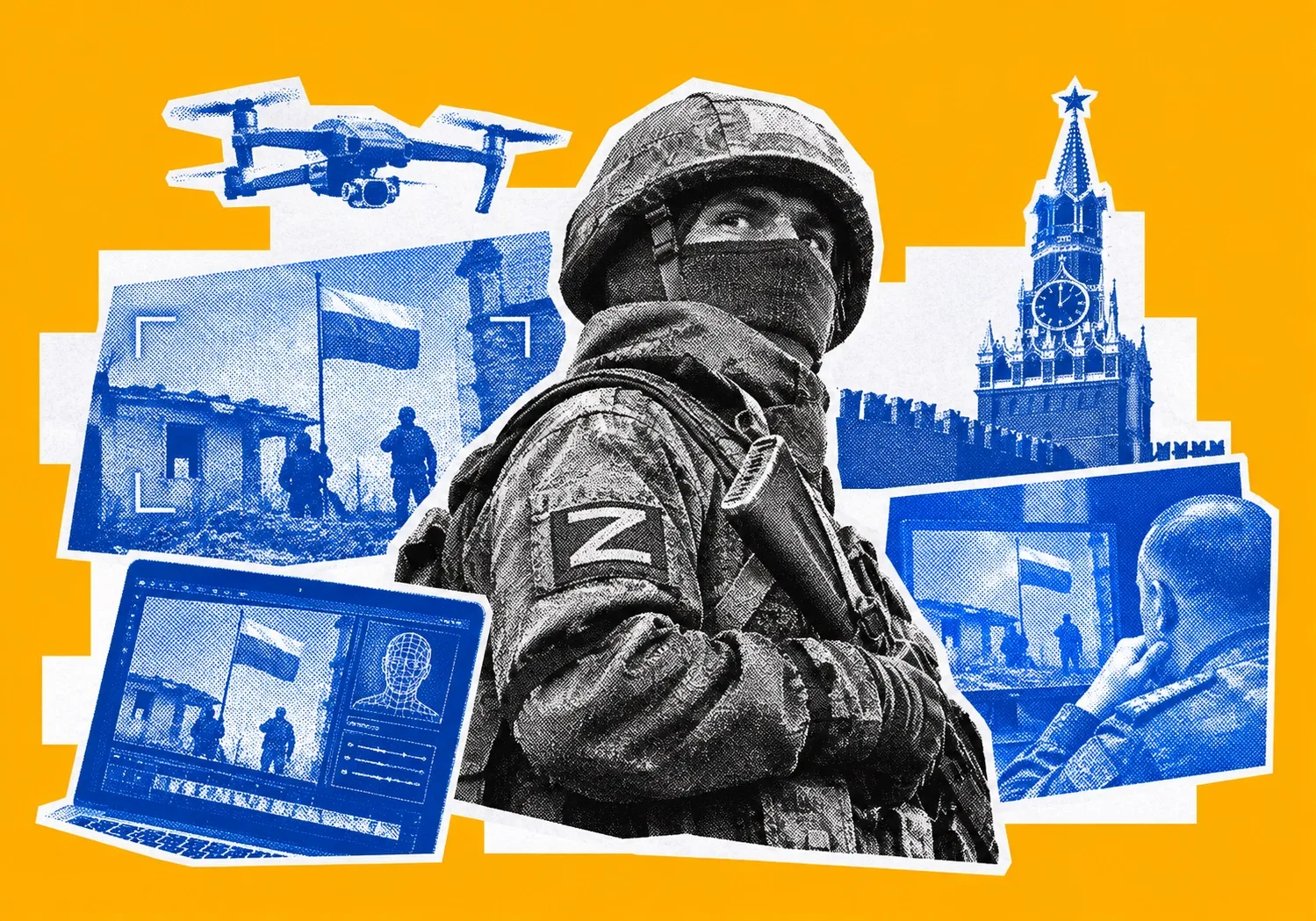
nvestigative reports reveal that Russian forces are increasingly using artificial intelligence and manipulated footage to fake territorial gains in Ukraine. Evidence analyzed by the Institute for the Study of War (ISW) suggests these AI-generated "neuro-flag-plantings" are not just misleading Western audiences, but may also be deceiving top Kremlin commanders.
Investigators examining Russian battlefield footage have encountered similar irregularities elsewhere. The Institute for the Study of War (ISW) identified at least 35 suspicious videos circulated between June and August, involving personnel associated with at least ten Russian regiments and brigades. The Financial Times subsequently investigated the use of artificially generated and altered footage to substantiate Russian claims of territorial advances.
The findings raise an uncomfortable possibility for Moscow: some of the false evidence produced to advertise Russian military success may also be reaching the officers responsible for planning the war.
The strange business of planting flags
Russian territorial claims have long been contested by Ukrainian officials and independent battlefield observers. A flag raised over a building does not necessarily mean the surrounding settlement has fallen. Soldiers may enter a location briefly without establishing lasting control.
Artificial intelligence makes that distinction harder to establish from video alone.
Instead of physically reaching a building to stage a flag-raising, an operator can manipulate existing footage to introduce a flag or a soldier who was never there. Real terrain can remain visible in the background, giving the recording an appearance of authenticity.
The technology is not flawless. Investigators have identified inconsistencies in movement, lighting and human anatomy, as well as objects that change shape or disappear between frames. In the Dobropillya footage, the behaviour of the flag was among the details that prompted scrutiny.
Yet an obviously flawed recording can still circulate widely before its defects are identified. For someone checking a military report under time pressure, a video showing identifiable terrain and Russian insignia may appear more persuasive than an unsupported written claim.
The problem becomes particularly acute when the video and the report come from the same source. What looks like independent confirmation may simply be a second version of the original assertion.
The 35 recordings examined by ISW do not establish that every Russian unit is producing synthetic battlefield evidence. Investigators have also been unable to reconstruct the full production and distribution history of every file. The material does, however, show that suspicious footage has appeared across several formations rather than being confined to one incident.
Even Russia's war supporters are complaining
The criticism has not come exclusively from Ukraine or Western researchers.
In late September, Rybar, an influential Russian pro-war Telegram channel, complained that military units were reporting the capture of settlements they did not control. Its criticism focused partly on the Lyman direction, where Russian forces had encountered difficulties advancing.
The channel gave the practice a mocking name: neuro-flag-planting, a reference to the use of neural networks to manufacture images of Russian flags in supposedly captured locations.
That criticism carries a particular significance. Rybar supports Russia's war, but its reporting has frequently differed from the more favourable accounts issued by official military channels.
For pro-war commentators attempting to follow Russian operations, fictitious victories create practical problems. If a settlement is declared captured while Ukrainian troops remain there, subsequent reports of fighting become difficult to explain. Claims about the pace of an offensive lose credibility, and assessments of which units are making progress become unreliable.
The disputed capture of Sviatohirsk produced similar disagreements. Ukrainian commanders, including Andriy Biletsky, challenged Russian assertions, while some Russian nationalist commentators also questioned the accounts.
Such disputes do not make pro-war Telegram channels neutral arbiters of battlefield truth. Their information is incomplete, and their assessments can be wrong. But the public criticism indicates that the reliability of Russian territorial claims has become a source of friction even among those who want Moscow's campaign to succeed.
What happens when commanders need good news?
The Financial Times investigation points to a possible explanation for the fabricated victories: pressure within Russia's military hierarchy to demonstrate progress.
Intelligence assessments and expert sources cited by the newspaper describe field commanders producing misleading accounts to satisfy superiors, conceal setbacks or meet expectations that battlefield conditions do not support.
The incentives are not difficult to understand. A commander ordered to advance may face uncomfortable questions if an operation stalls. Reporting the capture of a settlement offers a measurable achievement. Producing video evidence makes the claim appear more substantial.
AI has made such evidence easier to manufacture, although the available investigation does not establish the circumstances in which every suspicious recording was created.
This is where the issue becomes more serious than another episode of wartime misinformation.
A false claim published for propaganda purposes can mislead outside audiences. A false claim accepted inside a military command system can affect how officers understand their own operations.
Suppose a settlement is reported captured when Ukrainian forces still control it. Higher headquarters may believe that a route has been secured or that an attacking formation has achieved its assigned objective. Decisions about subsequent operations could then be based on an inaccurate picture of the front.
Whether that happens depends on the verification procedures available to senior commanders and the quality of intelligence reaching them through other channels.
There is no documented evidence in the briefing that one of the 35 suspicious videos directly caused a particular Kremlin decision. It would also be premature to assume that Russian senior officers are incapable of detecting false reports.
Nevertheless, Budanov's accusation concerning Dobropillya goes directly to this concern. He alleged that the commander of Russia's Center grouping had misrepresented battlefield developments to the country's leadership.
If reports are being falsified to satisfy expectations from above, the resulting inaccuracies may be difficult to correct. Officers who challenge an announced success could find themselves contradicting accounts already accepted by their superiors.
That possibility is especially troubling in a prolonged war where small territorial changes are repeatedly presented as evidence of progress.
The limits of what a battlefield video can prove
The spread of manipulated footage also complicates the work of journalists and independent military analysts.
Geolocation has become an important method of checking wartime claims. Investigators compare visible buildings, roads, tree lines and other landmarks with maps or earlier imagery to establish where a recording was made.
But a correctly identified location does not prove that every object in the recording is genuine.
A video may show an authentic Ukrainian building with a digitally inserted Russian flag. The geography can be accurate while the event supposedly taking place there is fictitious.
Investigators therefore have to examine the footage itself, looking for visual inconsistencies and checking whether the claimed military development is supported by other evidence.
The Dobropillya case illustrates why both checks matter. The video purported to show Russian soldiers at a recognisable location, yet its visual anomalies and the Ukrainian account of continued control called the capture claim into question.
This does not mean that every unusual image is necessarily AI-generated. Compression, editing and poor recording quality can also produce visual defects. Establishing deliberate manipulation requires examining the recording in context rather than treating a single anomaly as conclusive proof.
For European governments, researchers and news organisations following the war, the practical difficulty is determining which images can be trusted quickly enough to inform accurate reporting. A fabricated capture claim may spread long before investigators have completed their checks.
Russia's military faces a different version of the same problem. Its commanders need timely information about territory, enemy positions and the performance of their own formations. The people supplying that information may also have professional reasons to exaggerate their achievements.
The available evidence does not reveal how many fabricated reports have been accepted at senior levels, or how often contradictory intelligence has corrected them. Those unanswered questions matter more than the number of artificial flags appearing in individual videos.
A headquarters can dismiss a manipulated recording once it is exposed. It is considerably harder to assess the progress of an offensive when the officers responsible for reporting that progress may have helped manufacture the evidence.
Sources: FT, NV, SBS News, Novaya Gazeta