
Germany’s automotive crisis accelerates shift towards defence production

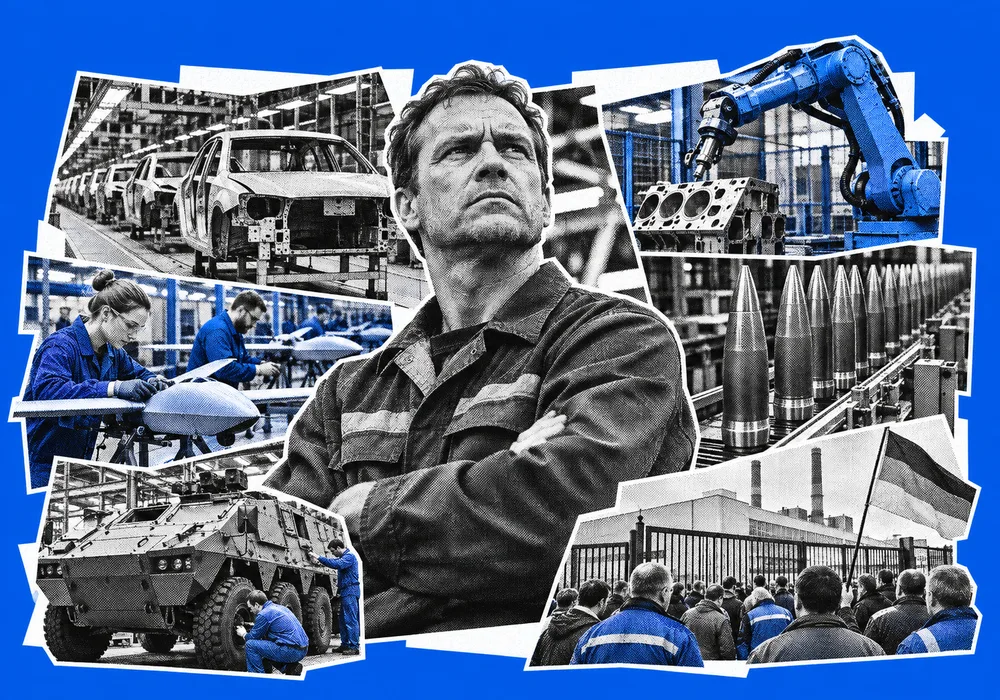
Germany’s struggling automotive supply chain is increasingly turning to defence, drones and space technology to offset declining car production and protect industrial jobs. The shift could strengthen Europe’s defence manufacturing base, but it also exposes the limits of relying on military contracts to compensate for structural weaknesses in the automotive sector.
Germany’s automotive industry is undergoing a structural transformation as declining demand, growing competition from Chinese manufacturers and US tariffs put pressure on companies across the supply chain. The consequences are extending well beyond major carmakers, affecting thousands of smaller manufacturers whose businesses have traditionally depended on supplying components to the automotive sector. Increasingly, these companies are looking towards defence, aerospace and other industrial markets to maintain production capacity and reduce their dependence on the car industry.
One example is Jopp, a family-owned manufacturer based in Bavaria, one of Germany’s most important automotive regions. The company began exploring defence production as its contract to manufacture gear systems for Porsche approached its end. It has since entered a partnership with German defence company Highcat, producing surveillance drones for customers including the military, police and fire services. Jopp now has the capacity to manufacture up to 1,000 drones per month, demonstrating how existing industrial facilities and manufacturing expertise can be redirected towards emerging defence requirements.
The transition is also part of a longer-term effort to diversify the company's customer base. Automotive production currently accounts for approximately 85% of Jopp's sales, but management aims to reduce that share to 60% by 2035. The immediate priority, however, is maintaining employment rather than rapid expansion. The company has already reduced its workforce from around 2,000 employees six years ago to 1,400, while closing two factories as demand from automotive customers weakened.
Defence becomes an alternative industrial market
Jopp's experience reflects a broader adjustment across Germany's manufacturing sector. According to a survey by consultancy Roland Berger, almost 80% of German automotive suppliers were seeking opportunities in other industries, with defence, space and medical technology emerging as particularly attractive alternatives. The scale of the adjustment reflects the depth of the automotive downturn: Germany's car industry has lost more than 140,000 jobs since 2019, equivalent to approximately one in six positions in the sector, according to EY.
Larger industrial groups are pursuing similar strategies. Schaeffler, one of Germany's major manufacturers of automotive and industrial components, has announced plans to eliminate more than 8,000 jobs while expanding into new markets. Its diversification strategy includes cooperation with US satellite data company Spire Global on spacecraft components, with the possibility of moving into satellite manufacturing. The company has also announced plans to produce Damocles attack drones developed by French manufacturer Delair, alongside Aspik interceptor systems designed to counter hostile drones.
These developments indicate that the expansion of European defence production is creating opportunities beyond traditional arms manufacturers. Companies with established expertise in precision engineering, electronics, mechanical systems and industrial-scale manufacturing can potentially become part of the defence supply chain without having previously operated in the military sector. For Germany, this offers a way to retain industrial capabilities that might otherwise be weakened by declining automotive investment and production.
The growing demand for drones and counter-drone technologies is particularly relevant. European militaries are increasingly prioritising unmanned systems, surveillance capabilities and protection against aerial threats. This creates a market for manufacturers capable of adapting existing production processes to meet military requirements. The involvement of automotive suppliers could therefore help broaden the industrial base available to European defence companies, reducing dependence on a relatively narrow group of specialised manufacturers.
Industrial diversification has structural limits
However, the transition from automotive to defence production is not a straightforward replacement of one market with another. Automotive manufacturers traditionally operate through long-term contracts and large production volumes, allowing suppliers to forecast demand, plan investments and maintain relatively stable employment. Defence procurement follows a different model, often relying on framework agreements, smaller production batches and orders that depend on government budgets and procurement decisions.
This creates uncertainty for companies attempting to transfer their operations into the defence sector. Although military demand is growing, it does not necessarily translate into predictable production volumes or sufficient contracts to replace lost automotive business. Competition is also intensifying as established defence manufacturers and new technology companies seek to benefit from increased European military spending.
Industry experts have consequently warned that diversification should be viewed as an additional source of revenue rather than a solution to the automotive crisis itself. The underlying problems facing German car manufacturers, including international competition, weak European demand and pressure on production costs, remain unresolved. Entering defence markets may protect selected factories and preserve specialised industrial knowledge, but it cannot independently restore the competitiveness of the automotive supply chain.
Implications for Europe's defence-industrial capacity
The shift nevertheless has implications extending beyond Germany's domestic economic adjustment. European governments are under growing pressure to expand defence production, strengthen supply chains and reduce vulnerabilities in critical military technologies. Bringing automotive suppliers into this process could provide access to existing industrial facilities, skilled workers and established manufacturing networks, potentially accelerating the expansion of production capacity.
Germany is particularly important in this context because of the scale and technological depth of its industrial base. The conversion of some automotive suppliers towards defence production could help connect traditional manufacturing regions with Europe's emerging defence ecosystem. It could also create opportunities for smaller companies that possess relevant engineering capabilities but have historically lacked access to military procurement markets.
At the same time, the success of this transformation will depend on whether governments can provide sufficiently predictable demand, simplify procurement procedures and establish longer-term partnerships with industrial suppliers. Without clearer production requirements and sustained investment, companies may struggle to justify the costs of adapting facilities, obtaining certifications and developing military-specific products. The challenge is therefore not simply to attract more manufacturers into defence, but to create the conditions under which they can remain commercially viable suppliers.
Germany's automotive crisis is consequently becoming part of a wider European industrial realignment. The movement of manufacturers from car components towards drones, spacecraft and military technologies illustrates how economic pressure can accelerate the reallocation of industrial resources. While this process offers an opportunity to strengthen Europe's defence manufacturing base, its long-term value will depend on whether the continent can turn growing military demand into a stable industrial ecosystem rather than a temporary alternative for companies struggling in other sectors.
Sources: Euronews, Roland Berger