
From Washington to Stockholm: Why Governments Are Banning Browser AI and DeepSeek

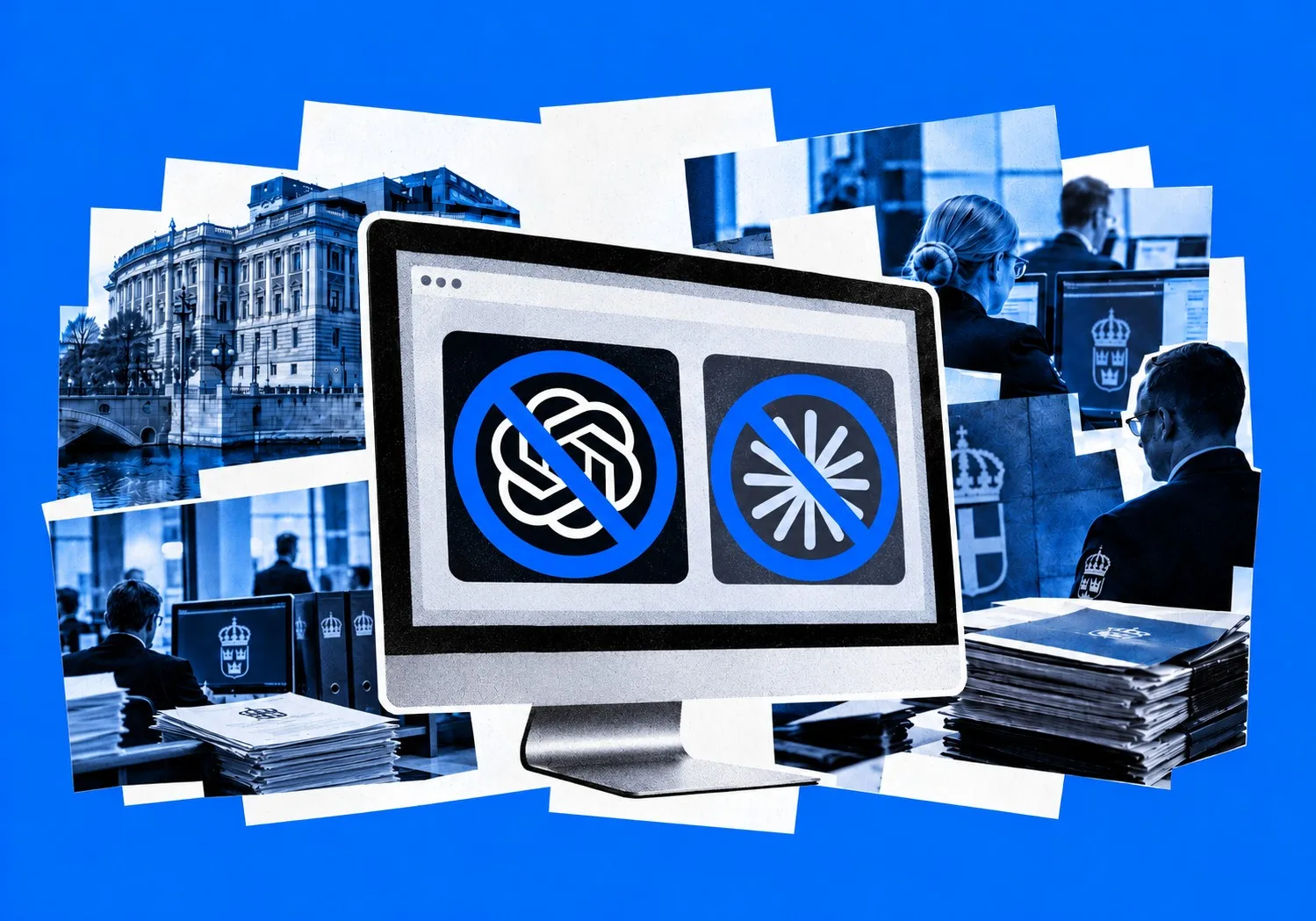
Sweden’s Government Offices officially restricted state employees from using browser-based versions of ChatGPT and Claude on work computers on Monday, October 26. The ban took effect amid security concerns over the processing of sensitive data across public sector networks. The decision follows an internal audit of artificial intelligence tools conducted at the Swedish Transport Administration earlier this year. That official review identified “problematic” uses of AI platforms by workers while carrying out government tasks and routine public administration.
Officials were concerned that entering sensitive information into these models without an agreement setting out how to protect and secure the data could lead to it being fed into the model and stored for training.
The use of platforms not regulated or protected by such agreements, also known as shadow IT, could bring “consequences for our information security,” said Mikael Wettercrantz, director of digitalisation at the Government Offices of Sweden.
According to the Swedish public broadcaster Sveriges Radio, restrictions on the use of ChatGPT and Claude have also been put in place at the Swedish Tax Agency and the National Board of Institutional Care.
The Swedish Enforcement Authority is currently reviewing the issue to assess its internal IT vulnerability.
While government workers will still be able to use artificial intelligence tools to help them carry out their daily professional tasks, they will do so under tighter security controls.
Just a limited number of employees are permitted to continue using ChatGPT and Claude, but only through a special platform for AI assistants developed directly by Swedish authorities to isolate prompt data.
Microsoft’s Copilot, which has passed a security screening process and is covered by a security agreement between the US company and the Swedish government, is being recommended as an alternative for state personnel.
The restricted AI platforms join DeepSeek on a list of AI tools not approved by the Swedish government over data security fears.
The Washington Purge
A similar restrictions policy was implemented in the United States, where the government ordered artificial intelligence technology from the Chinese firm DeepSeek to be removed from most civilian government systems.
The Department of Homeland Security (DHS) banned all use of DeepSeek within civilian government agencies, as well as any technology built with the aid of its AI models. The DHS made the order public on Monday, October 19, but the ban officially took effect from the end of July.
The DHS notice did not detail the exact security concerns surrounding DeepSeek within its public statement. However, the US Defense Department stated that the use of such tools “may result in the transfer of sensitive data” to China.
The executive order is specific to civilian agencies, including the Department of the Treasury, the Department of State, and the Department of Justice.
Agencies within the Department of Defense are excluded from this specific civilian order and operate under separate regulatory directives.
The ban follows criticism of Chinese artificial intelligence from the Trump administration and American technology firms.
White House tech lead Michael Kratsios wrote earlier this year in an internal memo that "malicious exploitation" of American AI firms had been occurring, mainly by rival firms in China.
Anthropic and OpenAI, both of which are preparing to list on the public stock market in the coming months, have claimed that their AI models were essentially copied by some Chinese AI firms, including DeepSeek. US President Donald Trump has stated that he sees China as the key US rival in artificial intelligence development.
The Open-Source Shock
DeepSeek has grown in popularity since its initial public release in 2025, with models being in such demand that the company's servers have gone down at times due to global user activity.
While DeepSeek's free chatbot app is listed prominently in Apple App Store rankings, its AI models are also used by US tech companies such as Snowflake, Vercel, and OpenRouter in their commercial customer offerings.
Startups have utilized open-source models like DeepSeek due to significantly reduced software development costs. For a technology or AI developer, using DeepSeek in their work costs a fraction of what a closed model like Google's Gemini, Anthropic's Claude, or OpenAI's Codex would cost on commercial markets.
DeepSeek reported last year that it took about $6 million to train the debut version of its model.
By comparison, the expenses associated with OpenAI's GPT-4 were roughly $100 million.
These financial disclosures previously sent tech stocks tumbling across public equity markets. DeepSeek released its most recent model iteration last week, with benchmark reports noting its performance on common tasks like computer software coding.
Institutional Infrastructure and Security Standards
The implementation of software restrictions across Swedish and American state bodies establishes specific compliance standards for public sector technology access.
Within the Swedish administrative system, regulations directly affect multiple government entities handling sensitive public records. Following the initial audit at the Swedish Transport Administration, restrictions have been implemented across the Swedish Tax Agency and the National Board of Institutional Care, while the Swedish Enforcement Authority is conducting an internal review of its software exposure.
State workers retain access to artificial intelligence functionality exclusively through pre-vetted options: Microsoft Copilot, which operates under a direct security agreement between Microsoft and the Swedish government, and a dedicated internal platform created by Swedish authorities for authorized personnel using OpenAI and Anthropic models.
In the United States, the civilian federal ban issued by the Department of Homeland Security operates under statutory authority defined by the Federal Information Security Modernization Act (FISMA).
This regulatory mechanism enables federal directives regarding information technology procurement across non-defense institutions, specifically including the Department of the Treasury, the Department of State, and the Department of Justice. The directive covers both standalone applications and third-party software containing code derived from DeepSeek models.
These regulatory measures coincide with financial and operational adjustments across the artificial intelligence industry.
Major US model developers, including OpenAI and Anthropic, are preparing for initial public offerings (IPOs) on the public stock market while maintaining specific security protocols for commercial clients.
Concurrently, the operational model of open-source providers such as DeepSeek—which documented initial training expenditures of $6 million compared to approximately $100 million for OpenAI's GPT-4—remains restricted from direct incorporation into Western federal supply chains.
Together, these verified administrative procedures, contractual requirements, and regulatory orders define the legal and technical boundaries currently governing artificial intelligence deployment across public sector institutions in Sweden and the United States.
Sources: Sveriges Radio, Euronews, BBC