
Friday the 13th, 2026: Why Scientists Predicted Doomsday for Today

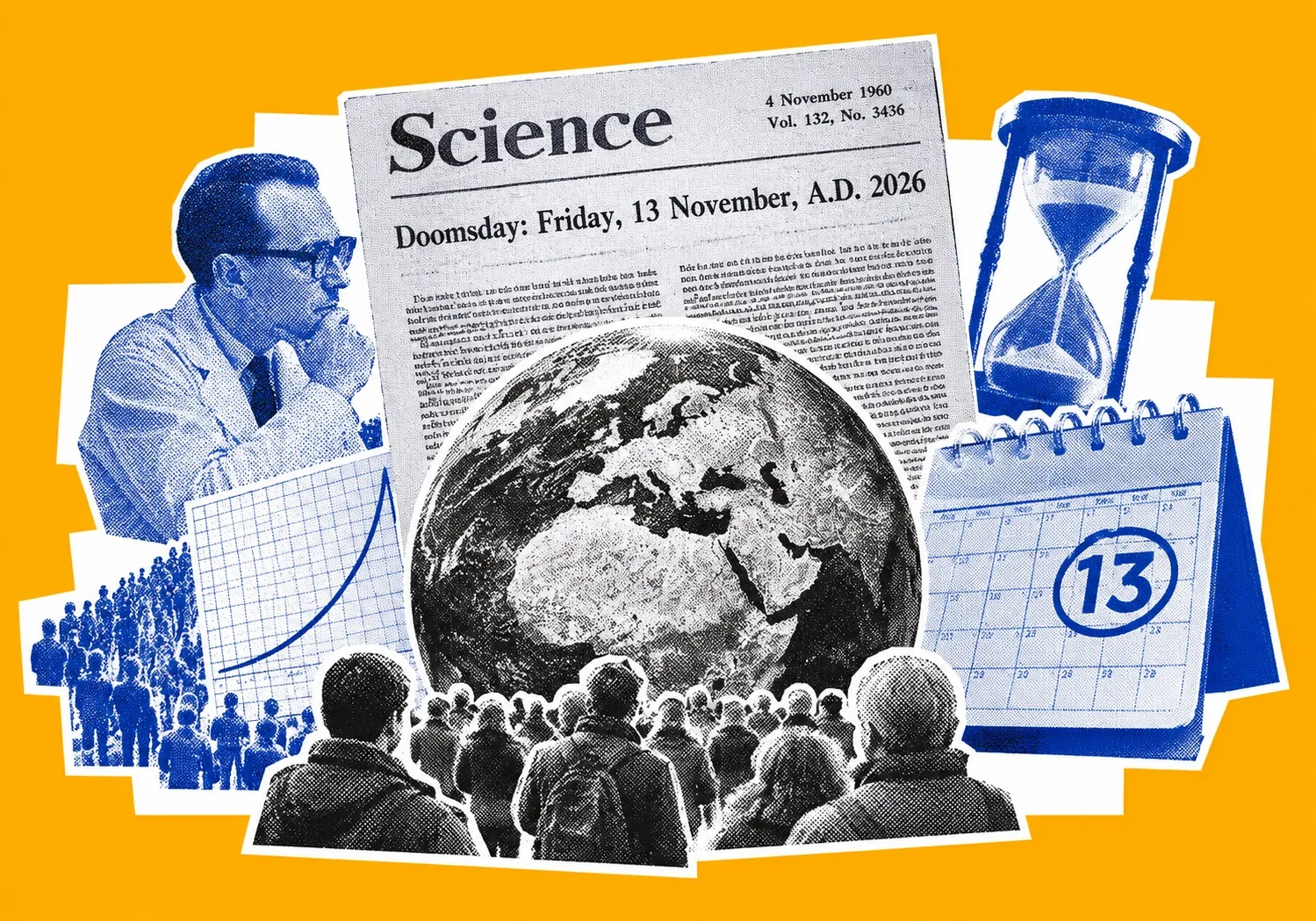
In 1960, researchers published a mathematical prediction placing humanity's theoretical doomsday on November 13, 2026. Sixty-six years later, the date has arrived – but the science tells a more interesting story than the headline suggests.
Friday, November 13, 2026, was once identified as the day humanity would reach a mathematical breaking point. The prediction appeared not in a book of prophecies or a conspiracy theory, but in Science, one of the world's most established scientific journals.
On November 4, 1960, Austrian-American physicist Heinz von Foerster and his colleagues Patricia M. Mora and Lawrence W. Amiot published a paper titled Doomsday: Friday, 13 November, A.D. 2026.
Their calculation suggested that, if humanity continued multiplying according to patterns observed over the previous two thousand years, the global population would approach infinity on this date.
The paper is still available in the journal's archives.

Of course, the world's population has not become infinite. There are approximately 8.3 billion people alive today, and modern demographic projections suggest that growth will eventually level off.
Yet the 1960 study remains a fascinating example of how scientific models can produce extraordinary predictions – and why even mathematically convincing forecasts can become unreliable when human behaviour changes.
How a mathematical formula produced a doomsday date
Von Foerster and his colleagues were investigating a question that had troubled demographers for decades: why did the human population appear to grow differently from populations of other species?
In nature, population growth usually encounters limits. Animals compete for food, territory and other resources. As populations expand, these constraints tend to slow reproduction and increase mortality.
Humanity had repeatedly found ways to push against those limits.
Agricultural improvements, technological advances, medical discoveries and increasingly complex societies had allowed more people to survive and reproduce. A larger population could also generate more knowledge, new inventions and greater productive capacity.
The researchers examined 24 historical estimates of the world's population covering approximately two millennia.
They found that the historical figures could be described by a mathematical relationship known as hyperbolic growth.
Unlike ordinary exponential growth, in which a population increases at a constant proportional rate, hyperbolic growth accelerates towards a finite point in time.
Extend that curve far enough, and the calculated population becomes unbounded.
For the researchers, that point fell in 2026.
Their model produced a critical year of approximately 2026.87, with an uncertainty of several years. The paper's title translated that mathematical result into the striking date of Friday, November 13.
It was an arresting way to present a demographic problem. But a mathematical singularity is not the same thing as a physical prediction that the planet will suddenly be destroyed.
The model was conditional on historical growth patterns continuing. It did not establish that such growth was physically possible.
Why the researchers feared overcrowding
The study appeared during a period when rapid population growth was becoming an increasingly prominent scientific and political concern.
In 1960, the world's population was roughly three billion. Advances in medicine, sanitation and food production had helped reduce mortality, while birth rates remained high across many regions.
For von Foerster and his colleagues, the concern was not simply that humanity might run out of food.
They considered the possibility that technological development could continue supporting population expansion even as the number of people placed increasing pressure on available space and living conditions.
Their paper included a deliberately provocative warning:
"Our great-great-grandchildren will not starve. They will be squeezed to death."
The statement captured a particular anxiety of the twentieth century: that humanity's technological success might enable population growth beyond sustainable limits.
The prediction also challenged the assumption that human numbers would automatically stabilise in the same way as other biological populations.
Yet it depended on a crucial condition – that the historical relationship between population size and population growth would remain broadly unchanged.
That condition did not hold.
What actually happened to the world's population?
The decades following the publication of the paper brought a major demographic transformation.
Global population growth continued, but its pace began to decline.
The annual growth rate reached approximately 2.3% in the early 1960s. By 2020, it had fallen below 1%.
The difference is important. The total number of people can continue increasing even when the percentage rate of growth is falling.
In many countries, families began having fewer children as education expanded, access to contraception improved, urbanisation increased and economic circumstances changed.
Longer life expectancy and declining infant mortality also transformed family decisions.
These developments undermined the central assumption behind the 1960 model.
Instead of accelerating indefinitely, global population growth began slowing.
The United Nations' World Population Prospects 2024 estimates that the global population will reach approximately 10.3 billion in the mid-2080s before gradually declining to around 10.2 billion by 2100.
These projections are themselves conditional estimates, not guarantees. They depend on assumptions about fertility, mortality and migration, all of which can change.
Nevertheless, they describe a demographic future radically different from the accelerating growth curve that produced the 2026 doomsday date.
Europe faces almost the opposite demographic problem
The contrast is particularly striking in Europe, where the public debate has shifted from fears of unlimited population growth towards concerns about ageing societies and declining birth rates.
According to the United Nations, more than half of all countries and territories now have fertility rates below approximately 2.1 births per woman, the level generally associated with long-term population replacement in the absence of migration.
Several European countries, including Italy and Spain, have fertility rates below 1.4 births per woman.
Germany is among the countries whose populations the UN identified as having already reached a peak before 2024.
The demographic implications extend beyond population statistics.
An ageing population can increase pressure on pension systems, healthcare services and public finances. A shrinking working-age population may also create labour shortages and complicate economic growth.
Governments face difficult choices involving retirement policy, immigration, family support and investment in productivity.
The European Union is therefore confronting a demographic challenge that would have seemed very different to researchers studying accelerating population growth in 1960.
Instead of asking how societies could accommodate an endlessly expanding population, many European policymakers are asking how economies can remain sustainable when the proportion of older residents increases.
The historical shift demonstrates why population forecasts cannot be separated from social and economic change.
Was the 1960 prediction really a scientific mistake?
It would be tempting to dismiss the study as a spectacular forecasting failure.
But that would overlook what made the research interesting in the first place.
The authors identified a mathematical pattern in historical population data and explored what would happen if that pattern continued.
The resulting singularity exposed the limits of extrapolation.
A mathematical model can accurately describe observations from the past without reliably predicting conditions decades into the future.
This distinction matters because human societies are not passive systems.
People change their behaviour. Governments introduce policies. Technologies alter economic incentives. Education, healthcare and cultural expectations reshape family decisions.
These changes can modify the very relationships on which earlier forecasts were built.
The 1960 paper is therefore better understood as a conditional mathematical projection than as evidence that scientists expected the Earth to disappear on a particular Friday.
Its dramatic title made the calculation memorable, but the underlying lesson concerns the assumptions that determine a model's results.
Why Friday the 13th makes the story irresistible
There is another reason the prediction has attracted attention in 2026.
November 13 genuinely falls on a Friday this year, combining the date of the mathematical singularity with one of the most recognisable superstitions in Western culture.
Friday the 13th has long been associated with misfortune, although there is no scientific evidence that the date is inherently more dangerous than other days.
The coincidence makes the 1960 paper particularly easy to misunderstand.
A headline about scientists predicting doomsday can sound like a warning of an imminent catastrophe. In reality, the study concerned the behaviour of a mathematical curve under a specific set of assumptions.
The distinction is essential.
The date does not represent an astronomical event, a predicted natural disaster or a scientifically established deadline for human extinction.
It marks the theoretical limit of a population-growth model developed 66 years ago.
What the doomsday calculation teaches us about predicting the future
Long-term forecasting remains essential for governments, businesses and scientific institutions.
Population projections influence decisions about infrastructure, housing, healthcare, education and public spending.
Climate models help governments assess future environmental risks. Economic forecasts inform budgets and investment decisions. Energy scenarios shape plans for power generation and industrial development.
But every model has limitations.
Its reliability depends on the quality of the available data, the assumptions used and the possibility that the underlying system will change.
The difference between the 1960 population projection and modern UN estimates illustrates how profoundly those assumptions can shift.
Today, the central demographic questions are no longer limited to how quickly humanity will grow.
They also concern where populations will increase, which societies will age, how migration will reshape countries, and whether economic systems can adapt to changing population structures.
For Europe, those questions are already influencing public policy.
And for the rest of the world, the continuing divergence between rapidly growing and ageing populations presents challenges that no single mathematical curve can capture.
Sixty-six years after scientists published their extraordinary doomsday date, Friday, November 13, 2026, has finally arrived.
The world's population is not infinite. The original model's assumptions no longer describe demographic reality.
But the paper still offers a useful reminder: a precise date produced by mathematics is only as reliable as the assumptions behind it.