
EU Diplomats Boycott Australia Club Over Russian Envoy’s Wife

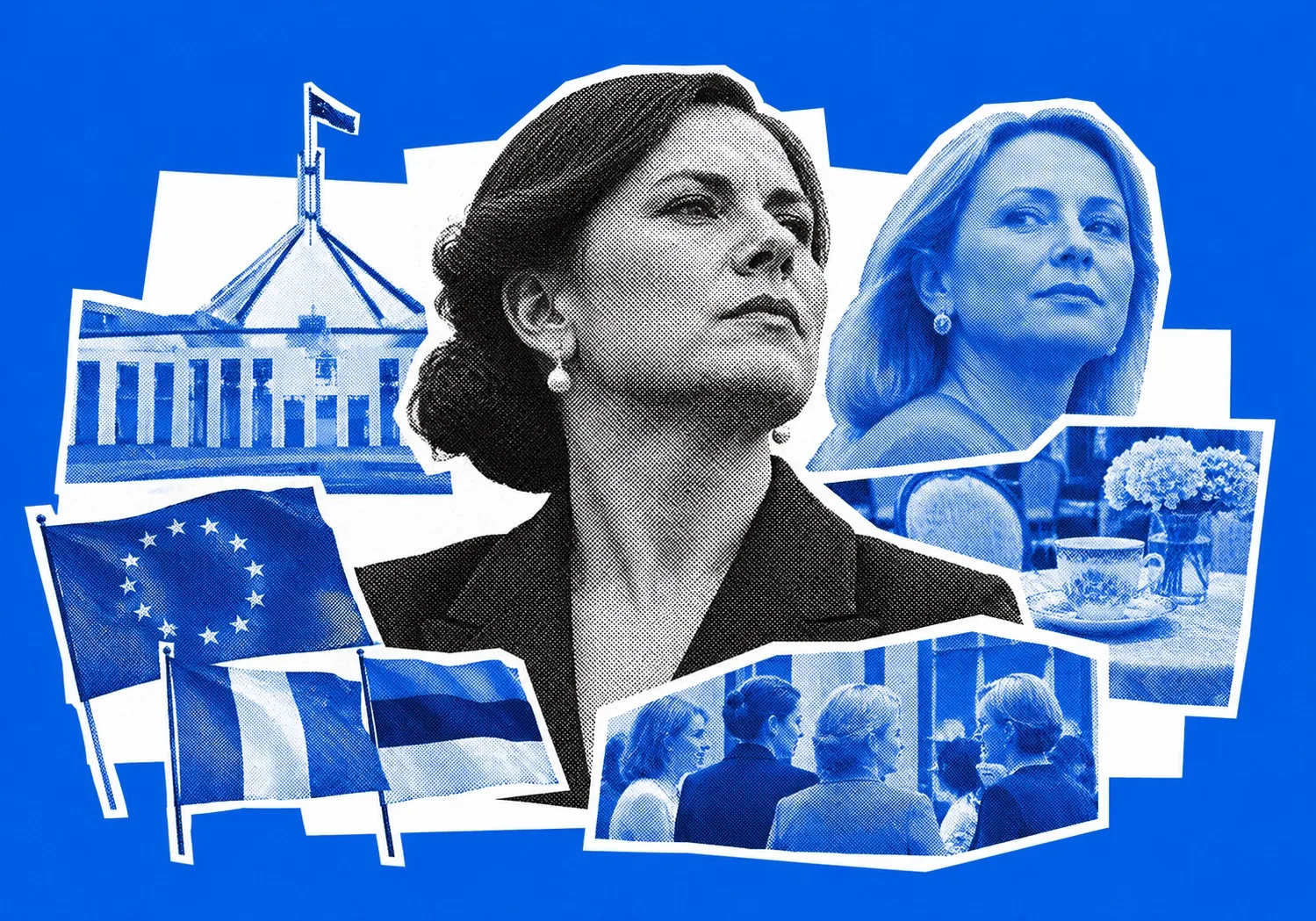
European Union diplomats and spouses have walked out of a Canberra international club after it admitted the wife of Russia’s ambassador. The protest highlights a growing clash between domestic anti-discrimination laws and Western efforts to isolate Moscow over the war in Ukraine.
Sandy Kane, the club’s president, defended Petrakova’s admission because excluding her because of her national origin would breach Australian law and the organisation’s own rules.
According to Kane, the WIC sought legal advice before making its decision. The advice indicated that rejecting an applicant on grounds connected to nationality would risk violating the federal Racial Discrimination Act 1975.
The legislation prohibits discrimination based on race, colour, descent, and national or ethnic origin. Its protections extend to certain aspects of membership and access to clubs and associations.
There is an important legal distinction here. The Act protects individuals against specified forms of discrimination; it does not establish a general requirement for diplomats or their families to maintain social relationships with one another.
Nor does the club’s account of its legal advice settle every possible question about membership decisions involving diplomatic representatives. The precise legal position would depend on the grounds for exclusion and the applicable provisions.
Nevertheless, Kane faced a practical problem. An organisation whose rules emphasise international inclusion could expose itself to legal challenges by refusing membership solely because an applicant is Russian.

The departing diplomats faced no equivalent obligation to remain members.
Their resignations therefore created a form of diplomatic protest that did not require the club to reverse its decision. Petrakova could retain the membership the organisation considered legally necessary to grant, while Ukrainian and European representatives could refuse to participate alongside her.
The result is an institution complying with its interpretation of domestic law but losing members over the political consequences of doing so.
The personal cost behind Ukraine’s protest
Miroshnichenko’s resignation letter made clear that her objection was not simply a matter of diplomatic protocol.
She described the losses she had suffered during Russia’s war against Ukraine, including the death of a cousin, a friend who was burned alive, and numerous friends from school and university.
Her decision placed those experiences directly against the expectation that diplomatic families should continue to share social spaces regardless of relations between their governments.
Such conventions have traditionally allowed diplomatic communities to preserve personal contacts even during periods of serious political disagreement. Spouses’ associations, cultural organisations and international clubs have offered settings in which official rivalries could be kept at a distance.
The war in Ukraine has made that separation increasingly difficult.
For Miroshnichenko, remaining in the same organisation as the Russian ambassador’s wife would have meant accepting a degree of social normality that she considered incompatible with her country’s experience.
The support from Italy and Estonia gave her resignation a wider diplomatic significance. It was no longer solely a Ukrainian representative withdrawing from an uncomfortable arrangement. Other European diplomatic families were prepared to make the same choice.
Meredith’s intervention added an institutional dimension. By expressing disappointment on behalf of European diplomats, the EU ambassador brought the controversy beyond the private decisions of individual club members.
Yet the protest also has limits. It does not alter Australia’s anti-discrimination legislation, remove the Russian ambassador from his post or establish a formal diplomatic sanction.
Its effect is social and political: it makes participation in shared institutions more difficult for Russian diplomatic representatives, even where their formal rights remain intact.
When a social club becomes a diplomatic platform
The WIC was established in 1964 and has more than 300 members representing over 50 countries. Its activities are primarily social, recreational and linguistic, rather than political.
That international character is central to the current dispute.
The organisation operates on the principle that members can meet across national boundaries without importing every disagreement between their governments. But the same international connections that make such clubs attractive can also give them diplomatic value.
The WIC has encountered Russian diplomatic outreach before.
In 2017–2018, Irina Logvinova, the wife of then-Russian ambassador Grigory Logvinov, served as the club’s vice-president. She openly described promoting a favourable image of Russia in Australia as one of her objectives.
That precedent matters because it complicates the idea that participation in a formally non-political association is necessarily free of political purpose.
A diplomatic spouse does not need an official government title to contribute to a country’s public image abroad. Social contacts, cultural activities and positions within international organisations can provide opportunities for informal influence.
There is no evidence in the briefing that Petrakova has pursued a comparable agenda. Her admission alone cannot establish that she intends to use the club for Russian diplomatic outreach.
But the earlier example helps explain why Ukrainian and European representatives may view such membership differently from the club’s leadership.
To the WIC, Petrakova is an individual applicant whose rights must be respected. To those protesting, she is also the spouse of Moscow’s official representative.
Neither description removes the other.
The shrinking space for informal diplomacy
Since Russia’s full-scale invasion of Ukraine in 2022, Western governments have sought to restrict Moscow’s diplomatic reach through expulsions of intelligence officers operating under diplomatic cover, limits on official contacts and informal social boycotts.
These measures have not eliminated diplomatic relations. Russian ambassadors continue to serve in Western capitals, including Canberra, where Mikhail Petrakov took up his post in August 2025.
But formal recognition and social acceptance are increasingly separate matters.
An ambassador may retain the legal standing associated with a diplomatic posting while finding that representatives of other countries are unwilling to share receptions, professional networks or social organisations.
The Canberra dispute shows how that separation can extend to diplomatic families.
It also exposes a weakness in the assumptions under which international social clubs operate. Their rules were generally designed to accommodate members from different countries, not to determine how those members should respond when one government wages a prolonged war against another.
Political neutrality offers no straightforward answer when members disagree over whether ordinary social contact itself carries political meaning.
For the WIC, admitting Petrakova was presented as a way of upholding established rules. For the departing members, continuing to participate would have signalled an unacceptable willingness to overlook the war.
The club has become the setting for a disagreement it was never designed to resolve.
Can neutrality survive a prolonged war?
The difficulty is not confined to Canberra.
International associations in Western capitals frequently bring together people whose countries have sharply conflicting foreign policies. Their legitimacy often depends on applying membership rules consistently, without allowing political disputes to determine who may participate.
Making exceptions for representatives connected to one government raises difficult questions about where those exceptions should begin and end.
Yet treating every applicant identically does not guarantee that an organisation will remain socially or politically neutral. Members may regard the presence of certain diplomatic representatives as incompatible with their own participation.
The WIC controversy illustrates the distinction between institutional neutrality and the choices of individuals within an institution.
Kane can argue that the club must comply with Australian law. Miroshnichenko can argue that she cannot remain alongside the Russian ambassador’s wife. The two positions are not necessarily legally contradictory, even though they are practically irreconcilable.
For European diplomats, the question is also one of consistency.
Western governments have invested considerable political effort in denying Russia the benefits of normal diplomatic engagement while its war continues. Social interaction among official representatives, though less visible than government meetings, forms part of the wider diplomatic environment.
Allowing such interaction to resume without objection could weaken the informal boundaries those governments have sought to maintain.
But refusing it creates problems for institutions whose purpose is precisely to bring people of different nationalities together.
That is the predicament now facing the Canberra club. Its decision to admit Petrakova may have followed the legal advice it received, but it cannot compel other members to regard that decision as politically neutral.
For Russian diplomatic representatives, the distinction is consequential. Legal access to an organisation is of limited value as a means of building international relationships if other diplomatic families withdraw from it.
For the club, the consequences may be longer-lasting. It must decide how to preserve its international membership and non-political character when some members regard shared participation as a political act.
The unresolved question is whether organisations built around universal inclusion can continue to function as neutral meeting places when the governments represented within them are engaged in a war that their members cannot, and will not, leave outside the door.
Sources: Politico, BBC, Human Rights