
Dutch Government Faces Collapse as Coalition Crisis Exposes Political Fragmentation

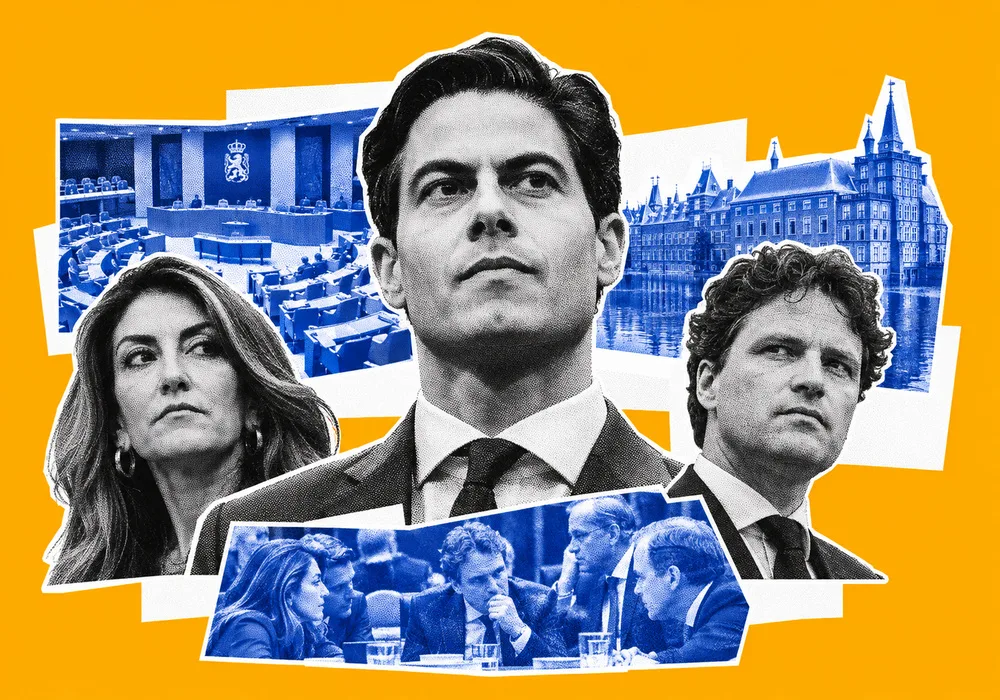
The Netherlands’ fragile minority government has resumed emergency negotiations amid growing pressure to avoid a Cabinet collapse. A dispute over wealth taxation has exposed deep divisions between coalition partners, raising concerns about political stability, economic policy and the country's ability to govern effectively.
The Netherlands is facing another test of political stability as leaders of the country's three governing parties resume crisis negotiations over the future of Prime Minister Rob Jetten's minority government. The talks come amid growing tensions between the centrist Democrats 66 (D66), the Christian Democratic Appeal (CDA) and the right-liberal People's Party for Freedom and Democracy (VVD), whose disagreements over taxation have brought the coalition close to breaking apart less than nine months after taking office.
The negotiations resumed on Sunday, 15 November, at the Zwaluwenberg estate in Hilversum. Prime Minister Rob Jetten, VVD leader Dilan Yeşilgöz and CDA deputy leader Bart van den Brink are seeking to find a way forward following an inconclusive first round of discussions. The political dispute has become increasingly difficult to contain, with the VVD questioning whether the existing minority-government arrangement can continue.
The immediate trigger was a controversial tax agreement negotiated by D66 and CDA with two opposition parties, Progressive Netherlands (PRO) and Volt. The agreement secured parliamentary support for the government's 2027 tax plan but introduced changes that significantly angered the VVD. The legislation provides for a greater tax burden on wealthier households while reducing taxation for middle- and lower-income groups.
The proposal was approved by the Dutch House of Representatives on Thursday, 12 November, despite opposition from the VVD, which voted against the government's own tax package. The disagreement exposed a fundamental problem within the coalition: two governing parties were prepared to negotiate with the political left to secure parliamentary support, while their conservative-liberal partner regarded the agreement as a departure from the government's economic commitments.
VVD Challenges the Minority Government Model
VVD leader Dilan Yeşilgöz described the minority Cabinet as a failed experiment and argued that the current arrangement could not continue without fundamental changes. The party has demanded a different balance within the coalition, stronger guarantees for the business and investment climate, and an end to cooperation with left-wing opposition groups on major policy decisions when the VVD does not agree.
The dispute has also highlighted the difficulties of governing without a parliamentary majority. Jetten's coalition depends on negotiations with opposition parties to pass legislation, making cooperation across political divisions essential. However, the latest confrontation has demonstrated how quickly that model can become unstable when governing parties disagree over which political partners should be involved in shaping government policy.
Officials Warn Against Another Government Collapse
The crisis has prompted senior Dutch administrators and constitutional experts to warn against allowing the Cabinet to collapse. Four prominent figures interviewed by the current-affairs programme NOS Nieuwsuur argued that another political breakdown would serve neither the Netherlands nor its wider interests. They urged coalition and opposition parties to put the national interest ahead of party competition.
Sharon Dijksma, mayor of Utrecht and chair of the Association of Dutch Municipalities, warned that it would be irresponsible for the government to become a caretaker administration, particularly given the international circumstances facing the country. Former vice-president of the Council of State Thom de Graaf also stressed the importance of political continuity, arguing that the Netherlands urgently needs a stable government.
De Graaf proposed appointing an independent facilitator to help the coalition parties overcome their disagreements. Such a figure would have no direct party-political interests and could help establish common ground between the governing parties. He also questioned whether new elections would offer a meaningful solution, warning that they could produce months of caretaker government and another prolonged coalition-formation process.
Instead, he suggested that Jetten consult parliament about alternative government arrangements based on the existing distribution of seats. This could allow political parties to establish a different coalition without immediately returning to the electorate. A proposal for restarting the government-formation process, put forward by Christian Union parliamentary leader Mirjam Bikker, has already received majority support.
Early Elections Could Deepen Political Uncertainty
The possibility of early elections nevertheless remains politically significant. Recent opinion polls suggest that PRO could emerge as the largest party, while the right-wing JA21 is also gaining support. By contrast, D66, VVD and CDA could lose parliamentary seats. However, electoral changes would not necessarily produce a more stable government, as the country's political fragmentation would remain a major obstacle to forming a parliamentary majority.
The Netherlands' political system has become increasingly fragmented, with 17 parties represented in the House of Representatives and 20 in the Senate. This complicates legislative negotiations and makes it harder for governments to maintain consistent support. Constitutional law professor emeritus Paul Boven'Eert has suggested introducing an electoral threshold similar to Germany's five per cent rule to reduce the number of parties represented in parliament.
Political Fragmentation Threatens European Policy Continuity
The current crisis therefore extends beyond disagreements over a single tax package. It raises questions about the sustainability of minority governments in an increasingly fragmented political environment, where coalition partners have to balance competing economic priorities and ideological differences while relying on opposition support.
For the Netherlands, prolonged political uncertainty could complicate the implementation of fiscal policy, undermine confidence among businesses and investors, and weaken the government's ability to respond consistently to domestic and international challenges. The country is an important EU and NATO member, and instability in The Hague could also affect its capacity to maintain predictable positions in European negotiations and security cooperation.
The outcome of the negotiations will determine whether Jetten can preserve his coalition or whether the Netherlands will have to consider a new government arrangement. Even if the parties reach a temporary compromise, the underlying disagreements over economic policy, parliamentary cooperation and the structure of the minority government remain unresolved.
The crisis illustrates a broader challenge facing European democracies: political fragmentation is making governments increasingly dependent on fragile agreements, while ideological divisions are reducing their ability to maintain stable governing coalitions.
Sources: NL Times, Associated Press