
Beyond Concrete: Can a Wall-Climbing 3D Printing Robot Solve Europe’s Housing Crisis?

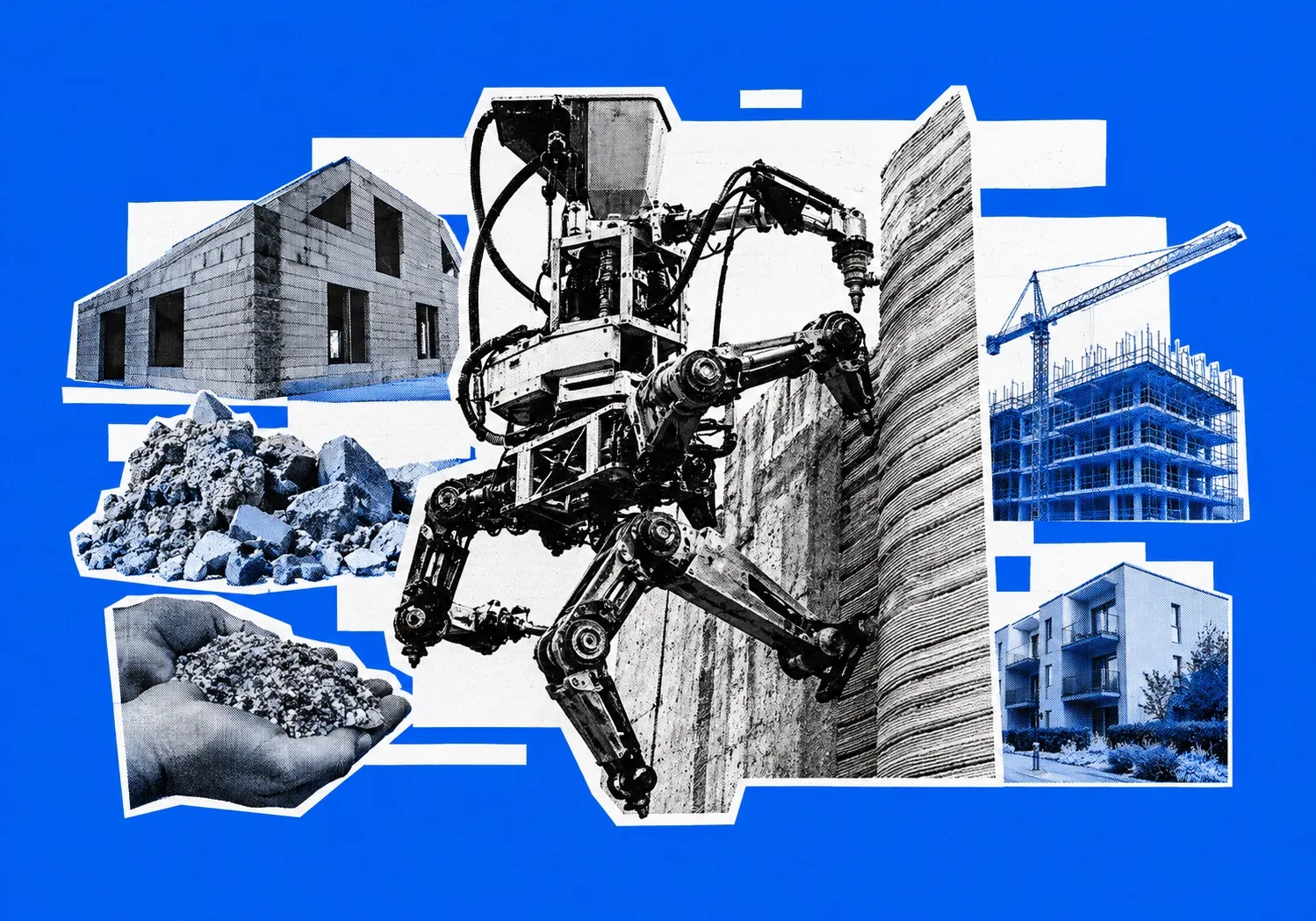
An Australian-built climbing robot, Charlotte, promises to print a 200-square-metre house shell in 24 hours using recycled local waste instead of carbon-heavy concrete. Revealed by Crest Robotics and Earthbuilt Technology, the machine challenges traditional gantry-based 3D construction printers like COBOD. But as European developers grapple with strict safety codes and labour shortages, can mobile wall-printing truly transition from prototype to commercial reality?
Yet the project raises a serious question for an industry struggling with labour shortages, material costs and pressure to reduce emissions: can construction automation become more useful by abandoning the machinery and materials on which its early successes were built?
Why Construction Robots Need to Move
Most commercially established 3D construction printers operate within a fixed framework. Large gantry systems position a printing nozzle above a building footprint and deposit successive layers of specialised concrete to create walls.
The approach works. Danish manufacturer COBOD International and German construction group PERI have helped move the technology beyond experimental demonstrations into occupied residential developments.

But gantry printing introduces its own logistical problems. Equipment must be transported, assembled, and positioned around the structure. The dimensions of the frame can constrain the size and configuration of the building, while moving machinery between sites adds costs.
Charlotte approaches the problem differently.
Developed by Crest Robotics, its multi-legged platform is designed to navigate a construction site and climb vertical surfaces without depending on a stationary printing frame or scaffolding. Earthbuilt Technology supplies the material-handling and extrusion technology.
Mobility could become particularly valuable on irregular sites where installing a large gantry would be impractical. It might also allow construction equipment to work around existing structures rather than requiring an environment designed around the machine.
There is, however, an important distinction between a robot capable of climbing and one capable of reliably manufacturing load-bearing structures while moving.
Construction demands repeatable accuracy, stable material deposition and consistent structural performance. A mobile platform must deliver these qualities despite changing ground conditions, varying surfaces and the mechanical complexity of its own movement.
Charlotte's existing prototypes establish that the hardware and wall-printing concept are technically plausible. They do not yet establish that the system can sustain industrial production speeds or satisfy the reliability requirements of commercial building projects.
A Different Material Strategy
Charlotte's more consequential innovation may lie in what passes through its printing system.
Conventional construction printing relies heavily on specially formulated cement-based mixtures. These must be sufficiently fluid to pass through an extrusion nozzle while retaining enough strength to support successive layers.
Earthbuilt has developed an alternative based on compacted mineral aggregates enclosed within a continuous geotechnical textile membrane.
The mixture can incorporate sand, crushed brick, recycled glass and other locally available bulk materials. Instead of relying on wet concrete to harden into a self-supporting wall, the system uses fabric as permanent formwork and tension-resistant reinforcement.
The principle resembles reinforced-earth engineering, in which soil, or mineral material, is confined and strengthened by reinforcing elements.
This changes the economics of material sourcing.

A building system capable of using locally recovered aggregates could reduce dependence on specialised concrete mixtures and create a productive outlet for construction waste. Crushed bricks and glass, traditionally treated as disposal or recycling challenges, become potential inputs for new structures.
There are environmental implications, too. Cement production carries a substantial carbon burden, making alternatives attractive to developers seeking lower embodied emissions.
But replacing cement does not automatically establish that a building is sustainable.
The environmental performance of Charlotte's system would depend on material processing, transport distances, the manufacture and durability of its textile membrane, and the eventual disposal or reuse of the finished structure.
Safety presents an equally demanding question. The behaviour of compacted aggregates inside a textile enclosure differs from that of conventional reinforced concrete or masonry. Engineers would need to establish how the walls perform under sustained loads, moisture exposure, temperature changes and fire.
The material concept is credible enough to justify development. Its suitability for widespread residential construction still requires rigorous validation.
Europe's Existing Printers Offer a Reality Check
Europe already provides examples of what construction printing can achieve when engineering, contractors and regulators work within a defined commercial project.
The DREIHAUS development in Heidelberg, Germany, illustrates the progress made with established gantry systems. The 21-apartment project demonstrated printing speeds of approximately one square metre of wall every five minutes, with structural shells completed over periods of 14 to 26 working days.
Reported project outcomes included a 30 per cent reduction in construction time and an overall cost saving of around 10 per cent.
Those figures matter because they concern a real development rather than the projected performance of an experimental machine.
They also reveal the limits of automation.
Industry estimates indicate that 3D printing can reduce structural shell costs by approximately 20–40 per cent, while savings across an entire building project are generally more modest, at around 10–30 per cent.

The difference is not difficult to explain. Walls represent only one part of a building.
Foundations must be prepared. Roofs, windows and doors must be installed. Electrical systems, plumbing, heating, ventilation and interior finishes require additional work, often involving specialised trades.
Charlotte's proposed 24-hour achievement concerns the structural shell, not a completed home ready for occupation.
Even if the machine eventually meets its speed target, the remaining construction stages will still determine much of the project's cost and delivery schedule.
The comparison with 100 bricklayers is similarly narrow. It describes an aspirational measure of wall-production capacity, not the elimination of a hundred workers from an entire construction project.
The Building Inspector May Matter More Than the Robot
Construction technology advances at a different pace from the rules governing buildings.
European regulatory systems have developed around established materials, engineering methods and documented safety performance. Concrete, steel and conventional masonry benefit from extensive testing histories and recognised design standards.
An unfamiliar structural system must establish its credentials.
For Charlotte, that means more than demonstrating that a wall can be printed. Developers would need evidence covering structural strength, fire resistance, long-term durability and the consistency of the production process.
The textile-confined aggregate system introduces questions that cannot be answered simply by applying standards written for conventional concrete.
Regulators must also determine how automated production is inspected and documented. When a machine deposits material continuously, responsibility for quality control may involve the equipment manufacturer, software developers, material suppliers, and construction contractors.
If a structural defect emerges years after completion, determining liability could become considerably more complicated than identifying faulty conventional masonry.
The approval requirements surrounding developments such as Heidelberg's DREIHAUS show that even relatively established construction-printing systems face demanding regulatory scrutiny.

Charlotte is attempting something more unconventional.
Its commercial future therefore depends as much on engineering certification and municipal approval as on advances in robotics.
Automation Will Change Construction Jobs Before It Eliminates Them
The promise of reduced labour dependency is particularly attractive in a sector facing persistent shortages of skilled workers.
Automated wall production could reduce demand for repetitive masonry tasks while increasing the importance of machine operators, maintenance specialists, digital construction technicians and materials engineers.
That transition would not necessarily reduce the need for workers across the entire building process. It could instead redistribute labour towards tasks that remain difficult to automate.
Specialised contractors may be among the earliest beneficiaries, particularly where projects offer predictable designs and controlled conditions suitable for robotic equipment.
Traditional suppliers of cement-intensive materials and conventional formwork could eventually face competitive pressure if alternative systems become commercially dependable.
For now, the market remains fragmented. COBOD accounts for roughly 18 per cent of the commercial construction-printing technology market, with US-based ICON holding approximately 16 per cent.
Established companies have an advantage that cannot be measured through printing speed alone: they have experience delivering projects within existing construction systems.
Charlotte's developers are trying to establish a different technological route before those systems become more deeply entrenched.
The opportunity is substantial, but so is the commercial risk.
From Housing Sites to the Moon
Crest Robotics has also identified potential applications in extreme environments, including lunar habitat construction associated with NASA's Artemis programme.
The connection is understandable. A mobile robot capable of working with locally available mineral materials could be useful where transporting conventional building supplies and deploying large construction equipment would be exceptionally difficult.
Such possibilities should not be confused with demonstrated capabilities.
A machine intended for terrestrial construction would face additional engineering challenges in an extraterrestrial environment. The immediate test remains whether Charlotte can deliver safe, repeatable and economically competitive walls on Earth.
Its development nevertheless points towards a potentially important change in how construction technology is conceived.
Rather than treating a building site as a factory floor that must accommodate a large printer, developers are exploring machines that adapt to the site itself. Instead of transporting specialised materials to every project, they are exploring ways to turn locally available minerals and recovered waste into structural components.
Those changes could prove more important than any single productivity claim.
The challenge for Crest Robotics and Earthbuilt is that construction does not reward technical novelty on its own. A wall must remain safe and serviceable long after the robot that produced it has left the site.
For Charlotte, the decisive breakthrough will not be printing a house-shaped structure in a day. It will be convincing engineers, insurers, contractors and building authorities that an unconventional wall made by a climbing machine can meet the same obligations as one built by established methods.
Sources: ABC, Rprealty+, New Atlas, COBOD