
Russia turns evacuation from Oleshky into a propaganda battle

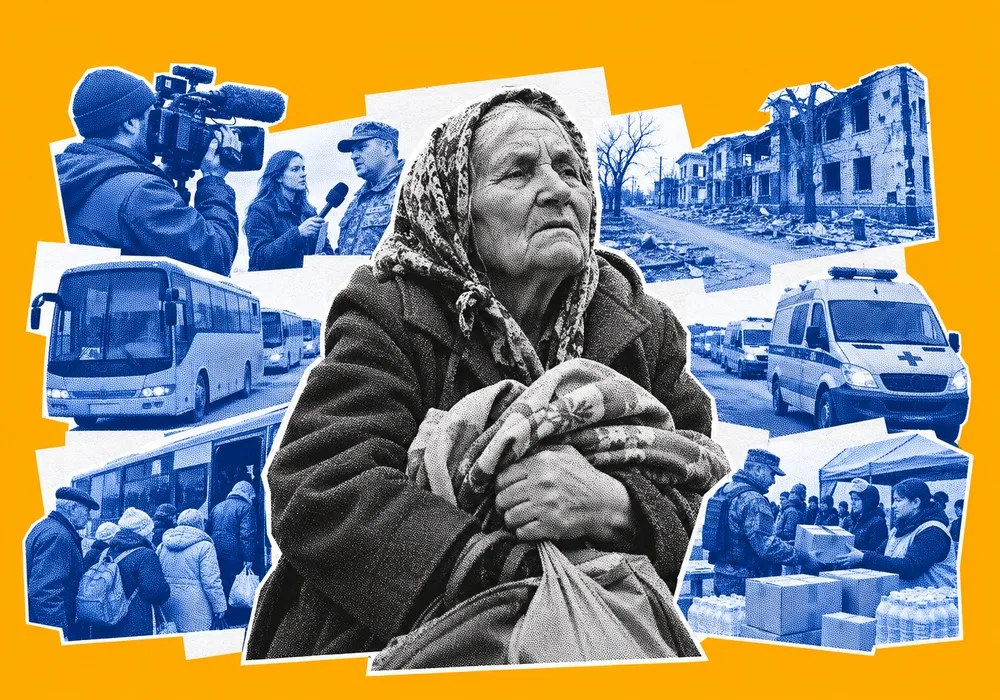
The evacuation of civilians from Russian-occupied Oleshky in Kherson region has exposed a second battle unfolding alongside the humanitarian operation: the struggle to control how the occupation, the city's collapse and the remaining population's identity are presented to international audiences. While Ukraine sought to secure the departure of civilians, Moscow used the operation to promote its own humanitarian narrative and shift responsibility for the crisis onto Kyiv.
The evacuation of civilians from Oleshky and surrounding settlements in Kherson region has highlighted the competing humanitarian and information objectives surrounding Russia's occupation of southern Ukraine. The operation involved coordination between Ukrainian and Russian representatives to facilitate humanitarian deliveries and the departure of residents from territory controlled by Russian forces. For Ukraine, the immediate objective was to get civilians out of an increasingly dangerous environment. For Moscow, the arrangements also offered an opportunity to present itself internationally as a humanitarian actor rather than the occupying power responsible for the conditions in which those civilians had been living.

Oleshky lies on the left bank of the Dnipro River, opposite Kherson. Before Russia's full-scale invasion in February 2022, the city had approximately 24,000 residents. Russia's war against Ukraine had begun in 2014, while Russian forces occupied Oleshky in the first days of the full-scale invasion. Its humanitarian situation deteriorated further following the destruction of the Kakhovka Hydroelectric Power Plant in June 2023, which caused catastrophic flooding across the surrounding area. Subsequent fighting, shelling, infrastructure damage and isolation made access to food, drinking water, medicines and other essential supplies increasingly difficult.
By October 2026, approximately 1,700 people, including 35 children, were reportedly still living in Oleshky. Russian military control, mined routes and the danger of moving through the surrounding area made independent evacuation extremely difficult. An arrangement for a temporary local ceasefire, facilitated with the involvement of Melania Trump, created an opportunity to organise humanitarian deliveries and civilian evacuation. The announced plan included 25 buses with a combined capacity of approximately 750 passengers, alongside medical and emergency support.
Moscow's control over the media narrative
The imbalance in media access became one of the defining features of the operation. Because Oleshky remained under Russian occupation, Moscow controlled access to the city and had considerable influence over which journalists could enter, where they could film and whom they could interview. Only a small number of Ukrainian journalists were reportedly present, including representatives of the television channels 1+1 and ICTV. In contrast, Russian human rights commissioner Yana Lantratova arrived with approximately 50 journalists representing Russian state television and other outlets, including RT, Rossiya, Izvestia, Channel One and Zvezda.
The delegation also included four representatives of the American broadcaster Newsmax. Its presence was particularly significant given the channel's reputation as a strong supporter of Donald Trump and its generally favourable coverage of his political agenda. Moscow had an opportunity to present the evacuation as evidence of its humanitarian intentions to an American audience, especially because the arrangements had involved Melania Trump. The participation of a US broadcaster could have given Russian accounts additional international visibility and helped the Kremlin frame the operation as an example of cooperation rather than a consequence of the occupation.
However, the coverage did not develop entirely according to Moscow's apparent expectations. On 30 October, Newsmax presenter Shelby Wilder warned American viewers that Russia was attempting to use the humanitarian operation for propaganda purposes. She drew attention to the fact that Russian authorities controlled access to Oleshky and could therefore determine what visiting journalists were permitted to see. Restrictions on movement and the selection of interviewees also raised questions about whether the resulting coverage could provide an independent picture of conditions in the city.
Newsmax broadcast footage showing Ukrainian ombudsman Dmytro Lubinets meeting residents who welcomed him and expressed their desire to leave for Ukrainian-controlled territory. Some recognised the Ukrainian representative and greeted him emotionally, while others said they had already packed their belongings and were waiting for evacuation buses. The images offered a direct challenge to Moscow's attempts to portray residents of occupied Ukrainian territories as naturally identifying with Russia. Although these encounters cannot establish the political views of the entire population, they demonstrated that the occupation had not erased the Ukrainian identity of all those remaining in the city.
The diplomatic complications of humanitarian cooperation
The operation also raised questions about the public conduct of Ukrainian officials when negotiating with representatives of the occupying state. Lubinets acknowledged the involvement of Lantratova in organising the humanitarian arrangements, and footage showed the two officials communicating in a seemingly friendly manner. Contact with Russian representatives is sometimes unavoidable during wartime, particularly when negotiations concern civilian evacuations, prisoner exchanges, the return of deported children and other humanitarian matters. Such communication does not in itself imply political recognition or reconciliation, but the individuals involved and the way their interactions are presented carry considerable symbolic weight.

Lantratova's background makes the issue particularly sensitive. Ukraine has imposed sanctions on her, and the Security Service of Ukraine has accused her of involvement in the deportation of Ukrainian children from an orphanage in occupied Kherson in September 2022. One of the children, ten-month-old Margarita Prokopenko, was subsequently illegally transferred for adoption to Russian State Duma deputy Sergey Mironov and his wife, with her name and place of birth changed. In March 2024, the SBU notified Lantratova of suspicion of the forced deportation of children and violations of the laws and customs of war.
This context makes it important to distinguish between necessary humanitarian coordination and the public presentation of personal cordiality. Ukrainian officials may have to negotiate with individuals accused of serious crimes to secure the safe passage of civilians, but images of friendly exchanges can be interpreted differently by domestic and international audiences. Russian media can use such footage to suggest that relations between the two countries are returning to normal, while the underlying circumstances of occupation and alleged war crimes remain unresolved. For Ukrainian society, particularly families whose children have been taken to Russia, the symbolic implications of such images are especially significant.
Russian state television reverses responsibility
Russian state media presented a markedly different account of the operation, focusing on allegations that Ukrainian forces had attacked civilians and caused the destruction of local infrastructure. Reports by Rossiya-1 correspondent Yevgeny Popov included an interview with a woman who claimed that her husband had been killed by a mine dropped from a Ukrainian drone. Another prominent interviewee was Vladimir Kharlan, a former doctor from Kherson who took over the occupied Oleshky hospital and subsequently became involved in the Russian occupation administration. His appearance provided Russian television with a local figure presented as an authoritative witness to the situation in the city.
According to Ukrainian investigative reporting, Kharlan encouraged medical personnel to cooperate with the occupation authorities, organised salary payments in rubles and facilitated the transfer of hospital property. He later became a member of the occupation council representing United Russia. In March 2025, a Ukrainian court sentenced him in absentia to 12 years in prison for aiding the aggressor state, and in April 2025 Vladimir Putin awarded him the title of Hero of Russia. His role in the Russian television report illustrates how occupation authorities select individuals whose personal histories and political positions reinforce the account they want to communicate to domestic audiences.
The reports also described shortages of electricity, water, gas, food and medicines without adequately explaining the circumstances that had produced the crisis. Russia's military presence, the occupation and the destruction of infrastructure were largely excluded from the narrative. Izvestia followed a similar approach, highlighting the delivery of humanitarian supplies, the deployment of 25 buses, nine ambulances and more than 50 medical personnel, thereby presenting Russia as the principal organiser of the rescue effort. The coverage also devoted considerable attention to the death of a Russian sapper during the clearance of an evacuation route and repeated Russian Ministry of Defence allegations that he had been killed by an explosive dropped from a Ukrainian drone.
Russian reports further relayed Vladimir Putin's accusations that Ukraine had mined approaches to the city and created the humanitarian crisis. Other residents were quoted as claiming that they had been placed on Ukrainian execution lists because of their participation in an election commission, although the reports did not provide evidence establishing the existence of such lists. The editorial approach was consistent across the coverage: individual accounts of suffering were presented alongside Russian accusations, while the broader context of the occupation and the responsibility of the occupying power were marginalised. Reporting civilian casualties or allegations of attacks by Ukrainian forces is not inherently propaganda, but presenting unverified claims as established facts while excluding essential context produces a distorted picture of events.
Another indication of the discrepancy between the Russian media narrative and the evacuation figures emerged from the Telegram channel Romanov Лайт, run by Russian military blogger Vladimir Romanov. On 30 October, Romanov reported that 17 buses were taking residents from Oleshky to Ukrainian-controlled territory, while four were heading to Russia. He also suggested that Russian television would show a larger number of buses travelling towards Russia, but that their windows would be tightly curtained, implying that some might be empty. The post was subsequently edited and the figures removed. Screenshots of its original version were preserved and reported by several Ukrainian media outlets. Although the numbers have not been independently verified and do not establish how many passengers were transported, the episode is significant because the initial account came from a Russian pro-war blogger rather than Ukrainian officials. It also exposed a potential gap between the evacuation figures circulating within Russian information channels and the image that Russian television might present to its domestic audience.

The wider battle over occupied Ukrainian territories
The information campaign surrounding Oleshky is part of a broader Russian effort to establish its own political and historical interpretation of occupied Ukrainian territories. The Kremlin has repeatedly sought to replace Ukrainian place names, historical references and national narratives with Russian versions, presenting occupation as a process of integration rather than the seizure of another country's territory. Humanitarian operations provide another opportunity to reinforce this approach by portraying Russian officials as rescuers and Ukrainian representatives as secondary participants in the provision of assistance.
The contrasting media coverage also demonstrates the importance of independent access to occupied territories. When one side controls the movement of journalists, the selection of interviewees and the locations available for filming, the resulting material cannot automatically be treated as a representative account of local conditions. The presence of international media does not resolve this problem if journalists remain dependent on the occupying authorities for access and information. The Newsmax coverage was notable precisely because it drew attention to these restrictions rather than simply reproducing the narrative presented by Russian officials.
For Ukraine, the challenge is not limited to securing international media coverage. Humanitarian operations must remain focused on civilian protection while also documenting the circumstances surrounding them and preserving the distinction between practical cooperation and political normalisation. The evacuation of Oleshky's residents remains first and foremost a humanitarian necessity, but the operation has shown how Russia can use even arrangements intended to save lives to pursue its broader objectives in the information war. The reactions of local residents and the willingness of some international journalists to question the Russian narrative, however, demonstrate the limits of Moscow's ability to control the story completely.
Sources: Newsmax, The White House, Security Service of Ukraine, Romanov Light, Ombudsman Dmytro Lubinets