
Albania’s Edi Rama Rejects Resignation Calls as Protests Challenge His Rule

Albania’s prime minister has refused to step down as student-led demonstrations enter their sixth day, exposing mounting public anger over corruption, education costs and economic opportunities. The unrest is becoming a significant test of the government’s political authority and Albania’s ambitions to join the European Union by 2030.
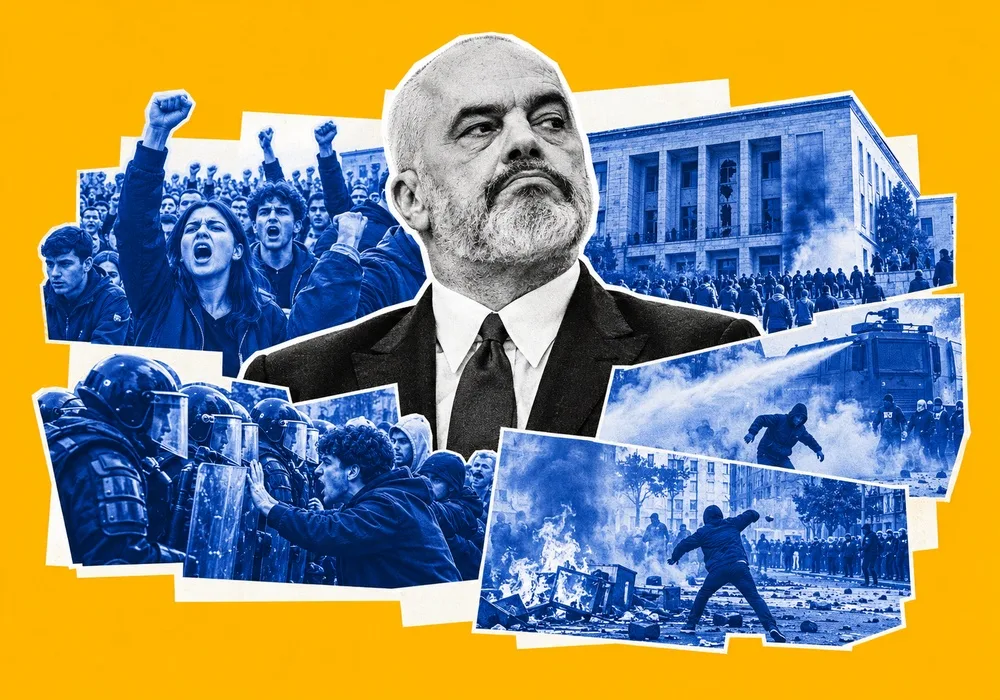
Albanian Prime Minister Edi Rama has rejected calls to resign as anti-government protests entered their sixth consecutive day on 18 October, with demonstrations in Tirana escalating into violent clashes between protesters and police. The movement, led increasingly by students and young people, has expanded beyond complaints about university conditions to encompass wider grievances over corruption, limited employment prospects and the perceived failure of political institutions to respond to public concerns.
Thousands of demonstrators have gathered in the capital in recent days, demanding Rama’s departure and changes to the country’s political direction. Protesters have thrown stones, fireworks and petrol bombs at police, while fires and vandalism have damaged public buildings, businesses and other infrastructure. Police have responded with tear gas, water cannon and rubber bullets. According to Albania’s Health Ministry, 28 people were injured during the clashes on Sunday, including police officers, demonstrators, passers-by and a journalist.
Rama, who has governed Albania since 2013 and secured a fourth consecutive term for his Socialist Party in the 2025 parliamentary election, has maintained that the demonstrations do not threaten his government’s mandate. In a live address on social media, he argued that the unrest instead endangered Albania’s European integration ambitions. He has also accused unspecified foreign interests of exploiting the situation, although his public remarks have not established evidence identifying those allegedly responsible.
The prime minister’s refusal to resign signals that the government intends to withstand the immediate pressure rather than concede to the protesters’ central political demand. However, the persistence of demonstrations and their spread beyond a single policy dispute suggest that the confrontation is no longer confined to university reform.
Students’ Grievances Reflect a Wider Economic Problem
Education has become one of the immediate focal points of the protests. Students have expressed frustration over university conditions, high tuition costs and the difficulty of securing a future in a country where wages and employment opportunities often fall short of expectations. Their demands have resonated with wider concerns about the cost of living, housing affordability and the relationship between political connections and access to jobs.
These grievances have particular significance for younger Albanians, many of whom see limited opportunities to build independent lives despite years of economic development and efforts to bring the country closer to European standards. The contrast between expensive new developments in Tirana and the financial constraints faced by students and young workers has become a visible expression of this frustration.
The demonstrations also follow months of protests against a controversial luxury resort development in a protected coastal area linked to Jared Kushner, the son-in-law of US President Donald Trump. Although the development dispute initially provided a separate focus for opposition, it has contributed to broader questions about transparency, political influence and whether major economic projects serve the public interest.
Corruption allegations have repeatedly damaged the Albanian government’s credibility. Rama’s administration has denied wrongdoing and says it is addressing corruption, but the protests indicate that official assurances have not persuaded a significant section of the public that institutions are sufficiently accountable. The combination of economic insecurity and distrust in political decision-making has helped turn specific complaints into a broader challenge to the government.
Violence Raises Questions About the Government’s Response
The escalation has created a second challenge for the authorities: maintaining public order without undermining the rights of peaceful demonstrators. While attacks on police, arson and the destruction of public property have accompanied the unrest, the use of force by law enforcement has also drawn scrutiny.
The European Commission condemned violence in Tirana and other Albanian cities in a statement published on 18 October. It said that attacks on state institutions and the destruction of public and private property had no place in a democratic society, while stressing that the authorities’ response must remain lawful and proportionate. The Commission also reaffirmed that freedom of assembly and expression are fundamental European values.
This position places responsibility on both sides without treating violent incidents as grounds for disregarding legitimate public grievances. For the Albanian government, the handling of the protests could therefore have consequences beyond restoring order in the capital. Any perception that peaceful demonstrators are being unfairly targeted could deepen mistrust, while further attacks on institutions could weaken public support for the movement and give the authorities greater justification for security measures.
Rama has invited students to talks, but dialogue will have limited impact if protesters view it as an attempt to defuse the immediate crisis without addressing the underlying problems. The government's ability to distinguish between peaceful political opposition and violent acts will be important in determining whether the confrontation subsides or hardens into a more prolonged struggle.
European Integration Becomes Part of the Political Dispute
The protests have also exposed the risks of tying domestic political legitimacy too closely to Albania’s European ambitions. Rama has presented EU membership as a central objective of his government, arguing that the country must preserve its progress towards accession rather than allow unrest to derail it. Albania aims to join the bloc by 2030 and has advanced negotiations across the EU accession framework.
On 13 October, the European Commission announced that Albania had provisionally closed negotiations on another accession chapter, covering enterprise and industrial policy. The milestone demonstrated that technical progress towards membership was continuing even as political tensions intensified. Albania had opened all 33 screened negotiating chapters and provisionally closed four, although individual agreements remain subject to the overall accession process.
The protests do not automatically threaten that progress, nor has the EU announced that the unrest would halt negotiations. However, accession requires more than completing technical discussions. The process also depends on sustained reforms, effective institutions, the rule of law and the ability to address corruption. A prolonged political crisis could complicate that work, particularly if it undermines confidence in the independence and accountability of public institutions.
Rama’s argument that the protests threaten the country’s European future may reassure supporters who prioritise accession, but it also risks framing criticism of the government as opposition to EU membership itself. For demonstrators demanding better governance, accountability and economic opportunity, those objectives are not necessarily contradictory. Their demands could instead reinforce the standards that European integration is intended to encourage.
A Test of Political Credibility
The immediate question is whether the protests can sustain their momentum and translate street mobilisation into political concessions. Rama has a substantial electoral mandate and has shown no willingness to resign under pressure. At the same time, the duration and intensity of the demonstrations indicate that the government faces a challenge that cannot be assessed solely through its parliamentary position.
A return to calm without credible action on education, corruption and economic opportunity may leave the underlying grievances unresolved. Conversely, a sustained confrontation could increase pressure on the government, damage public confidence and complicate Albania’s efforts to present itself as a stable candidate for EU membership.
For now, Rama remains in office and has rejected the central demand of the protesters. The significance of the crisis lies in whether the government can restore public confidence while protecting the right to peaceful dissent, or whether its response leaves a growing section of society convinced that meaningful change requires a more fundamental political break.
Sources: European Commission, European External Action Service