
Tear Gas over Tirana: How Edi Rama Lost the Generation That Was Supposed to Build EU Albania

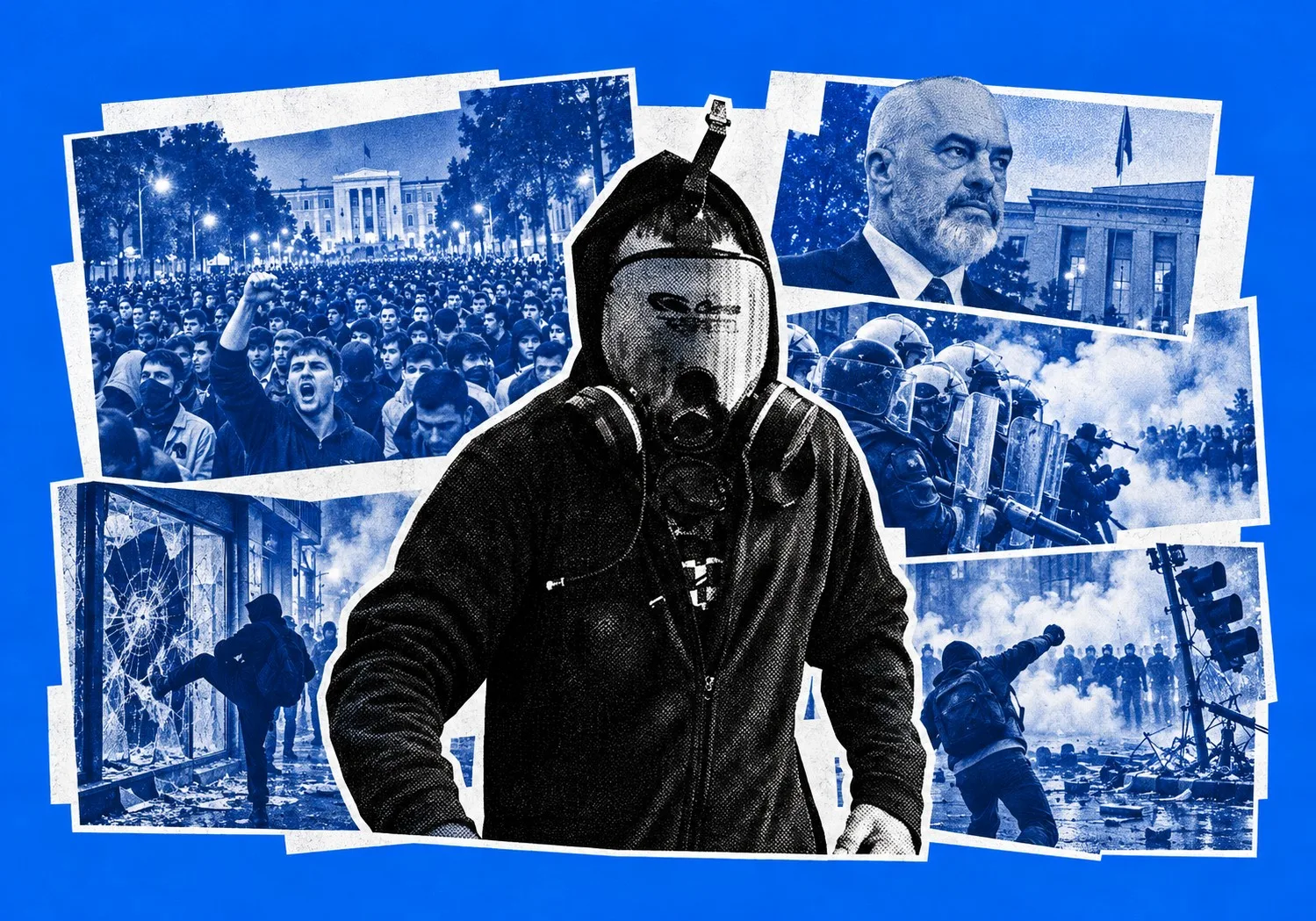
Tirana woke up to smashed windows, torched bins, and tear gas drifting past the Ministry of Education on Friday. For four straight days now, thousands of students have taken over the capital and at least seven regional hubs, turning what began as a quiet summer dispute over coastal real estate into a blunt demand for Prime Minister Edi Rama to step down.
By Friday evening, the official narratives coming out of the prime minister’s office were already hitting a wall. Rama insists his government will not "bow to violence," pointing fingers at veteran opposition figures and hinting at vague foreign interference aimed at derailing Albania's European path. But out on the streets of Durrës, Shkodër, and Korçë, nobody is taking orders from the old political guard. The narrative of a smooth, fast-tracked entry into the European Union by 2028 lies crumpled under police boots.
This was not an unexpected crisis. It was a slow-motion wreck, years in the making.

How 140 Days of Peaceful Protests Turned Violent
The whole affair started with paper flamingos.
Back in late May, small groups of activists started showing up outside government offices in Tirana holding cutouts of pink birds. They were protesting a proposed luxury resort on Sazan Island and the pristine Vlora coastline—a high-stakes project linked directly to Jared Kushner’s investment firm. For locals, the deal was a breaking point. Villagers near the site openly complained that their ancestral plots had been wrongfully expropriated and flipped to developers. Investigative reporters soon discovered that the vendor who originally sold the disputed land was wanted by prosecutors on international drug trafficking charges.
While no legal fault was pinned on Kushner, the nuance hardly mattered to the crowds. To them, the resort was everything wrong with modern Albania in a single deal: protected public land handed off to foreign capital, opaque property deals, and real estate speculation oiled by narcotics proceeds.
The executive branch treated the whole thing as a minor nuisance. Ministers ignored the placards, cracked jokes about the flamingos, and waited for the summer heat to drive people home.
That complacency blew up in their faces by mid-October.
On Tuesday, October 13, the coastal grievance slammed right into a separate, furious student movement. Exhausted by extortionate tuition fees, overpriced textbooks, miserable dormitories, and zero job prospects after graduation, university and high school students walked out of classrooms. Within twenty-four hours, peaceful marches turned into hard barricades.

By Wednesday, central Tirana looked like a war zone. Protesters set fire to a floor inside the Ministry of Education, smashed business fronts, and raided a Raiffeisen Bank branch down the road. Anti-riot units moved in with water cannons, batons, and heavy tear gas, leaving 23 police officers and six civilians injured, alongside 35 arrests on Wednesday alone.
Any chance of dialing back the anger vanished when video footage caught a young demonstrator being dragged off by friends, his broken leg swinging loosely underneath him. Apologies from police chiefs did nothing to clear the streets. By Friday, October 16, teenagers in Lezhë were throwing paving stones at riot shields, while shopkeepers in the capital rolled down their steel shutters, posting handwritten notes on the doors: “We are with you. Please do not destroy our business.”
The Myth of Opposition Control
Predictably, the government ran straight to its usual political defense.
Posting to Facebook, Prime Minister Rama insisted his cabinet would not yield to vandalism, claiming the unrest was secretly directed by his bitter rival, Democratic Party leader Sali Berisha. When that explanation failed to gain traction, Rama raised the spectre of "foreign hands"—a transparent nod to Serbian intelligence—supposedly stirring up chaos to block Albania’s EU accession.
That line of argument completely ignores what is actually driving the crowds.
Berisha and his inner circle would love to claim credit for mobilizing this many young people, but they do not control this crowd. The most striking thing about these protests is their total contempt for the entire post-communist political class.
Walk through the rallies in Tirana or Shkodër and you will not hear calls to bring back the opposition. Instead, the crowd chants a simple, double-barreled slogan: "Rama in jail, Berisha in jail."

As political analyst Afrim Krasniqi observed as the tear gas cleared, young Albanians feel completely shut out of their own country. They see national wealth, administrative power, and economic chances locked inside a tight circle of political oligarchs. Traditional politics offers no way out. When 140 days of peaceful protests get you nothing but condescension from ministers, taking to the streets with stones stops being a surprise and starts being a calculated choice.
Youth anger is bubbling up right across Europe—from high school blockades in France over rotting infrastructure to climate protests in the West. But in a country like Albania, plagued by weak courts and massive youth emigration, this level of generational burnout poses an existential threat to state stability.
Why the EU’s "Stability Bargain" Failed
For well over a decade, Western policy toward the Balkans operated on a cynical, unwritten deal known as "stabilitocracy." Brussels was perfectly content to look the other way on domestic graft, court-packing, and democratic erosion, so long as regional strongmen kept their borders quiet, backed EU foreign policy, and stopped migration flows.
Edi Rama played that game better than almost anyone.
By pitching himself as the reliable, pro-Western moderniser, Rama secured steady diplomatic cover from European capitals, even as corruption probes chipped away at his own cabinet. Over the past few years, high-profile graft cases became routine: one former deputy prime minister fled the country to avoid arrest, while another was forced out under heavy scrutiny over government procurement deals.
That stability deal has finally run out of runway.
Images of burning ministry floors and riot police charging students leave European diplomats with a hard truth: ignoring internal rot does not secure long-term order. It just buys time until the explosion.
The response from the EU delegation in Tirana on Friday was noticeably chilly. While calling for calm, European officials explicitly pointed to reports of police brutality against protesters and journalists, demanding a full investigation. For an administration that built its entire political brand around a clean run into the EU by 2028, formal European rebukes over police violence are a major blow.
The economic hit is landing fast, too. Foreign embassies, including the UK Foreign Office, updated travel warnings advising tourists to steer clear of major city centers and political gatherings—a direct hit for an economy relying heavily on foreign visitors. Meanwhile, anti-enlargement factions inside EU capitals have been handed fresh ammunition to argue that Western Balkan candidate states are nowhere near ready for prime time.
A Generation with Limited Alternatives
At heart, this crisis comes down to a glaring gap between how the government markets itself abroad and how it runs things at home.
Older generations of Albanians put up with the grinding pain of economic transition because the European dream felt like a real promise of rule of law and better days ahead. For the teenagers and twenty-somethings occupying the streets today, that promise feels like an empty political slogan. They watch pristine coastal property get handed over to foreign luxury developers, university buildings left to rot, and career doors slammed shut unless you carry a ruling party membership card.
How the prime minister handles the next few days will decide whether this remains an acute security crisis or turns into a long-term threat to his government.
Deputy Prime Minister Albana Koçiu and President Bajram Begaj have both made public appeals for calm, insisting that protesters must stay within legal boundaries. But reading the constitution to angry students is not going to clear the squares.
If Rama actually wants to stop the violence, he will have to put real policy changes on the table: restructure university funding, resolve coastal land disputes transparently, and show real intent on tackling high-level graft. Trying to brush off student rage as an opposition conspiracy or foreign sabotage will only push a desperate generation further over the edge.
Sources: Reuters, BBC, The Guardian