
Deadly Floods Cut Off Towns in Spain and Turkey as Extreme Storms Hit Five Countries

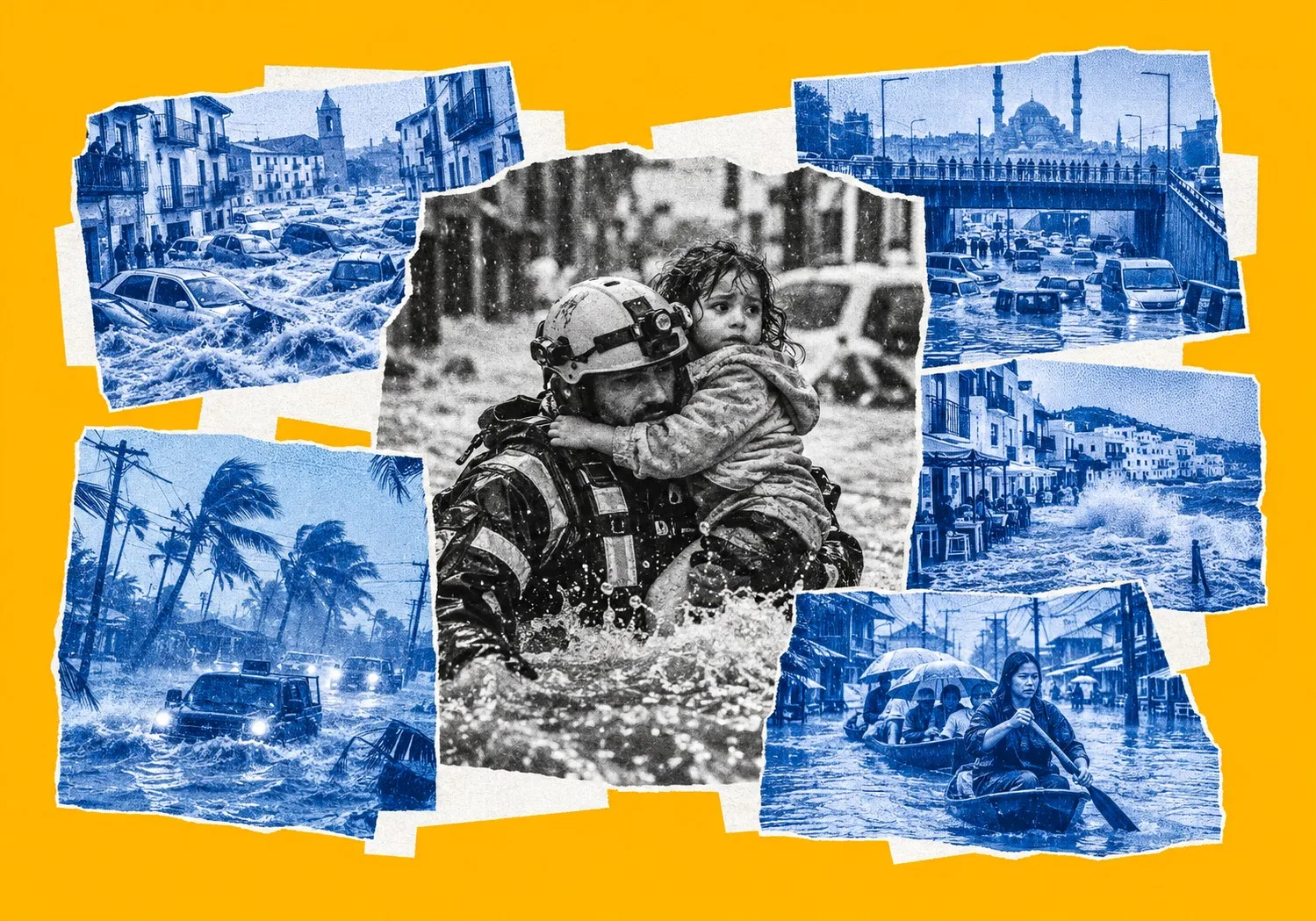
Torrential rain and severe floods triggered by Storm Adam and extreme Mediterranean weather systems have killed at least ten people and trapped residents on rooftops in Spain and Turkey, while widespread flooding continues across Greece, Mexico, and Thailand. Emergency services are deploying military units, boats, and helicopters as national weather agencies issue red alerts and travel restrictions on October 19, 2026.
Eastern Spain Isolated
In eastern Spain, torrential rains triggered by Storm Adam—a high-altitude depression—severely affected the Mediterranean coast, leaving at least six towns in Valencia province completely cut off and forcing authorities to issue shelter-in-place orders for more than 800,000 residents across southern Valencia and northern Alicante.
Spain’s national meteorological agency, AEMET, issued red alerts after recording rainfall exceeding 600 millimeters (24 inches) over a 48-hour period in certain areas.
It"s the highest precipitation figures recorded in the region since 1987.

In the municipality of Forna, weather stations recorded 718 liters per square meter (28.3 inches) of rain in just over 24 hours.
The local flooding was intensified by a coastal storm generating waves up to four meters (13 feet) high, which prevented swollen rivers from draining into the Mediterranean Sea.
Two fatalities were confirmed in Spain over the weekend.
One woman drowned at a beach in Sagunt, Valencia, after entering the water during an active weather alert. Another woman drowned after being swept away by a flooded stream in Cabrera de Mar, near Barcelona, her body later recovered six kilometers away in the sea.
Emergency crews from the Spanish Armed Forces’ Military Emergencies Unit (UME) and national police deployed helicopters and boats to rescue trapped residents, including people stranded on rooftops in Pego and elderly residents waiting on tables inside flooded homes in Oliva.
In Oliva, emergency services evacuated approximately 2,000 people from coastal campsites.

"It is not possible to travel; you must remain in your homes. Intense and continuous rains are taking place, causing significant flooding in municipalities such as Pego, Oliva, Piles, or Miramar," Juan Carlos Valderrama, Valencia’s regional emergency minister, stated in a broadcast to the population.
Valderrama added that there were "many people trapped" and urged residents to follow official instructions.
Pilar Bernabé, the Spanish government delegate in Valencia, confirmed that several areas remained inaccessible with "many people waiting to be rescued."
The mayor of Pego, Enrique Moll, told Spanish public broadcaster RNE, that people are waiting on the rooftops of houses.
"We are witnessing horrifying scenes," The mayor of Pego said.
Moll noted that access routes were entirely blocked and that even heavy-duty military vehicles struggled to advance into outlying residential areas.
Salvador Llopis, deputy mayor of Oliva, told state broadcaster TVE that emergency workers were rescuing residents stuck with water up to their waists, noting that people had to "stay on top of tables and furniture to avoid getting wet."
Spanish Prime Minister Pedro Sánchez advised citizens to avoid unnecessary travel and stay on upper floors of buildings.
The Interior Ministry reported 24 road closures across six provinces, rail operator Renfe suspended two commuter train lines in Valencia, and more than 100,000 students were affected by school closures, including 81,000 in Valencia province and 22,000 in Alicante.
AEMET lifted its red alert for southern Valencia and northern Alicante at 10:00 a.m. local time on Monday, maintaining orange and yellow warnings as river levels remained elevated.
Istanbul’s Historic Inundation
In Turkey, the death toll from severe flooding in and around Istanbul reached eight on Monday, October 19, following rainfall described by officials as the heaviest in the city since records began in 1942.

Istanbul Governor Davut Gül stated that six deaths occurred within Istanbul proper, while the bodies of two individuals who had been swept away in the neighboring province of Kocaeli were recovered in the Pendik district on the southeastern outskirts of Istanbul.
The rainstorm, which began on Wednesday, October 14, caused flash flooding across several provinces, registering up to 242 millimeters of rain in Beykoz, a district of Istanbul.
Recorded casualties in Istanbul included a 14-year-old boy who was electrocuted in a puddle, two men found in the Golden Horn estuary on Friday and Sunday, and a man recovered near the Ayvansaray ferry pier on Monday.
Search and rescue operations continued for one missing person.
Governor Davut Gül informed reporters that municipal authorities received 19,300 property damage reports, with confirmed structural damage to approximately 2,000 homes and 900 businesses.
Over the preceding days, emergency teams rescued nearly 600 stranded individuals and evacuated at least 2,700 residents from affected housing.
The Turkish state meteorological service issued additional rainfall and thunderstorm warnings for Marmara and western Black Sea provinces, forecasting another 40 to 60 millimeters of rain.
To assist affected citizens, the Turkish government distributed emergency financial aid of 10,000 Turkish lira (€180) to 5,200 residents on Friday, October 16, with payments scheduled for an additional 2,500 residents on Monday.
Governor Gül detailed the situation during a press briefing: "In Istanbul, a total of six people have died and one person is missing. Two people who died in Kocaeli and were swept away as far as Pendik were found dead by our search and rescue teams. Therefore, a total of eight bodies have been found."
Commenting on the scale of property damage, Gül stated: "We experienced a disaster that generated around 19,300 reports, each with different types of problems. At this point, it has been determined that around 2,000 homes and about 900 businesses have suffered serious damage."
Aegean Storms in Greece
In Greece, severe weather systems brought heavy thunderstorms and intense precipitation to the Aegean region, resulting in one fatality and localized destruction across Rhodes, Evia, and the Sporades islands during the preceding week.
The National Observatory of Athens reported that a weather monitoring station on the island of Rhodes recorded 202 millimeters of rainfall between 3:30 a.m. and 9:50 a.m. UTC on October 14.

Regional emergency authorities conducted more than 30 rescue and extrication operations to assist trapped motorists and homeowners. The Greek coastguard confirmed that floodwaters swept four passenger vehicles directly into the sea on affected islands, while two additional cars were washed away by flood torrents on Skiathos.
Pacific Surge in Mexico
In Mexico, Pacific Hurricane Trudy reached Category 2 strength, posing a threat to the country's southwestern coast before weakening into a tropical storm.
The US National Hurricane Center issued hurricane warnings for coastal areas in the states of Jalisco, Michoacán, and Colima, forecasting sustained winds between 60 and 90 miles per hour (96 to 145 kilometers per hour) along with total rainfall ranging between 100 and 150 millimeters.
Meteorologists warned of potential landslides, flash floods, and coastal storm surges accompanied by damaging waves along onshore wind zones.
By Monday morning, Hurricane Trudy had moved roughly 100 miles (160 kilometers) southwest of the Mexican coast, weakening to a tropical storm as wind speeds decreased, prompting authorities to lift coastal hurricane warnings.
Prolonged Basin Flooding in Thailand
In Thailand, widespread flooding caused by heavy seasonal rains and river discharges killed 80 people over the past month, according to data released on Monday, October 19, by the Department of Disaster Prevention and Mitigation (DDPM).
The inundations affected 604,265 households and approximately 1.83 million people across 22 provinces and the capital, Bangkok.

The highest concentration of flooding occurred in the low-lying river basins of the Central Plains, with persistent water levels also recorded in northern, eastern, and southern regions.
Prachin Buri province, located east of Bangkok, reported the highest fatality count with 26 deaths and 51,390 affected households.
Samut Prakan recorded nine deaths, Chachoengsao reported seven deaths and 54,729 affected households, while Sa Kaeo and Nakhon Nayok recorded six deaths each, with 23,835 households affected in Nakhon Nayok. Suphan Buri reported five deaths, and Bangkok recorded four fatalities.
Within the capital, floodwaters affected 210,648 households across the eastern districts of Lat Krabang, Nong Chok, and Min Buri.
Disaster management updates showed a progressive rise in flood impact since early October.
On October 1, the DDPM reported 24 deaths across 30 provinces affecting 1.17 million households and 3.35 million people.
DDPM Director-General Nirat Pongsittithavorn explaining that heavy rainfall combined with water discharged from northern reservoirs into central river systems caused the overflow across 191 districts and 8,714 villages.
By October 10, the fatality count rose to 53 across 21 provinces and Bangkok, affecting 1.13 million households, including 329,000 households in Bangkok.
The Thai Interior Ministry reported on October 12 that 51 provinces had been impacted by flooding since mid-September, with the overall death toll reaching 71 before rising to 80 on October 19.
Across all affected regions in Spain, Turkey, Greece, Mexico, and Thailand, emergency response operations, damage assessments, and search activities remain active as local authorities clear debris, evaluate municipal infrastructure, and maintain weather advisories.
WMO Global Climate Outlook
“We're living in a world where extreme weather and climate events in all their various forms are in the news every day,” said SERCOM President Ian Lisk on Monday during WMO’s Commission for Weather, Climate, Hydrological, Marine and Related Environmental Services and Applications meeting.
SERCOM is one of World Meteorological Organization ( WMO) main technical commissions and helps provide a bridge between observations, research, prediction systems and infrastructure on one side, and the decisions of governments, businesses, communities and individuals on the other.
The meeting takes place during a strengthening El Niño which is influencing temperatures and rainfall and exacerbating hazards like record-breaking heat, catastrophic floods, prolonged droughts, rapidly intensifying tropical cyclones, wildfires and dense haze, and marine heatwaves.
WMO’s monthly WMO Global Seasonal Climate Update indicates that El Niño will continue to steadily intensify into a strong event during August–October 2026.
Multi-model ensemble forecasts from leading global producing centres indicate seasonal-average sea-surface temperature anomalies are expected to exceed 2.9°C in key monitoring regions. In addition to a strengthening El Niño, a positive Indian Ocean Dipole (a climate pattern in the western Indian Ocean becomes warmer on average, while the eastern Indian Ocean becomes cooler than average) is forecast.
Together, these oceanic drivers can amplify regional climate impacts including drought, floods and wildfire risk, particularly around the Indian ocean basin. Tropical Atlantic sea surface temperatures are also expected to remain warmer than average.
The August–October 2026 rainfall outlook exhibits patterns of a classic, strong El Niño event.
Wetter-than-normal conditions are expected across the Greater Horn of Africa; parts of Central Asia; Southern Europe; Western North America (south of 45°N); and Southeastern South America.
In contrast, drier-than-normal conditions are more likely over The Indian subcontinent; Southern and eastern Australia; Southern Central America and parts of the Caribbean; Northwestern South America; and Northern Europe.