
Russian Drone Strike Near Polish Border Tests NATO Security and Diplomatic Transit to Kyiv

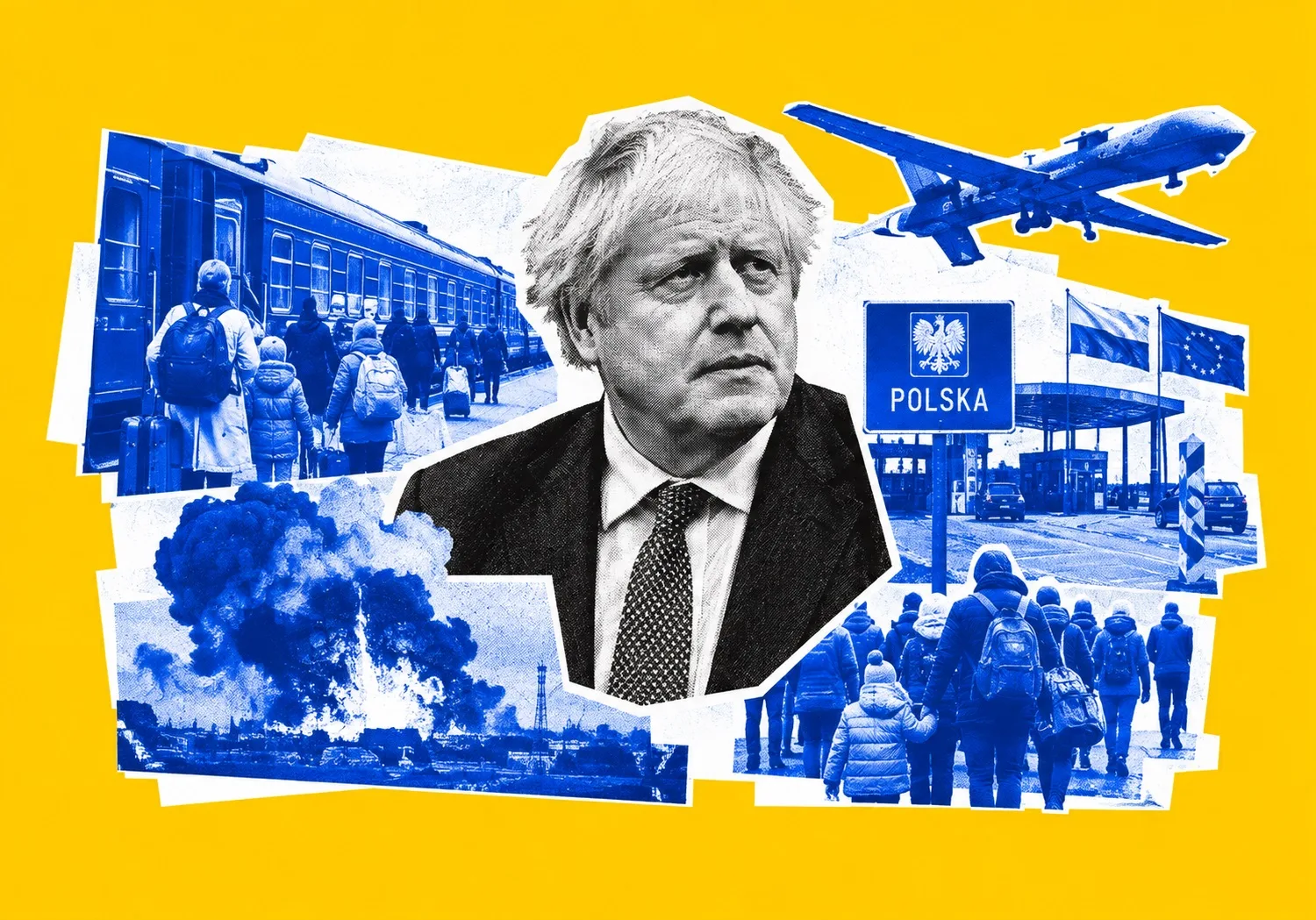
A Russian drone strike just 1 kilometre from the Polish border at the Jahodyn–Dorohusk crossing damaged rail infrastructure on the Kyiv–Warsaw route, narrowly missing a diplomatic train carrying senior European figures, including Boris Johnson. By bringing kinetic strikes directly to the EU’s doorstep and prompting Poland to scramble F-16s, Moscow has exposed the growing operational risks facing Western diplomatic transit and forced a critical test of NATO’s eastern flank air defence.
That changes the security calculation around one of the most important routes connecting Ukraine to the EU.
A border that is no longer a buffer
Jahodyn is more than a Ukrainian border crossing. With Ukraine's Black Sea ports blocked since the full-scale invasion, routes through Poland have become essential to the country's commercial, humanitarian and diplomatic connectivity with Europe. The railway linking Kyiv with Warsaw has also become the backbone of what might be called Ukraine's "iron diplomacy": since February 2022, foreign leaders, ministers and international delegations have travelled to Kyiv by rail because Ukrainian airspace remains closed.
That system has depended on an implicit assumption. Western political engagement could continue inside Ukraine while the most dangerous consequences of the war remained geographically contained.
The September 13 strike weakens that assumption.
Russian forces launched 453 drones of various types alongside cruise missiles during the morning attack, with western Ukraine among the principal target areas. At Jahodyn, drones struck a petrol station about one kilometre from the border checkpoint and the railway station roughly two kilometres from Poland. The tracks themselves remained intact and the border crossing continued operating, but passenger rail services were delayed by between five and ten hours before normal movement into Poland resumed around midday.

For Ukraine, this is an infrastructure problem. For Poland, it is a border-security problem. For European governments sending officials into Kyiv, it is increasingly a problem of operational risk.
The distinction matters because the response is no longer confined to Ukrainian territory.
Poland had to react in real time
Polish authorities scrambled F-16s, helicopters and a SAAB reconnaissance aircraft as Russian drones operated close to the country's frontier. Defence Minister Władysław Kosiniak-Kamysz said Polish forces were tracking 12 Geran-5 drones in western Ukraine, with impacts reported one and five kilometres from the Polish border. Poland's Government Centre for Security issued warnings to counties along the frontier.
This is precisely the uncomfortable space in which NATO's eastern-flank doctrine operates.
A strike in Ukraine does not automatically create a collective-defence case. NATO's kinetic engagement remains tied to the sovereignty of its members, meaning that Russian weapons operating on Ukrainian territory, even extremely close to Poland, do not by themselves authorise the Alliance to attack them there. But a drone one kilometre from Polish territory leaves almost no room for complacency.
Poland must monitor the threat, determine its trajectory and prepare to protect its own airspace while avoiding an escalation that could transform an incident in Ukraine into a direct confrontation between Russia and NATO.
The result is a narrow and increasingly consequential strip of geography in which Ukrainian air defence and NATO border defence are becoming operationally intertwined.
The September 13 response showed what that looks like in practice: surveillance and fighter aircraft on the Polish side reacting to a Russian strike taking place just beyond the border.
The train question matters less than the vulnerability
There are conflicting accounts over what happened to the diplomatic train.
According to a version reported by Der Spiegel and other European media, the special train was halted near Jahodyn because of incoming drone threats, with some high-profile passengers evacuated around 05:00. Kiesewetter gave a different account, saying the delegation's train had already crossed into Poland ahead of schedule and that its stop was for normal passport checks. He said the passenger train struck by the attack was travelling roughly 10 kilometres behind it.
The distinction is important for the people involved, but it should not obscure the broader security issue.

Even if Johnson, Sautter and the other European officials were never directly endangered by an impact on their train, the route on which they were travelling was under attack. The Ukrainian railway operator said the diplomatic train may have been the intended target and noted that its timetable had been changed shortly before the strike. Kyiv also said the locomotive was deliberately targeted.
There is not enough information in the available accounts to establish whether the delegation itself was specifically targeted. What can be established is that the infrastructure carrying Western political traffic was exposed to the same strike environment as ordinary Ukrainian passenger transport.
That alone is enough to force a rethink of how "safe" diplomatic rail movements can be.
Moscow's explanation creates another problem
Russia's Ministry of Defence confirmed that it had struck railway infrastructure in western Ukraine, arguing that the facilities were being used to transport Western military cargo from Europe.
But the train that sustained the impact was a passenger service travelling out of Ukraine towards Europe. The Institute for the Study of War noted the contradiction between Moscow's justification and the reported nature and direction of the train.
That discrepancy matters because the western rail corridor serves several purposes simultaneously. It carries civilians, commercial freight, humanitarian supplies and international delegations. A claim that infrastructure is a legitimate military target because Western cargo can use the network potentially places a large part of Ukraine's European-facing transport system inside the scope of Russian military operations.
For European governments, that makes the issue bigger than the safety of one railway station.
If civilian and diplomatic traffic cannot be reliably separated from military logistics in Moscow's targeting calculus, then the assumption that western Ukrainian transport corridors can operate as relatively stable gateways to the EU becomes increasingly difficult to sustain.
The political price is rising
The attack is also strengthening arguments in Kyiv and among some Western politicians for measures that have remained politically contentious.
Foreign Minister Andrii Sybiha called for a full trade embargo, visa bans and more military assistance, warning that Russian terror was reaching the doorstep of the EU and NATO. Johnson renewed calls for immediate air-defence transfers and for Russian state assets to be unfrozen. He pointed to roughly £10bn held in London and more than €140bn in Belgium. Ukrainian leaders have also used the incident to press for systems such as Patriot.
The financial argument is becoming inseparable from the defence argument.
Approximately $300bn in Russian central-bank assets were immobilised globally after the invasion, including more than €140bn held in Belgium and roughly £10bn in the UK. The debate in the G7 and EU has continued between outright confiscation and the use of profits generated by frozen assets.
A strike beside the EU's border gives advocates of a harder policy a new political frame: Russian sovereign assets are not merely a financial or legal question, while air-defence systems are not simply another item on Ukraine's military shopping list. Both are increasingly being presented as instruments for reducing the risks Russia creates on Europe's own frontier.
That argument will face the same legal and political constraints as before. But the geography has changed.
Diplomacy will have to adapt to the new map
The most immediate consequence may be less visible than fighter jets over eastern Poland.
Western governments will have to reconsider the logistics of sending senior officials into Kyiv by rail. Since the closure of Ukrainian airspace, the railway has provided a functioning alternative to air travel and has allowed European leaders to maintain physical diplomatic engagement with Ukraine despite the war.
The Jahodyn incident shows the vulnerability embedded in that arrangement. A route can be inside Ukraine, carry civilians and diplomats, remain technically outside NATO territory - and still place a European government only minutes from a decision about whether its own airspace is under threat.
That compresses the time available for intelligence, evacuation and air-defence decisions.
Ukrainian railway staff demonstrated the value of preparation during the September 13 attack. A monitoring team detected incoming drones approximately 15 minutes before impact, allowing dispatchers to evacuate passengers and the train crew from the platform and locomotive. No deaths or injuries were reported.
But a successful evacuation is not a security architecture.
The western railway corridor now sits at the point where Ukraine's transport defence, European diplomatic access and NATO's eastern-flank surveillance meet. The practical question for European capitals is no longer whether those systems overlap. It is how much of that overlap they are prepared to formalise before the next Russian strike tests the same border again.
Sources: Boris Johnson/Х, Bild, ISW, The Irish News