
Russian Ballistic Attack on Kyiv Kills One and Injures 24

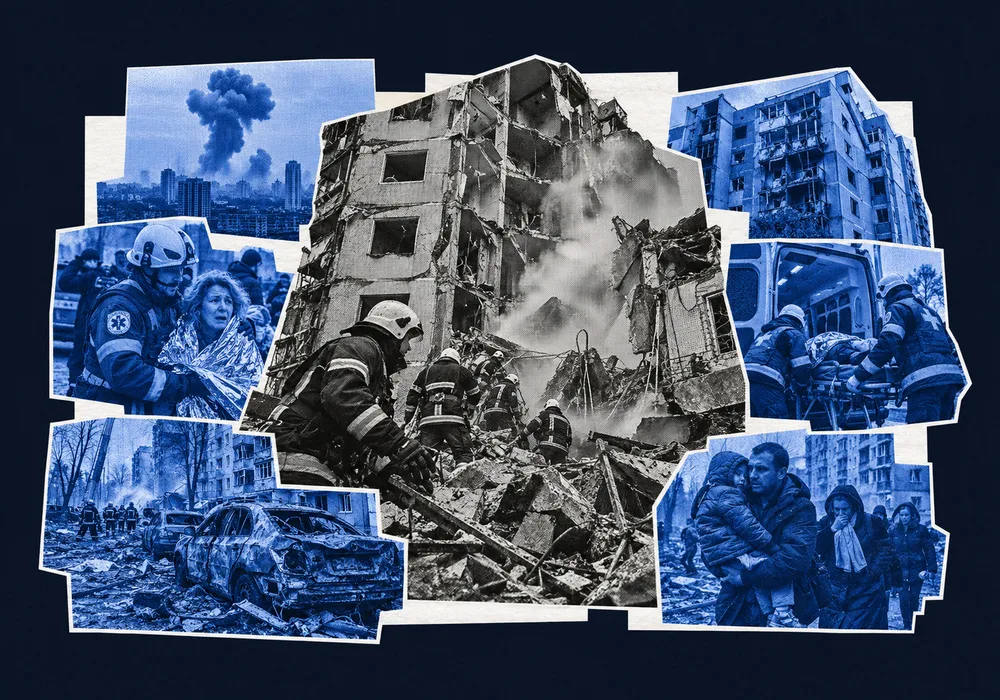
Russia’s missile and drone attack on Kyiv on the night of 21–22 October killed one person and injured 24, including children. Damage across several districts highlights the continuing threat to civilians as Russia sustains its war against Ukraine.
Russia attacked Kyiv with ballistic missiles and strike drones overnight on 22 October, killing one person and injuring 24, according to updated information from the Kyiv City Military Administration. Six districts of the capital were affected. The strikes damaged residential and non-residential buildings, vehicles and civilian infrastructure, while emergency crews responded to fires at multiple locations.
The consequences varied across the city. In the Dniprovskyi district, one person was killed and several others injured, with damage reported to buildings and cars. In the Pecherskyi district, the attack damaged buildings, ambulances and a monastery. Strikes also caused fires in non-residential premises in the Holosiivskyi, Obolonskyi and Sviatoshynskyi districts. In the latter, a fire at a restaurant complex covered approximately 1,100 square metres before emergency workers extinguished it, according to Ukrainian media reports citing rescue services.
Transport infrastructure was also affected. Authorities restricted traffic across the Pivdennyi Bridge from the right bank to the left bank of the Dnipro. The damage added to the disruption caused by the attack, as emergency services worked across several parts of the capital simultaneously.
A Sustained Campaign Against Ukrainian Cities
The latest strike follows a series of Russian attacks on Kyiv in recent days. On 21 October, another missile attack injured civilians and damaged transport infrastructure. The repeated assaults demonstrate the continuing exposure of the capital to Russian long-range weapons despite Ukraine’s efforts to strengthen its air defences.
Ballistic missiles present a particular challenge because of their high speed and the limited time available to respond after launch. Protecting urban areas requires effective interception systems, adequate stocks of ammunition and coordinated early-warning measures. Even when air defences intercept incoming weapons, falling debris can still endanger people and damage buildings.
The impact extends beyond the immediate casualty figures. Fires, damaged homes, disrupted transport and pressure on emergency services affect the functioning of the city and the daily lives of its residents. Repeated attacks also force civilians to adapt their routines around air-raid alerts, with no certainty that their homes or workplaces will remain safe.
The Human Cost of Russia’s War
The killing of civilians and the repeated destruction of civilian infrastructure are central features of the human cost of Russia’s full-scale invasion. Russia’s continued attacks are part of a campaign of violence against the Ukrainian people that Ukrainian officials and many Ukrainians describe as genocidal. A formal legal determination of genocide depends on evidence of the specific acts and intent required under international law, but the immediate consequences of the strikes are clear: civilians continue to be killed and injured in their own cities.
The attack on Kyiv also illustrates the importance of distinguishing military objectives from civilian protection. Under international humanitarian law, parties to an armed conflict must distinguish between civilians and combatants, take precautions to minimise civilian harm and refrain from attacks that violate the rules of distinction, proportionality and precaution. Damage to a civilian building does not by itself establish that a particular attack was unlawful; assessing individual incidents requires evidence about the target, the weapon used and the circumstances of the strike.
For Ukraine, strengthening air defence remains essential to limiting further casualties. Protecting critical infrastructure, maintaining emergency-response capacity and ensuring that damaged facilities can be restored quickly are equally important as Russian attacks continue.
The overnight assault is another reminder that the war is not confined to the front line. Its consequences reach residential neighbourhoods, medical services, transport networks and the everyday lives of people across Ukraine. As Russia continues its invasion, protecting civilians remains an immediate security priority.
Sources: Kyiv Post, Interfax-Ukraine, Ukrainska Pravda