
'Buses Standing Ready until 14:00': Ukraine and Russia Open Strict Window for Oleshky Evacuation

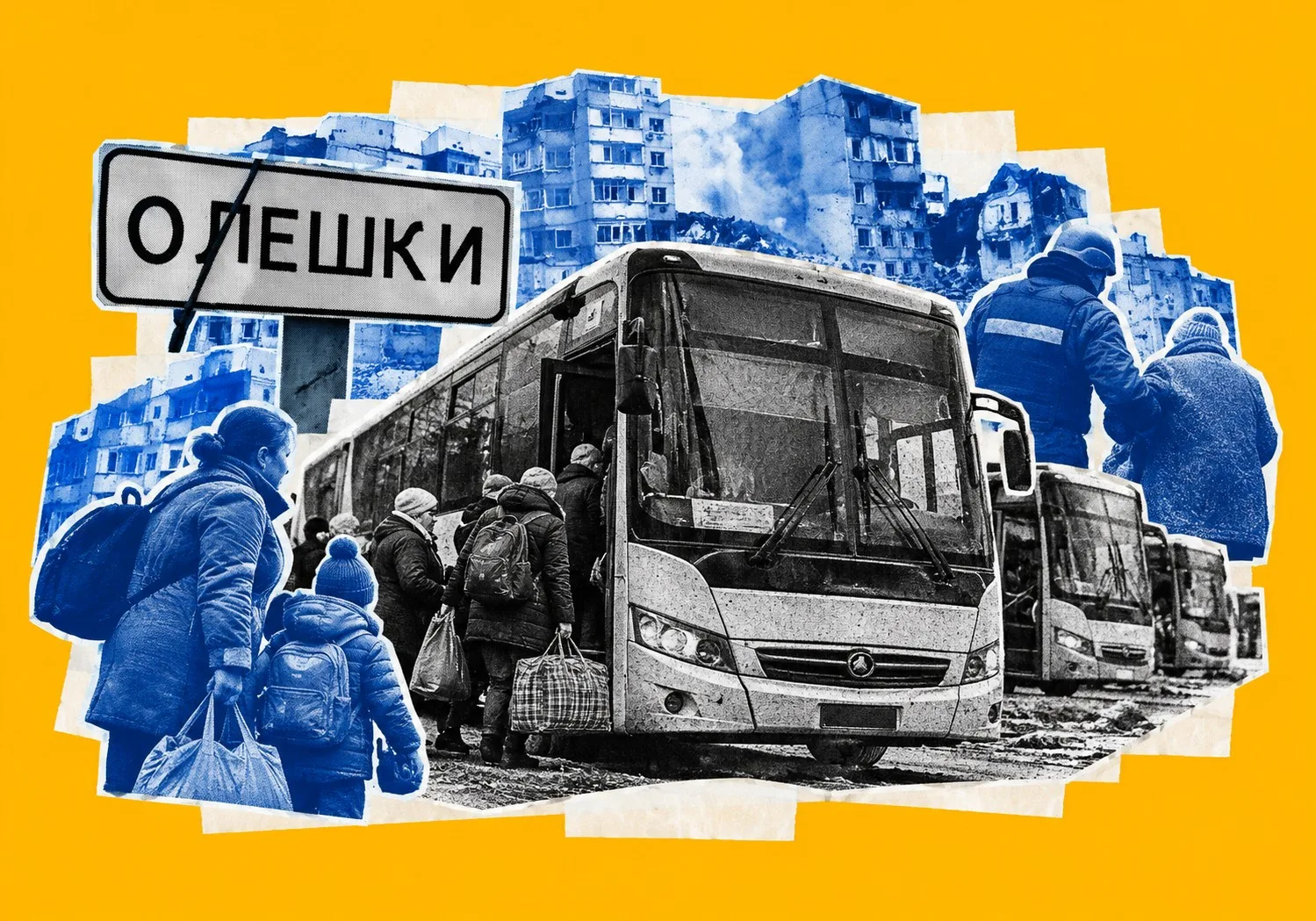
A fleet of 25 evacuation buses and nine ambulances stands waiting near Oleshky. Ukrainian and Russian officials have set a strict deadline for civilians to register and flee. Under the agreed schedule, residents wishing to leave have until 14:00 to board before the transport departs and aid distribution begins. According to the latest reports, the Ukrainian delegation has already arrived on the ground in Oleshky to oversee the process. This high-stakes operation holds across a multi-day front-line truce mediated by US representatives, offering trapped residents their sole opportunity in more than four years of war to escape via a complex multi-stage route.
Speaking during the government question time in the Verkhovna Rada on 30 October, Ukrainian Prime Minister Serhii Koretskyi confirmed that 527 people from Oleshky are preparing to return to Ukrainian-controlled territory.
' By 14:00 today, the preliminary medical examination of those departing for Ukraine is scheduled for completion. At present, this includes 527 people,' — Serhii Koretskyi said.

In Oleshky, opposite Ukrainian-controlled Kherson, an estimated 1,500 residents remain from a prewar population of 24,000.
Marooned inside an active front-line sector, these civilians have endured more than four and a half years of acute deprivation without reliable access to food, clean water, or basic medicine. T
he evacuation mission, negotiated directly between Kyiv and Moscow via third-party mediation, provides the first structured exit route from the town since its capture by Russian forces in early 2022.
The Operational Reality on the Ground
Executing the corridor required direct operational coordination between opposing human rights officials.
Ukrainian Human Rights Commissioner Dmytro Lubinets confirmed the exceptional duration of the truce, highlighting the procedural discipline maintained by both militaries along the Dnipro River.
'We have now had a ceasefire between Ukraine and the Russian Federation for more than 75 hours. Special thanks to the people overseeing and monitoring the ceasefire process. Neither side has violated the ceasefire even once,' — Dmytro Lubinets said.
Lubinets noted that this is the first sustained front-line ceasefire of this scale since the 2022 invasion.
The operation was effectively launched on 23 October through daily technical consultations between Ukrainian and Russian representatives. Following his arrival in Armiansk, Lubinets met with his Russian counterpart to finalize staging arrangements before both delegations proceeded together into Oleshky on 30 October.
Russian Human Rights Commissioner Yana Lantratova detailed the precise logistical assets and medical personnel committed to the convoy.
'The humanitarian aid was put together according to the needs reported to us by the people. This includes food, hygiene products, everything essential, medical supplies, fuel – everything people need.' — Russian Human Rights Commissioner note.
Lantratova specified that the fleet includes specialized transport for approximately 30 bedridden individuals and over 50 medical staff. Vehicles were equipped with drinking water and dry rations, alongside dedicated transport for personal luggage and domestic pets.
To maintain order and ensure civilian safety around the primary staging point at the district hospital, organizers implemented strict operational schedules separating passenger registration from supply operations.
'People who have made the decision to leave will have the opportunity to register and board the buses until 14:00. The distribution of humanitarian aid will take place after 14:00,' — Yana Lantratova.
Despite strict adherence to the truce along the designated convoy routes, the preparatory phase involved casualties.
Lantratova confirmed that two people died during preparations, including a bomb-disposal expert killed during demining operations.
Journalists from Ukraine, the United States, and Russia accompanied the mission, with Lubinets stating that the procedural model established in Oleshky could potentially be applied to future humanitarian operations in other contested front-line settlements.
The Cartography of Extraction
The evacuation route lays bare the physical impassability of the active front line along the Dnipro River.
Because the river delta is heavily mined and subject to ongoing artillery and drone fire, direct transit across the water from Oleshky to Ukrainian-held Kherson was ruled out by both military commands.
No official information has been released regarding whether an aerial evacuation across the river using helicopters was evaluated by negotiators.
Addressing the logistical necessity of routing the Ukrainian delegation and evacuees through Russian-controlled territory, the press service of the Ukrainian Human Rights Commissioner issued a formal statement: 'There are currently two possible ways to reach temporarily occupied Oleshky: across the front line or through the territory of the Russian Federation. However, there are certain restrictions in place along the front line."
"There is also no route across the river: the area is mined and is part of the front line. Therefore, given the situation and the need to ensure the speed and safety of the humanitarian mission, the ombudsman agreed to travel via Russian territory. The priority remains unchanged: people's safety, the provision of humanitarian aid and the creation of conditions for the civilian population of Oleshky to be evacuated.' — Press Service of the Ukrainian Human Rights Commissioner wroted in the statement.
Under the terms established by the negotiators, civilians choosing to return to Ukrainian-controlled territory must undergo a circuitous four-stage transit.
First, evacuees are transported south from Oleshky through Russian-occupied Crimea to Anapa airport in Russia's Krasnodar Krai.
From Anapa, the Ukrainian delegation and residents will be flown to Homiel (Gomel) airport in Belarus aboard a Russian Defense Ministry military transport aircraft, a flight expected to take place around 31 October.
From Gomel, evacuees will cross the land border back into Ukrainian-controlled territory.
This extensive routing through three countries highlights the total absence of operational transit infrastructure along the active front line, where river and ground crossings remain impassable barriers.
Geopolitical Signaling and Washington's Orbit
The operational timing of the Oleshky mission is closely linked to external diplomatic scheduling.
Both Kyiv and Moscow explicitly credited US First Lady Melania Trump’s team for facilitating communications, an engagement that began on 20 October.
Lubinets publicly expressed Kyiv's gratitude to her for devoting personal attention to the humanitarian situation in the Kherson region.
National leadership on both sides addressed the US-mediated effort directly.
Ukrainian President Volodymyr Zelenskyy confirmed Kyiv's insistence on international oversight during the operation: 'American journalists must come to the location of the US-mediated mission. This was our request because we cannot trust the Russian side.'
Russian President Vladimir Putin also referenced the American mediation effort during an international gathering with African delegates in Moscow.
'Relief supplies will begin reaching civilians on Thursday and Friday, with the support, incidentally, of the first lady of the United States. Russia is working on issues relating to a possible peaceful resolution of the Ukrainian crisis itself,' — President of the Russian Federation said.
This public acknowledgment of US mediation by both leaders coincides with preparations for bilateral peace talks scheduled to resume next month in Abu Dhabi following a prolonged freeze. With U.S. midterm legislative elections approaching and Donald Trump maintaining an active posture on foreign policy negotiations, both warring states face tactical incentives to demonstrate cooperation to Washington.
For Moscow, agreeing to a localized humanitarian corridor provides a structured platform to project diplomatic flexibility while maintaining its primary strategic positions, including full territorial claims over the Donbas and a permanent prohibition on Ukraine's accession to NATO.
For Kyiv, active participation in the corridor is tied to preserving critical operational support from Western allies.
Ukrainian military operations remain dependent on U.S. battlefield intelligence sharing, continued access to Elon Musk's Starshield satellite communication platform, and a steady supply of Western air defense interceptors, including Patriot systems purchased through European partners. Demonstrating alignment with U.S.-brokered initiatives allows Kyiv to safeguard these essential supply lines while fulfilling humanitarian obligations toward trapped civilians.
The Divergent Realities of War
The 75-hour localized truce in Oleshky contrasts sharply with military operations across the rest of the country.
While the southern corridor observed a total suspension of fire without a single reported breach, Russian military forces conducted long-range missile strikes against central and eastern Ukrainian urban centers.
One strike targeted the central railway station in Dnipro, resulting in 15 civilian deaths and significant infrastructure damage, while Russian forces also launched a ballistic missile attack against Kyiv overnight.
Tactical compliance along the Dnipro River has provided a vital exit window for Oleshky's remaining population, but it operates independently of the broader military trajectory.
While local arrangements offer immediate relief to evacuees, the physical destruction along the front line remains intact, and the wider conflict continues.
Sources: Ukrainian Pravda, The Guardian, Euronews