
Microsoft’s Real-Time AI Patent Tests the Limits of the EU AI Act

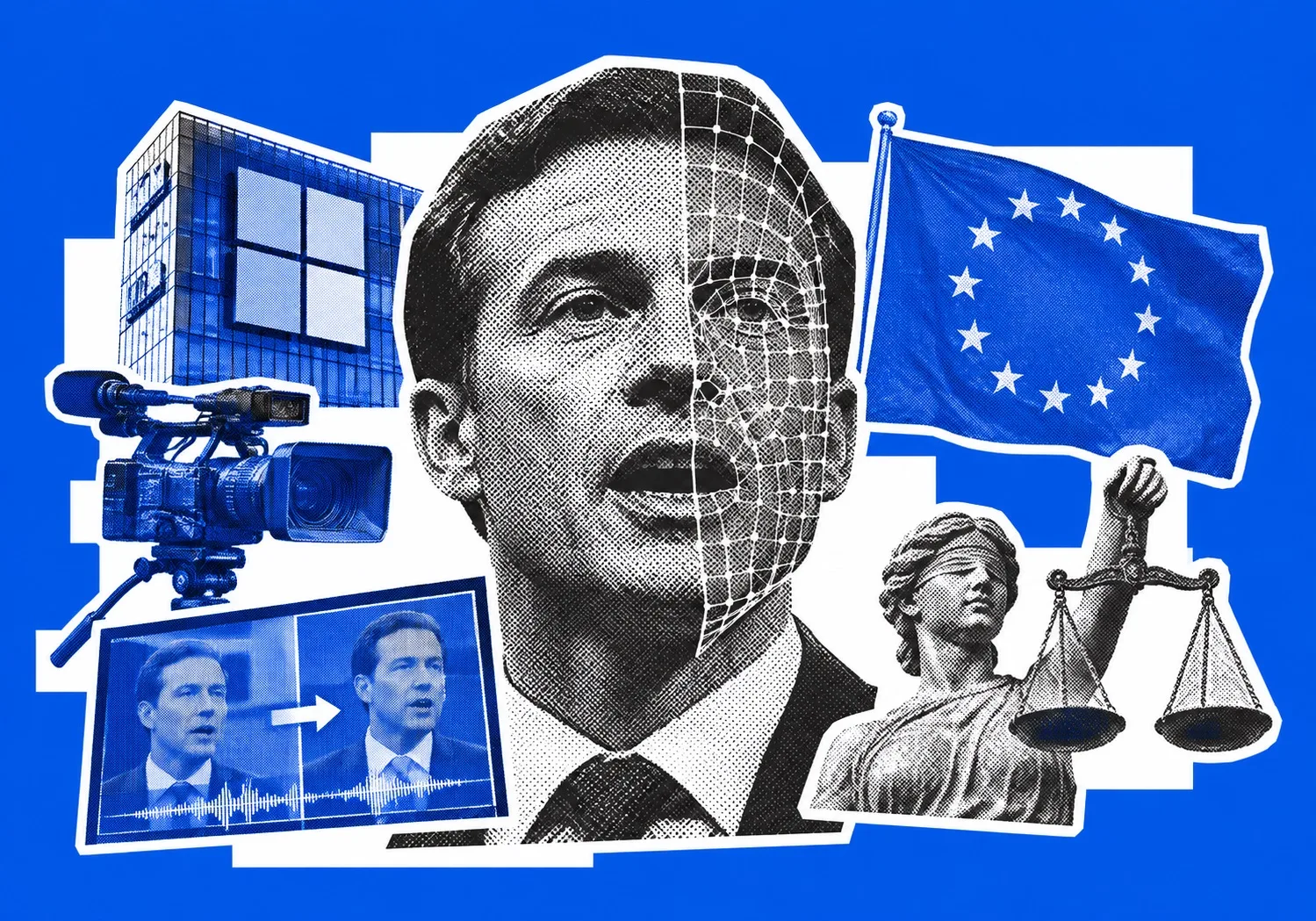
Microsoft’s patent application for real-time video and speech editing points to a future where live broadcasts can be algorithmically altered in seconds. As generative AI advances from post-production to live transmission, the technology faces an immediate compliance test under the EU’s newly implemented AI Act transparency rules.
The application, US 2026/0341309 A1, was submitted by Microsoft Technology Licensing on 29 April 2025 and published on 30 October 2026. Its claims have already encountered objections during initial examination by the United States Patent and Trademark Office (USPTO). The available information does not establish the specific legal grounds for those objections, and the filing should not be mistaken for an approved patent or a functioning commercial service.
Yet the technical ambition is significant. Microsoft is describing a method of intervening in an audiovisual stream while it is being transmitted, rather than editing footage after an event. That distinction matters for journalism, political communication and the growing European market for AI-assisted broadcasting.
When a broadcast becomes editable
The proposed system would examine incoming audio and video, identify words selected for replacement and generate corresponding changes to both sound and image.
A speaker's original words could be removed or substituted according to predefined rules or information associated with a viewer. Generative AI would then modify the speaker's lip movements and facial expressions to match the replacement audio.
The patent also addresses a familiar weakness of synthetic video: visible or audible discontinuities. Rather than changing only the targeted word, the system would adjust short sections immediately before and after the intervention, making the edited passage appear more continuous.
For broadcasters, the applications are readily apparent. A foreign-language interview could be translated while the interviewee's mouth movements followed the translated speech. Offensive language might be removed without an obvious interruption. Hesitations or verbal mistakes could disappear from a presentation.
The more consequential possibility is individualised content.
The patent describes adaptations based on viewer profiles or internet searches. In principle, different audiences could receive different versions of the same speaker's remarks, with each version appearing visually coherent.
There is a substantial difference between making a broadcast accessible in another language and altering its wording according to the characteristics of its audience. Both may rely on similar technical processes, but they raise different questions about editorial responsibility.
A translated statement can preserve the speaker's intended meaning. A personalised substitution may change the message itself.
The technology therefore challenges an assumption on which broadcast journalism has long relied: that viewers watching the same live event are witnessing substantially the same public record.
The significance of a ten-second delay
Microsoft's application envisages processing delays of approximately one to ten seconds.
That range is important because live broadcasting is rarely instantaneous. Encoding and transmission already introduce delays, commonly between two and six seconds in low-latency streams.
Some existing generative systems can process avatars and dialogue with latency of roughly 0.9 to 1.75 seconds. These figures do not establish that Microsoft's proposed architecture can perform reliably across unpredictable live broadcasts, but they help explain why such a system is technically plausible.
A few seconds may provide enough time to recognise speech, select a replacement, generate new audio and reconstruct the relevant facial movements.
The engineering challenge becomes considerably harder when the source material is unscripted. Political debates, interviews and conferences involve interruptions, changing expressions and speech patterns that cannot be anticipated.
Existing commercial services offer a useful comparison.
HeyGen's AI Video Translator and platforms such as Synthesia and Runway already demonstrate capabilities involving translated speech, synthetic presenters and manipulated video. Their principal applications, however, remain pre-recorded material, controlled production environments or generation processes that do not require arbitrary interventions in an external live feed.
Microsoft's filing points towards a different architecture: continuous modification of material as it passes through a transmission system.
It is not evidence that this capability has been perfected. Nor does a patent application establish that Microsoft intends to introduce the technology into news broadcasting.
What it does establish is that real-time intervention in audiovisual communication is becoming a subject of formal intellectual-property development.
The remaining distance between a patent description and a reliable product may be considerable. For regulators, however, waiting until that distance disappears carries its own risks.
Europe’s transparency rules face a practical test
The European Union has already introduced legal obligations addressing synthetic media.
Article 50 of the EU Artificial Intelligence Act, applicable from 2 August 2026, establishes transparency requirements for AI-generated and manipulated content.
Under the framework described in the briefing, providers must ensure that synthetic or modified media carry machine-readable indicators. Those distributing manipulated material depicting real individuals must also provide appropriate disclosures that audiences can perceive.
The distinction between technical identification and public disclosure is crucial.
A digital marker may help software recognise that content has been altered. It does not necessarily tell a viewer watching a political interview that the words and facial expressions on screen have been reconstructed.
Microsoft's patent description does not include mandatory viewer-facing labelling as a baseline feature.
That omission is not proof of an intention to conceal modifications. Patent applications describe claimed technical inventions, not necessarily every compliance mechanism that might accompany a commercial product.
Nevertheless, any European deployment would have to confront the regulatory difference between producing synthetic media and presenting it transparently.
A translation service might visibly inform audiences that a speaker's voice and mouth movements have been modified. A system making personalised substitutions would require a more difficult assessment of what had changed and how that change should be communicated.
An additional complication arises when the editing takes place downstream from the original broadcaster.
If a platform modifies a live feed after receiving it, responsibility for the resulting content may no longer rest solely with the organisation that recorded or transmitted the original event.
The broadcaster could have preserved the speaker's words accurately while an intermediary delivered an altered version to viewers.
European rules are designed to impose transparency obligations on relevant participants, but enforcing them across a chain of providers, platforms and distributors becomes more complicated when modifications occur continuously.
The problem of proving what was said
The media industry's response to synthetic content increasingly relies on provenance technologies.
The Coalition for Content Provenance and Authenticity, known as C2PA, has developed a framework for attaching verifiable information about the origins and modification history of digital media.
Cryptographic signatures and Content Credentials can help establish whether material has been altered after a particular stage of production.
Such mechanisms could become valuable if live editing develops beyond controlled demonstrations.
A broadcaster might cryptographically sign its original feed, allowing subsequent versions to be compared against an authenticated source. Platforms could preserve records of modifications, helping establish which changes were made and where they entered the distribution chain.
Yet provenance is not identical to truth.
A valid signature can support a claim about the origin or integrity of a file. It cannot independently establish that a speaker's statements were accurate, that an alteration was authorised or that a translation preserved the intended meaning.
Nor can a technical standard guarantee that every intermediary will retain the relevant information.
These limitations matter particularly for live video. A disputed statement may circulate before the original recording and its modification history can be examined.
For politicians, journalists and other public figures, the resulting reputational risk is clear. A person could appear to make a statement they never delivered, while the corresponding facial movements make the alteration difficult to detect through ordinary viewing.
Consent becomes another contested area.
Rights relating to an individual's likeness, voice and public identity, alongside contractual consent arrangements, may offer protection against unauthorised manipulation. The briefing does not establish which specific legal remedies would apply to Microsoft's proposed system across different jurisdictions.
The practical question is whether consent and provenance can be enforced at the point of alteration, rather than addressed only after a disputed video has reached its audience.
A new layer of control over public speech
The commercial incentives behind real-time audiovisual editing extend beyond entertainment.
Broadcasting infrastructure providers could offer automated localisation, language filtering and adaptations to meet content requirements in different markets. Platforms might use similar systems to deliver more personalised experiences without producing entirely separate recordings.
Those capabilities could reduce production costs and expand access to international content.
They would also place greater editorial power in the hands of organisations controlling distribution.
Traditionally, a broadcaster's editorial decisions determine what material is transmitted, while subsequent editing produces a separate version. A system that modifies speech during delivery weakens that separation.
The original event remains unchanged, but the audience's experience of it becomes adjustable.
This is especially consequential for political communication, where exact wording, hesitation and tone can influence how statements are interpreted. Even changes intended to improve clarity may remove information that viewers consider relevant.
Microsoft's application has attracted attention from publications including Futurism and Yahoo Tech, but the central issue is not whether the company is about to release a tool capable of rewriting live political debates. There is no established commercial launch.
The more immediate issue concerns the institutional arrangements that would govern such capabilities if they became widely available.
For compliance technology providers, that creates a potential market for stronger authentication, watermarking and audit systems. For established media organisations, it introduces another cost of maintaining public trust.
The EU's transparency requirements offer a legal starting point, but their effectiveness will depend on how reliably alterations can be identified, disclosed and attributed across increasingly complex distribution networks.
A particularly difficult scenario would involve a broadcaster transmitting an authenticated, unmodified political speech while a separate platform changes selected passages for particular viewers.
The original recording could remain intact. Its provenance could be verified. The broadcaster might never have authorised an alteration.
Yet the version reaching the audience would contain words the speaker had not said.
In that situation, proving the authenticity of the original would be only part of the regulatory problem. Authorities would also need to establish who controlled the version delivered to viewers, what modifications were made, and whether the audience was informed before encountering them.
Sources: JUSTIA, Microsoft Technology Licensing, Futurism, Patentlyze