
María Corina Machado Returns to Venezuela, Challenging Trump-Rodríguez Deal

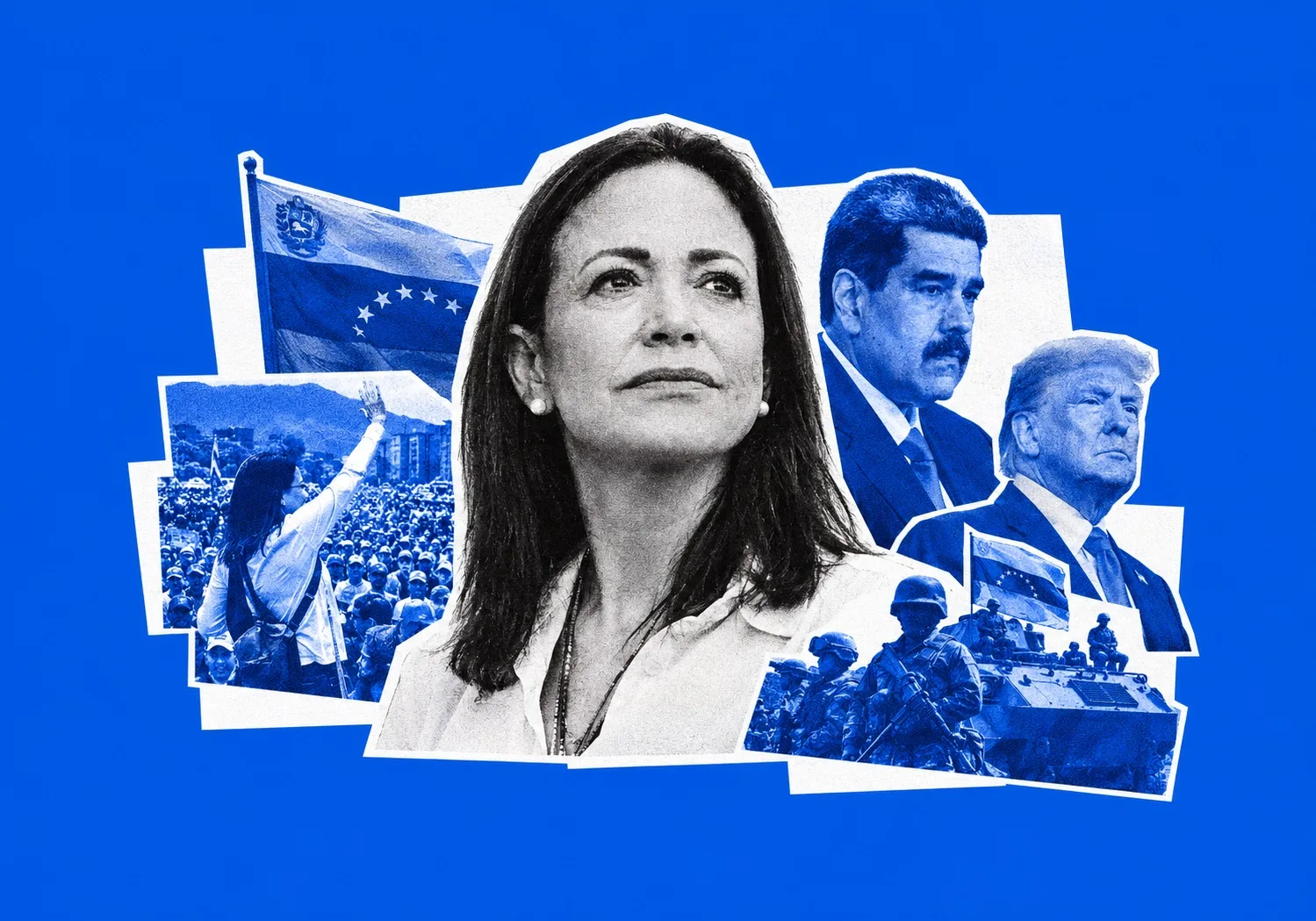
Venezuelan opposition leader María Corina Machado has returned to the country after nearly ten months in exile, drawing massive crowds and demanding immediate presidential elections. Her surprise return directly challenges the fragile arrangement between Donald Trump’s administration and interim president Delcy Rodríguez, putting renewed pressure on Washington to deliver a democratic transition.
Her first public appearance was at the Santa Rosa church in Lara state. Supporters gathered around her before she continued towards the capital, accompanied by a procession of cars and motorcycles. More people waited along the highways and in Caracas, waving Venezuelan flags and shouting “Libertad!”
“I am here, with you,” Machado told supporters in a statement.
The crowds offered a reminder of her political following. More importantly, they brought an opposition movement that Washington had largely dealt with at a distance back into Venezuela's domestic political arena.
Rodríguez, meanwhile, has remained in office well beyond the 90 days originally envisaged for her interim presidency. She has yet to announce when Venezuelans will vote for a new president.
Machado intends to make that delay harder to sustain.

The arrangement that kept Rodríguez in power
When American forces captured Maduro in January, Washington faced a choice over what should replace his government. It could press for a rapid political overhaul or work with officials already running the country.
Trump chose the latter.
Rodríguez had served as Maduro’s vice-president and remained closely associated with the political establishment that survived his removal. For the Americans, that continuity had advantages. Venezuela’s institutions and security apparatus remained operational, while the interim administration offered a partner for negotiations involving oil production and access to natural resources.
It was a practical arrangement, though hardly the democratic transformation many Venezuelan opposition supporters had expected.
Rodríguez initially held a 90-day mandate. She also promised a transition to full democracy during an appearance at the UN General Assembly. Yet the deadline passed without a presidential election being scheduled.
Trump has shown little urgency to change that. In September, he said it was too early to discuss elections and emphasised the continuing American role in Venezuela’s oil and natural resources sectors.
The economic interests are substantial enough to influence Washington’s political choices. American companies need a functioning administration with which to negotiate contracts and maintain operations. Rodríguez provides that continuity, even if her government remains politically contentious.
An election would introduce a variable Washington cannot control: the possibility of a government with different priorities and a mandate independent of the current US-backed arrangement.
For Machado, the prolonged interim presidency raises a more basic question. If Maduro’s removal was supposed to open the way to democracy, why is one of his former senior officials still governing without a date for voters to choose a successor?
That question has become more difficult for Rodríguez to avoid now that Machado is asking it from inside the country.
Why Washington stopped standing in her way
Trump's reaction to Machado's arrival was notably cautious. He said he had not known in advance that she was returning, described her as a “very nice woman” and wished her safety. He offered no endorsement of her political ambitions.
Secretary of State Marco Rubio took a different approach, presenting her safe return as a result of US-backed reconciliation negotiations. He called on political forces to support the process.
Neither response amounted to a commitment to the elections Machado wants.
The distinction is important. Washington has allowed a prominent opposition leader to return, but it has not withdrawn its backing for Rodríguez. Nor has it publicly accepted the opposition’s preferred timetable.
The change in American behaviour may have as much to do with politics in the United States as with developments in Caracas.
With the midterm elections approaching, the Trump administration faces pressure from voters in Florida who believe it has done too little to restore democracy in Venezuela. Maduro's capture was a dramatic intervention, but the government that followed still includes senior figures from his administration.
That is difficult to reconcile with expectations of a decisive break from the previous political order.
Preventing Machado from returning again would have made the contradiction more visible. Allowing her back offers Trump a less costly alternative: he can point to greater political freedom in Venezuela without immediately forcing Rodríguez to hold elections.
It is not clear whether Washington deliberately changed its policy for that reason. But the timing gives Machado an opportunity that was unavailable during her earlier attempts.
She now has two audiences. One is Venezuelan, where her supporters want political change. The other is American, where the administration must defend the results of its intervention ahead of an election.
Her return puts pressure on both.
Machado needs more than a date for elections
Machado and her advisers have been careful not to present her arrival as the launch of a presidential campaign.
David Smolansky and Pedro Urruchurtu, among those working with her, have described the objective as accelerating the transition and securing a firm timetable for free and verifiable elections.
There are good reasons for that distinction. Venezuela has yet to settle some of the institutional questions that would determine whether an election could be regarded as credible.
Negotiations between the opposition and the interim administration have already included proposals to reform the Supreme Court and the National Electoral Council.
The composition and independence of those institutions matter. An election date would mean little to opposition supporters if they had no confidence in the authorities administering the vote or resolving disputes.
Machado therefore faces a difficult political task. She must press for elections soon enough to prevent the interim arrangement from becoming permanent, while insisting on reforms that could take time to negotiate.
Rodríguez has room to exploit that tension.
Her administration could engage with the opposition over institutional changes without immediately committing to a presidential contest. Such negotiations might produce genuine improvements. They could equally become a way of extending the transition while leaving the existing leadership in place.
Machado's party, Vente Venezuela, had already organised demonstrations calling for her return, the release of political prisoners and faster political change. Sunday's reception indicates that the movement can still bring people onto the streets.
Whether it can turn that support into concessions is another question.
Machado does not control the state institutions that would implement reforms. Nor does she have Washington's backing for an immediate transfer of power. Her influence comes from public support and the political difficulties that prolonged delay could create for Rodríguez and Trump.
That gives her leverage, but no guarantee of success.
Can Rodríguez accommodate the opposition without losing control?
Rodríguez has so far offered no public response to Machado's return. Her position is awkward.
She needs continued American support, particularly while Washington remains closely involved in Venezuela's economic and political affairs. Yet she also has to manage an opposition leader whose popularity could make prolonged interim rule increasingly contentious.
An attempt to suppress Machado's movement would risk damaging the political opening that Rubio has attributed to American diplomacy. It could also intensify criticism of Trump's Venezuela policy among voters who already question the administration's commitment to democracy.
Accommodating Machado carries risks of its own.
A genuine electoral timetable would begin to limit Rodríguez's freedom to govern indefinitely. Reforms to the Supreme Court and Electoral Council could also reduce the influence of officials inherited from the previous administration.
The interim president has an incentive to negotiate, but not necessarily to conclude negotiations quickly.
Washington's interests make the situation still more complicated. The United States wants a stable partner in Caracas and predictable arrangements for American businesses. Rodríguez offers both, at least for now.
Machado offers something different: the prospect of a government whose authority would come from an election rather than an agreement reached after a foreign military intervention.
That prospect may be attractive to Venezuelan voters without being equally attractive to officials managing commercial and diplomatic relations.
The conflict is not simply between democracy and economic interests. A government elected through a credible process could provide a stronger basis for long-term stability. The difficulty for Washington is that such a government would have its own political priorities and would not necessarily preserve every understanding reached with Rodríguez.
Trump's administration has invested in a particular governing partner. Machado is demanding a process that could replace her.
Venezuela's political future is no longer being negotiated only at the top
For much of the period since Maduro's capture, the country's direction has depended heavily on discussions between Washington and the interim authorities.
That arrangement left relatively little room for the kind of mass political mobilisation Machado is now seeking to revive.
Her arrival changes the atmosphere, though not yet the distribution of formal power.
Rodríguez remains interim president. The state institutions continue to operate. The Americans have not abandoned their economic priorities, and Trump has given no indication that he intends to replace Rodríguez with Machado.
Still, the opposition has gained something important: a leader who can campaign for political change inside Venezuela rather than attempting to influence events from exile.
Machado left the country secretly in late 2025 to receive the Nobel Peace Prize in Oslo. What was intended as a temporary departure became nearly ten months abroad, with security concerns and political resistance preventing her return.
Her presence in Caracas now makes the terms of the transition a domestic political dispute in a way they were not while she remained overseas.
The next contest may centre less on Machado's personal ambitions than on the institutions that will determine whether Venezuelans can elect a government.
For Rodríguez, negotiations over the Supreme Court and Electoral Council offer a means of controlling the pace of change. For Machado, they are necessary steps towards elections that she wants held promptly.
Washington sits between those positions, supporting a government whose continued existence helps protect American economic interests while facing growing demands to deliver the democratic transition promised after Maduro's removal.
The immediate test will be whether negotiations produce an election timetable with credible safeguards, or simply give Rodríguez another reason to remain in office.
Machado can mobilise voters and demand a date. Rodríguez can influence the institutions that would organise the election. And Washington, having helped determine who governed Venezuela after Maduro, must now decide how much uncertainty it is prepared to accept over who governs next.
Sources: Bloomberg, Euronews, France24, Il Foglio, AFP