
Iran’s Undersea Cable Threats: What the Strait of Hormuz Standoff Means for Global and European Connectivity

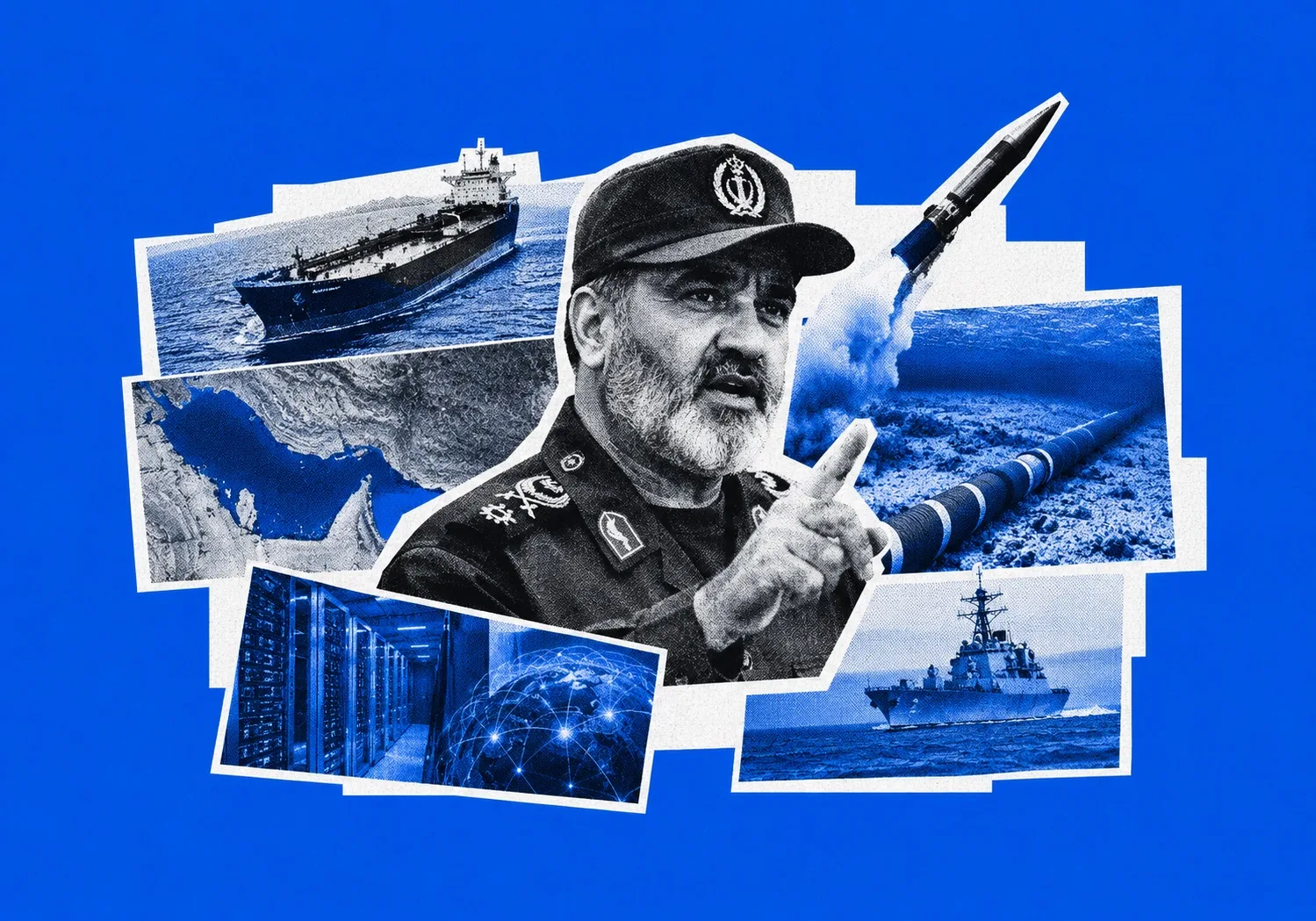
Tehran’s warnings to target submarine communications cables in the Strait of Hormuz have raised alarms over the security of critical digital infrastructure. While primary Europe-Asia data corridors in the Red Sea remain intact, Iran’s shifting focus to hybrid digital warfare exposes key regional vulnerabilities - and tests the resilience of international finance, cloud services, and cross-border communications.
The core of the risk lies in the Strait of Hormuz itself, where seven major cable systems cross or approach the passage, carrying data essential to financial transactions, cloud services, and government operations across the Gulf. The warning, issued by Islamic Revolutionary Guard Corps (IRGC) spokesperson Brigadier General Hossein Mohebi, marks a further escalation in Tehran’s attempt to turn control of a strategic maritime passage into leverage over its adversaries. Their destruction would not sever the global internet, as Iranian rhetoric implies. It could, however, inflict substantial damage on countries whose economic importance rests partly on their ability to move money, information and commercial data without interruption.

The distinction matters. Iran does not need to threaten the entire world’s connectivity to make the threat credible. It needs only to identify infrastructure on which its regional adversaries depend and exploit the difficulty of replacing it during a war.
From oil chokepoints to digital coercion
The Strait of Hormuz has long offered Iran an opportunity to exert pressure disproportionate to its economic weight. Its importance to maritime commerce interferes with shipping an effective way to raise costs and force foreign governments to respond. The latest escalation follows Iranian attacks on shipping as the United States seeks to escort oil tankers through the chokepoint.
Submarine cables introduce another layer of vulnerability. Unlike tankers, which are visible and mobile, fibre-optic systems lie beneath the seabed and are difficult to protect continuously. Their strategic significance is less obvious to the public, but the services they carry are deeply embedded in the daily operations of modern economies.
Mohebi’s warning was explicit. Referring to the seven communications cables beneath the strait, he said: “We are reminding them of this so that the enemy knows.” An AI-generated image of a missile accompanied the statement on X, under the caption “The world will see what will happen!”
The theatrical presentation is less important than the underlying message. Tehran is signalling that the infrastructure supporting its opponents’ economies could become another instrument of retaliation.
Semi-official Iranian media outlets, including Tasnim and Fars, have also floated the possibility of charging foreign countries transit fees for using undersea cables in the region. The idea echoes threats concerning maritime shipping: infrastructure passing through a strategically sensitive area becomes a potential source of political and financial leverage.

There is an important difference between threatening to impose costs and possessing the ability to sustain a disruption. Iran’s statements do not establish that an attack on the cables is imminent, nor do they prove that Tehran could control the consequences. But they put civilian digital infrastructure more clearly inside the conflict’s strategic calculations.
The Gulf, not the global internet, is at risk
The geography of submarine connectivity places limits on the scale of the threat.
TeleGeography and other telecommunications analysts have identified multiple cable systems crossing or approaching the Strait of Hormuz, including AAE-1, FALCON, GBI/MENA, TGN-Gulf and SEA-ME-WE 5. Newer deployments, including Fibre in Gulf and the SEA-ME-WE 6 system, add to the network serving the region.
These connections matter to Gulf states, but they are not the principal artery of global Europe-Asia internet traffic. Much of that traffic travels through the Red Sea, roughly 900 miles away. A disruption in Hormuz would therefore be a serious regional infrastructure crisis rather than a global internet blackout.
That qualification should not obscure the potential damage.
Qatar, Bahrain, Kuwait, the United Arab Emirates and Saudi Arabia rely on submarine connections to link financial institutions, businesses, government systems and cloud services to the wider digital economy. Losing several major links simultaneously could degrade connectivity, increase latency and force traffic onto alternative routes with limited spare capacity.
For financial institutions, the consequences would extend beyond slower internet access. Data-intensive services and cross-border operations depend on reliable connections, while government agencies require communications networks to maintain routine administration. Businesses could face interruptions to cloud-based systems and commercial transactions precisely when regional instability was already raising operational costs.

The danger lies in concentration. A cable need not carry a large share of worldwide traffic to become a critical vulnerability for the countries and organisations that depend on it.
For Gulf governments seeking to position their economies as international centres for finance, energy, logistics and technology, connectivity is part of the economic proposition. A prolonged interruption would test not only network engineering but also the credibility of that proposition.
Redundancy exists, but it has limits
The Gulf is not entirely dependent on a single route. Terrestrial networks and alternative maritime cables can provide paths around damaged links, while the wider regional network offers some scope to reroute traffic.
Yet redundancy on a network diagram is not necessarily redundancy under wartime conditions. Alternative routes must have sufficient capacity, compatible infrastructure, and available connections at both ends. If several systems fail together, surviving cables may become congested, pushing up latency and degrading services even where connections remain available.
The distinction between nominal and usable backup capacity is central to the risk. A route that can carry traffic during normal operations may struggle to absorb a sudden transfer of demand from several damaged cables.
Satellite communications offer another fallback. Low Earth orbit (LEO) networks can help maintain selected connections, particularly for government and defence users requiring emergency communications. Their value increases when terrestrial infrastructure is damaged or inaccessible.
But satellites cannot simply replace the capacity of major fibre-optic systems. Submarine cables carry enormous volumes of data with low latency and relatively high cost efficiency. Satellite networks have different capacity constraints and cannot economically sustain every service normally carried by fibre.
Governments and critical businesses would therefore face difficult choices about prioritisation during a prolonged outage. Keeping selected communications running is not the same as preserving normal economic activity.
The practical question is not whether an alternative connection exists. It is how much traffic that connection can sustain, whether users can access it, and how long the arrangement can remain viable.
Repairing a cable is a security problem
Even when damaged cables can be identified, restoring service in an active conflict zone presents a separate challenge.
Submarine cable repairs require specialised vessels, equipment and technical crews. Under normal conditions, repairs can take weeks, with typical timelines ranging from 20 to 40 days. Conflict can make that process substantially more difficult.
Cable-laying and repair vessels operating near a contested maritime chokepoint could face security risks, restricted access and higher insurance costs. Damage to multiple systems would also create competing demands for a limited pool of specialised ships.
The repair process could become a strategic vulnerability in its own right. A cable cut may be a relatively localised physical event, but the resulting outage can persist while operators secure access, mobilise equipment and complete repairs.
Months of disruption are possible if conflict conditions prevent timely intervention. During that period, rerouted traffic could remain congested and businesses could be forced to operate with degraded services. The economic cost would depend not only on the initial damage but also on how quickly normal capacity could be restored.
This creates an asymmetry that may appeal to an adversary. Disrupting infrastructure and restoring it are very different tasks: the former can threaten a system’s availability, while the latter requires sustained access, specialised resources and a sufficiently secure operating environment.
A wider battlefield for hybrid warfare
The threat to submarine cables also fits a broader pattern of Iranian pressure against Western interests. British domestic security officials have warned of intensifying Iranian and Russian-linked threats, including a September plot targeting a US-run military airbase in the UK and proxy-led arson and sabotage against Jewish sites.
Those incidents do not establish a direct operational connection to the cable threat. They do, however, illustrate the wider security environment in which states and their proxies can seek leverage through targets outside conventional battlefields.
Iranian officials have previously raised the possibility of attacking US-linked submarine cables, data centres and AI infrastructure in a future war. The latest warning places the communications network beneath Hormuz within that expanding set of potential targets.
The underlying change is strategic rather than technological. Civilian infrastructure has always been vulnerable during war, but digital networks now connect commercial activity, public administration and national security so tightly that disruption in one area can spread across others. A communications cable may be privately operated, yet its loss can have consequences for financial stability and state capacity.
Responsibility for protecting such systems is also fragmented. Submarine cables operate through private consortia and international arrangements, while their security depends on cooperation among governments, operators and maritime authorities. There is no single global military framework capable of guaranteeing their protection across every contested route.
That leaves states with a difficult problem: infrastructure can be essential to national resilience without being under the exclusive control of national defence institutions.
For Europe, the immediate threat is geographically concentrated in the Gulf, and the principal Europe-Asia data corridors are not centred on Hormuz. But the strategic principle travels well beyond the region. If states increasingly treat civilian digital infrastructure as a source of coercive leverage, the security of international connectivity will depend on more than protecting the largest routes or preparing for a global outage.
The more consequential test may be whether governments and operators can keep critical services functioning when a regional conflict turns the repair, rerouting and protection of civilian infrastructure into contested operations themselves.