
EU’s 23rd Sanctions Package Targets Russia’s Shadow Fleet and Oil Logistics

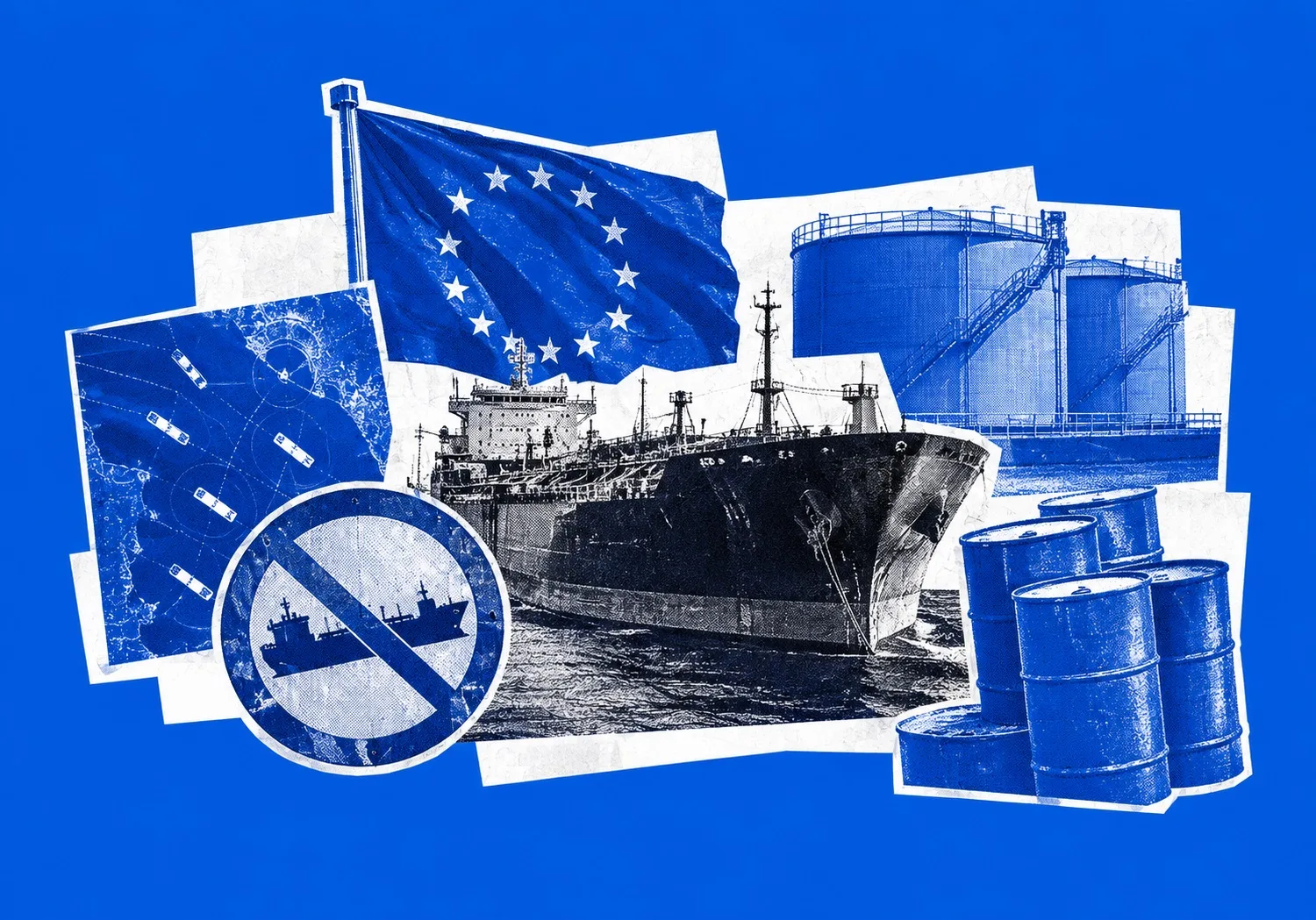
The European Union is shifting its sanctions strategy from military suppliers to Russia’s oil revenues, maritime logistics, and the shadow fleet driving the Kremlin’s war economy. Following the 12 October restrictions, Brussels is preparing a 23rd sanctions package to disrupt energy transport and financial networks—just as a widening rift emerges with Washington over US signals to ease energy pressure on Moscow.
Brussels is moving towards that problem, but the tools required to address it are more politically contentious and economically disruptive than another round of asset freezes.
The limits of the blacklist
The scale of the 12 October package illustrates both the reach of European sanctions and the difficulty of making them more effective. The EU added 1,569 individuals and entities, bringing the total number of listings under its territorial integrity sanctions regime to roughly 4,600. The measures targeted suppliers of components for ballistic missiles, drones and aviation, alongside other businesses connected to Russia’s military-industrial complex.
The targeted suppliers account for an estimated €20bn or more in combined annual turnover and employ over 250,000 people. More than half of the new listings concern ballistic missile production chains.
These are substantial restrictions. Yet the volume of listings is no longer a reliable measure of the pressure being exerted on Moscow. A company can be designated, its assets frozen and its direct access to European markets restricted without necessarily bringing its activities to a halt. Alternative suppliers, intermediaries and trading routes can preserve parts of the supply chain.
The problem is particularly acute when restrictions target manufacturing rather than the commercial infrastructure supporting it. A Russian defence contractor may face difficulties obtaining a particular component, but the wider war economy continues to benefit from export earnings generated elsewhere.
That is why the next phase is turning towards oil.
Russia’s fossil fuel export revenues are estimated by the Center for Strategic and International Studies at approximately €193bn annually. The figure indicates the scale of the financial system that European policymakers are trying to constrain. Even substantial disruption to individual manufacturers may have limited strategic effect if Moscow retains the income needed to finance procurement, replace equipment and sustain military operations.
The Commission’s emerging approach is therefore less about finding another thousand companies to sanction than about making the networks connecting Russian exports to international markets more difficult to use.
The shadow fleet becomes the central target
The most immediate test will be maritime transport.
Russia has developed a shadow fleet to move oil outside the reach of conventional Western shipping and insurance arrangements. Ukrainian intelligence estimates that the fleet includes more than 1,000 vessels, equivalent to around 17 per cent of the global tanker fleet.
That scale presents a different enforcement problem from the one addressed by conventional sanctions. Restrictions against an individual Russian company can be implemented through an identifiable legal entity. A maritime network is harder to constrain when vessels, commercial intermediaries and financial arrangements operate across multiple jurisdictions.
The planned 23rd package is expected to concentrate on these connections, alongside the financial and logistical channels that allow Russian oil to reach buyers. Tighter restrictions affecting maritime services, insurance and access to ports could raise the cost of operating the fleet and make transactions more difficult to arrange.
But there is an important distinction between raising costs and eliminating the trade.
The shadow fleet exists precisely because restrictions have created incentives to develop alternative transport arrangements. Additional pressure may reduce the efficiency of those arrangements, increase commercial risks and narrow the pool of willing counterparties. It does not follow that every targeted vessel will become unusable or that all Russian oil revenues will disappear.
The effectiveness of the measures will depend on enforcement beyond EU territory. Third-country intermediaries are central to that challenge. Earlier sanctions rounds have already targeted 60 entities involved in circumvention, including 28 based in countries such as China, Hong Kong, the United Arab Emirates, Uzbekistan, Kazakhstan, Turkey and Belarus.
That precedent points towards a more demanding phase of economic pressure. Brussels will have to influence the behaviour of businesses and jurisdictions that are not directly governed by EU sanctions, while avoiding unnecessary disruption to legitimate international trade.
For European governments, the objective is to make sanctions evasion more expensive and less dependable. The difficulty is ensuring that the resulting costs fall primarily on the networks sustaining Russia’s war economy rather than on the wider system of global shipping.
Washington is pulling in another direction
The European shift is taking place against an increasingly uncertain transatlantic backdrop.
Trump has presented the situation between Moscow and Kyiv as an energy truce and announced a deal involving Russian diesel supplies to the United States. His administration has also considered rolling back certain sanctions on shadow fleet tankers. European leaders, meanwhile, are pressing for tighter restrictions on the same sources of Russian revenue.
The disagreement concerns more than the timing of individual measures. It exposes competing assumptions about how economic pressure should be used to influence the war.
For Brussels, continued Russian attacks on Ukrainian energy infrastructure make the case for maintaining or increasing restrictions. European leaders, including Germany’s Friedrich Merz and representatives of Poland, have pushed for a tougher approach. France’s Emmanuel Macron has disputed the suggestion that Russia is observing an energy truce, while EU foreign policy chief Kaja Kallas has argued that the pattern of Russian attacks warrants greater pressure rather than relief.
Zelenskyy has likewise characterised the strikes on Ukrainian infrastructure as Putin’s direct response to American statements.
If Washington eases restrictions while the EU tightens them, the result could be a less coherent system of economic pressure. Differences between Western jurisdictions may give traders additional opportunities to redirect transactions, complicate compliance and weaken the predictability of enforcement.
The precise consequences will depend on which restrictions the United States ultimately changes and how European measures are implemented. An American decision to relax particular tanker sanctions would not automatically invalidate EU restrictions. But it could make coordination more difficult, especially where international shipping and commercial counterparties operate across both markets.
Europe would then face a familiar problem in a more acute form: the capacity to impose its own restrictions does not guarantee that those restrictions will produce the intended result when other major powers follow a different course.
China exposes Europe's own vulnerabilities
The EU’s negotiations with China over a German supplier to the semiconductor industry reveal another limit to the sanctions strategy.
Sindlhauser Materials GmbH, a German supplier of critical coatings for ASML, faces the prospect of a shutdown following Chinese export controls on rare earths imposed in July 2026. Brussels and Beijing are discussing a targeted arrangement under which restrictions on a Chinese entity could be lifted in exchange for restoring access to the necessary inputs.
The proposed compromise is striking because it brings the logic of sanctions into direct contact with the vulnerabilities of European manufacturing. The EU is seeking to constrain networks that support Russia’s military-industrial capacity, including businesses in third countries, while negotiating with Beijing to prevent a disruption to a critical European technology supply chain.
These are not identical policy questions, but they share a common constraint. Economic pressure works through commercial dependencies, and those dependencies do not run in only one direction.
Europe can restrict access to its markets, freeze assets and impose compliance obligations. China’s control over important mineral inputs can also create leverage over European producers. When that leverage threatens a supplier linked to a strategic technology company, the cost of maintaining an uncompromising position becomes more immediate.
A targeted carve-out would not amount to a general retreat from sanctions. It would, however, illustrate how exemptions and reciprocal concessions can become part of the machinery of economic statecraft rather than exceptions to it.
The proposed arrangement also faces a political obstacle. Lifting restrictions on a Chinese entity requires unanimous approval from all 27 EU member states. A commercially narrow agreement could therefore become a test of the bloc’s ability to reconcile national interests with a common external policy.
The same unanimity requirement has complicated earlier sanctions negotiations. Hungary and Slovakia have previously resisted or sought exemptions from measures against Russia, while the adoption of the 20th package in early 2026 was delayed until late April.
There is no guarantee that the next round of energy restrictions will encounter the same degree of resistance. Nor does previous obstruction establish that either government will block the forthcoming package. But unanimity gives individual capitals the ability to complicate negotiations precisely when the EU is trying to move beyond measures that are relatively straightforward to administer.
The next phase will test Europe's capacity to enforce
The emerging strategy asks more of Brussels than the accumulation of new listings. Restricting oil revenues requires sustained attention to shipping, insurance, financial transactions and commercial activity beyond the Union’s borders. Each additional layer of enforcement increases the importance of cooperation with other jurisdictions and the consistency of rules applied across markets.
There is also a political trade-off. Measures broad enough to affect a large maritime network may create risks for legitimate operators, while narrowly targeted restrictions may leave alternative routes open. The challenge is to impose sufficient friction to affect Russia’s ability to generate revenue without creating a compliance system that international businesses struggle to navigate.
The EU’s hawkish governments are gaining momentum in the debate over pressure on Moscow. Yet their preferred approach depends on a level of coordination that Europe cannot guarantee on its own. Washington may pursue a different energy policy, China can use control over critical materials to defend its commercial interests, and individual EU governments retain the power to delay sensitive decisions.
For the Kremlin, the coming test will be whether higher transport costs, tighter financial scrutiny and more aggressive action against intermediaries translate into a meaningful reduction in export earnings. For Brussels, it is whether a sanctions regime built around European legal authority can exert sufficient influence over commercial networks that extend far beyond European jurisdiction.
The harder Europe presses on those networks, the more its own industrial dependencies and political divisions become part of the equation.
Read also:
- The European Union has adopted its 22nd sanctions package against Russia, targeting 1,646 individuals and defense companies behind Moscow’s precision weapons. Approved in Luxembourg on 12 October, the new measures aim to restrict Russian missile supply chains while extending the EU's overall sanctions framework for three years.
Sources: EEAS, Reuters, Bloomberg, UNN