
NATO’s New ‘Theory of Victory’: How Drones, AI, and Deterrence Shift Eastern Flank Defence

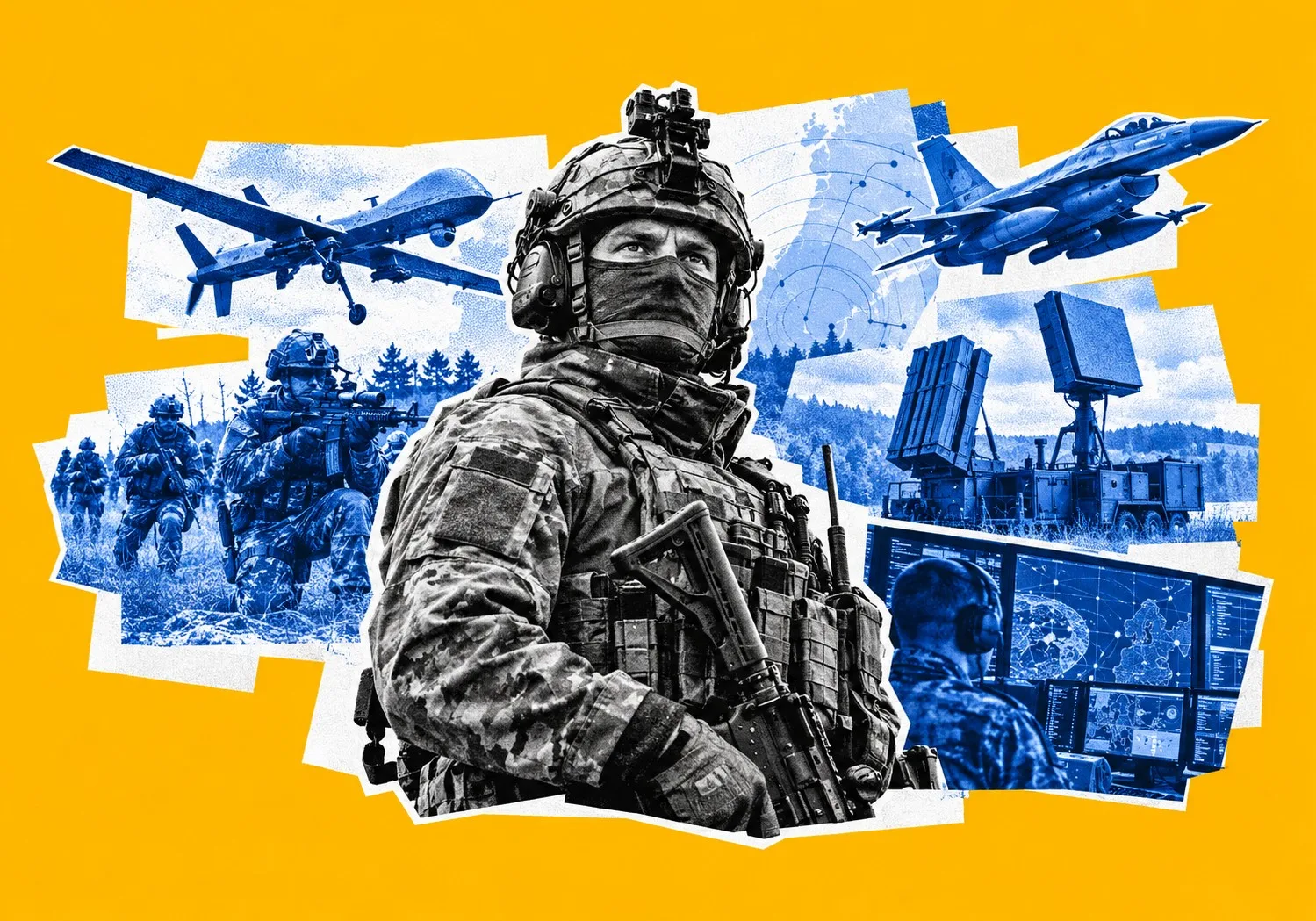
Ahead of the Warsaw Security Forum, NATO is set to officially outline its new ‘Theory of victory’. Supreme Allied Commander Europe (SACEUR) General Alexus Grynkewich will present the operational strategy, which combines military AI, autonomous drone networks, and forward posture on the Eastern Flank. The framework shifts planning away from delayed mobilization toward immediate, tech-enabled collective defence designed to block potential Russian incursions from the start.
This update reflects changes in European security since 2022. Intelligence assessments pointing to potential risks along NATO borders have prompted the Alliance to adjust its core defensive assumptions.

From ‘Deterrence by Punishment’ to ‘Deterrence by Denial’
For decades, NATO’s forward defence relied on deterrence by punishment.
Under that model, planners accepted the risk that an initial surprise attack might lead to temporary loss of border areas in Eastern Europe. The strategy assumed the Alliance would eventually mobilize industrial resources, launch a counter-offensive, and regain control.
That approach changed following Russia’s 2022 invasion of Ukraine and the documentation of civilian atrocities in Bucha and Irpin.
For member states near the border, including Poland and the Baltic nations, temporary occupation became an unacceptable risk.
NATO consequently adopted deterrence by denial.
The objective is to stop an incoming force from making territorial gains at the outset. By establishing constant forward readiness, the Alliance aims to convince potential adversaries that an attack will not succeed.
SACEUR spokesman Colonel Martin O’Donnell stated that General Grynkewich’s strategy focuses on maintaining NATO’s operational capabilities. While the Alliance maintains a defensive posture, its current plans prioritize immediate engagement in the event of an attack.
Countering Hybrid Warfare and Sabotage
The updated framework includes provisions against hybrid operations, such as sabotage, cyberattacks, and sub-threshold actions.
Germany’s foreign intelligence chief recently told parliamentarians in Berlin that President Vladimir Putin’s political standing remains tied to his military campaign, maintaining threat levels across Europe.
NATO Secretary General Mark Rutte, speaking in Munster, noted that while a direct conventional attack on NATO territory is not assessed as imminent, European nations must prepare for ongoing Russian sabotage targeting critical infrastructure.
The Eastern Flank Deterrence Initiative
The unclassified document, reviewed by news agencies including Bloomberg and ANSA following discussions within the NATO Military Committee, outlines an operational structure centered on the Eastern Flank Deterrence Initiative (EFDI).
Tested during exercises in Latvia, the concept sets up an autonomous buffer zone along exposed border sectors. This forward layer relies on networked systems, including reconnaissance and strike drones, uncrewed ground vehicles, and precision artillery linked to automated detection sensors.
In this setup, artificial intelligence processes incoming sensor data to prioritize threats and streamline target identification. The system processes inputs in real time, allowing human commanders to evaluate and approve engagement options within seconds.
If an incursion occurs, forward-deployed units and EFDI assets would engage the advancing force. NATO plans would then call for kinetic strikes and offensive cyber operations to disrupt Russian command, control, and communications (C4ISR) networks. If required, heavy land formations, missile systems, and combat aircraft would be deployed. The doctrine also permits targeting logistics hubs, airfields, and staging areas inside Russian territory to interrupt offensive operations at their source.
Forward Posture: Estonia's Border Realignment
Nations on the eastern flank are adjusting troop placements to align with these guidelines.
Estonia is relocating core combat units closer to the Russian border. The Estonian Defence Forces' 1st Infantry Brigade is moving from Tapa—130 kilometres from the border—to Jõhvi, located 50 kilometres from the frontier. New barracks are under construction in Jõhvi, alongside a military facility in Narva designed to accommodate up to 1,000 personnel.
Estonia is also procuring long-range strike systems, including US M142 HIMARS and South Korean K239 Chunmoo rocket launchers. Munitions with a range of up to 300 kilometres put military infrastructure around St. Petersburg within operational reach.
Software Integration and Ukraine Lessons
The doctrine incorporates operational observations from Ukraine, where low-cost uncrewed platforms have repeatedly targeted armored vehicles. European defense planners are currently balancing budget allocations between heavy armor and scalable autonomous systems.
System interoperability remains a primary challenge.
Dutch technology firm Intelic recently signed a €30 million contract with the Netherlands Ministry of Defence and established an office in Kyiv to work on software integration.
During flight tests in the Netherlands, Intelic demonstrated its AI command platform, Nexus.
The software integrates data feeds from multi-vendor radars, optical sensors, and drones into a single operational interface. Using computer vision to detect incoming threats, the system prompts operators to deploy autonomous interceptors.
The Netherlands has allocated over €12.5 billion in military assistance to Ukraine since 2022, including uncrewed aerial vehicles. Data from the Kiel Institute for the World Economy indicates that European aid for Ukrainian drone programs reached €1.6 billion in the first four months of 2026.
Procurement Cycles and Industrial Capacity
NATO faces logistical and manufacturing hurdles, including long procurement timelines and low-rate production schedules.
Former Ukrainian Defence Minister Andriy Zahorodniuk argued that European procurement historically prioritized highly complex weapon systems over low-cost precision weapons produced in volume. High-intensity combat requires attritable systems, where mission objectives can be achieved even if a significant percentage of platforms are intercepted by electronic warfare or air defenses.
Latvian Major General Kaspars Pudāns noted at the Riga Drone Summit that drone warfare requires systems that are functional, cost-effective, and delivered quickly. NATO Secretary General Mark Rutte made a similar point at the Ankara Summit, stating that defense budget increases must translate directly into deployable units.
US Force Posture and European Burden-Sharing
NATO's operational concepts have been tested during Exercise Sword 26 across 11 member nations, as well as uncrewed defense trials in Slovakia.
At the same time, discussions continue regarding North American force commitments in Europe. Washington sent a survey to European defense ministries to evaluate spending trends, operational contributions to SACEUR plans, and foreign policy alignment.
The results will inform US decision-making on potential force reallocations in Europe.
General Grynkewich held discussions at the Pentagon regarding these options, which US Defence Secretary Pete Hegseth is scheduled to present to President Donald Trump. European member states are under pressure to take on greater responsibility for Eastern Flank defense, while countries such as Poland continue to request a larger permanent US military presence.
The strategy presented by General Grynkewich in Warsaw updates NATO’s operational posture by linking heavy land forces with autonomous drone networks, sensors, and AI integration. The practical implementation of the doctrine will depend on how efficiently European allies manage defense procurement and scale production across their forces.
Sources: Bloomberg, Gazeta Wyborcza, Reuters