
Europe’s New Bunker Boom: How Civil Defense and Military Shelter Infrastructure Are Reshaping Continental Security

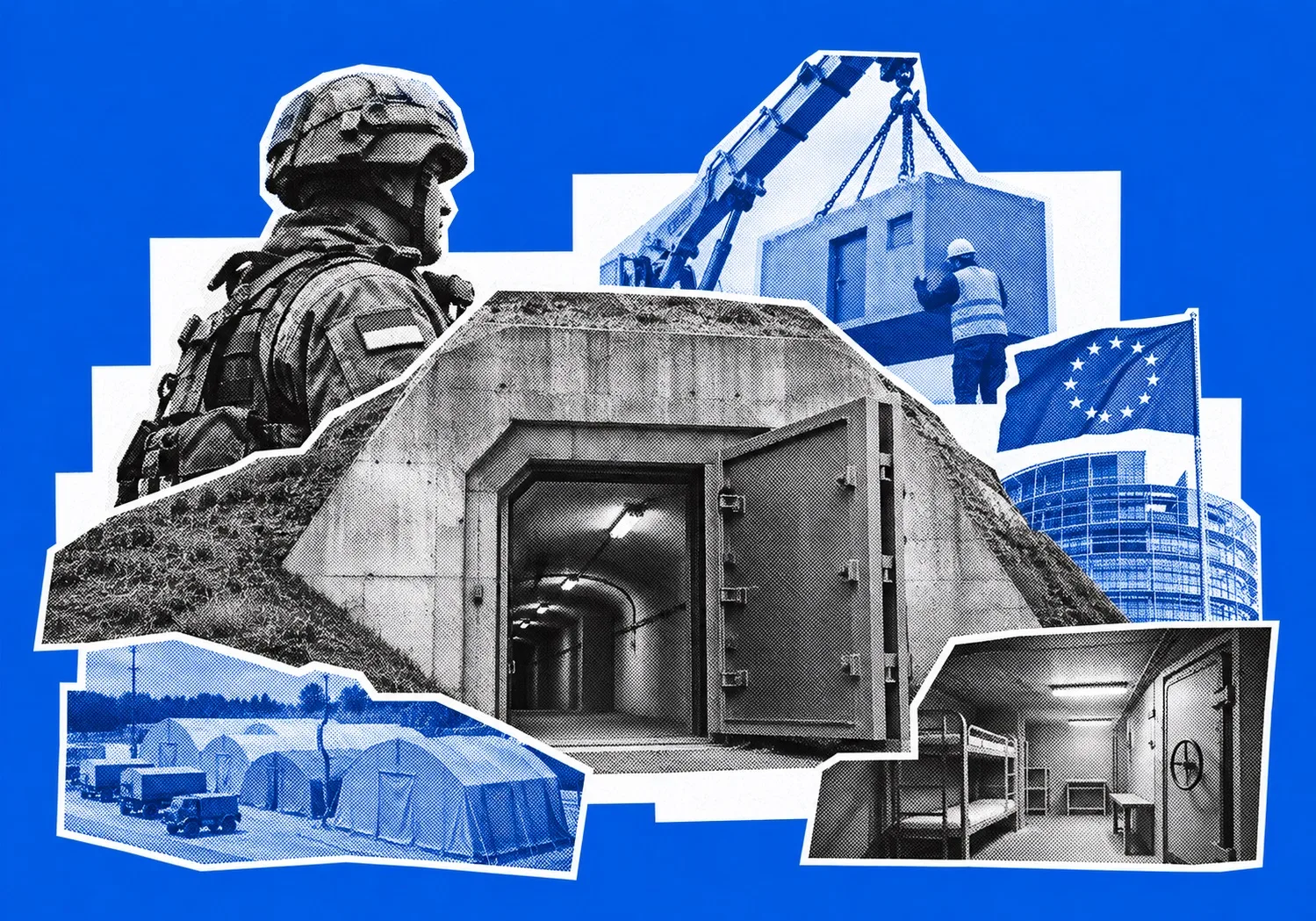
Europe is building military and civilian bomb shelters at a scale not seen since the Cold War. Driven by Russia’s war in Ukraine, governments from Germany to the Baltic States are investing billions into reinforced frontline bunkers, modular military camps, and civil defense protection networks. As military deterrence increasingly relies on permanent physical infrastructure, both public funding and the private shelter market are expanding rapidly across the continent.
The financial commitments are substantial. Estonia has allocated up to €60 million for its section of the Baltic Defence Line, while Latvia plans to spend approximately €303 million over five years. Germany has outlined an even larger programme, with €10 billion envisaged over four years and a further €30 billion over the following decade to expand civilian shelter capacity.
These projects are at different stages of development. Some bunkers have already been installed. Others remain in procurement or planning. But they point towards a change in European security policy: military deterrence is increasingly being supplemented by permanent physical protection.
The Baltic States Are Turning Defence Plans into Concrete
Estonia offers perhaps the clearest example of how the war in Ukraine is influencing infrastructure decisions.
In February 2026, Estonia's State Defence Investment Centre, RKIK, and Latvia's Ministry of Defence launched the Baltic Defence Line initiative. Estonia's procurement plans include 600 modular reinforced concrete bunkers designed to withstand 152mm artillery fire.
The estimated expenditure is roughly €100,000 per bunker, including installation. Around €30 million of Estonia's allocation was earmarked for 2026.

Progress has been incremental. By early 2026, 28 bunker kit elements had been delivered and nine bunkers installed in southeastern Estonia.
The numbers are modest compared with the scale of the planned network. Yet the choice of modular construction is significant. Standardised components can be manufactured, transported and installed across multiple locations without treating every defensive position as a separate engineering project.
For the Baltic governments, the issue is not simply how many fortifications can be built. It is whether construction capacity, procurement systems and military planning can operate together quickly enough to produce a coherent defensive network.
Lithuania's investment illustrates another dimension of the same problem.
German defence manufacturer Rheinmetall secured an initial order from the German military procurement authority, BAIUDBw, for a modular camp in Lithuania capable of accommodating up to 2,000 personnel. The construction contract is valued at €250 million, with annual operating costs of approximately €40 million.
Unlike reinforced frontline bunkers, the camp addresses the requirements of maintaining a substantial military presence. Accommodation, logistics and operational support are essential to keeping forces deployed over extended periods.
That distinction matters. Europe's emerging shelter industry is supplying both the structures intended to withstand attacks and the infrastructure needed to sustain military operations.
Germany Faces a Different Shelter Problem
Germany's proposed expansion concerns civilian protection on a much larger scale.
Its programme envisages approximately one million additional shelter spaces, supported by planned spending of €40 billion across two phases.
The ambition is considerable, although much of the programme remains at an early tender stage. Announced investment should not be confused with completed protection capacity.

Germany also faces a different engineering challenge from the Baltic states. Building defensive positions in designated border areas is one task. Providing shelter for large civilian populations across existing towns and cities is another.
Civilian protection must account for building regulations, local infrastructure and the practical availability of suitable spaces. Underground construction also involves structural and geotechnical requirements that vary according to location.
The European Union has no single, comprehensive bunker law governing these projects. Designers instead work within national permitting systems and established engineering frameworks, including the Eurocodes.
This makes the expansion of civilian shelter capacity as much an administrative challenge as a construction one.
Municipal authorities, engineering contractors and national governments must deal with the practical consequences of programmes whose financial scale is determined at the state level.
The spending also creates long-term obligations. A shelter that exists on paper, or even one that has been constructed, is not necessarily a facility that can be maintained and made available when required.
A Growing Industry with Two Very Different Markets
The commercial figures indicate why manufacturers and construction specialists are paying attention.
Europe's deployable military shelters market was valued at approximately $225 million in 2024. It is projected to reach $318 million by 2030, representing compound annual growth of 5.8%.
Mobile shelters account for roughly 58% of the modular blast shelters segment.
The civilian bomb shelter market is larger, with an estimated value of $483.5 million and a projected increase to $699.5 million by 2030.

Despite their apparent similarities, these are not interchangeable products.
Military modular shelters must meet requirements for transport, deployment and environmental performance. NATO-related specifications, including STANAG 2895 and AECTP-200/300, address operating conditions, while MIL-STD-810 provides testing methods covering vibration, shock, humidity and temperature.
Standardised container dimensions and fittings also support movement by aircraft, road and sea.
For manufacturers, compliance is part of the commercial proposition. A structure that cannot be transported efficiently or perform under demanding conditions has limited military value, regardless of its protective qualities.
Private underground bunkers operate under a different set of constraints. They require site-specific engineering, construction permissions and, where applicable, environmental approvals.
The difference helps explain why the market supports both large defence contractors pursuing government contracts and smaller specialist businesses serving individual customers.
When Civil Protection Becomes a Private Purchase
The private shelter industry has developed a remarkably wide price range.
German provider BSSD Defence, also operating as BSSD Global, offers products ranging from basic shelters and panic rooms starting at around €20,000 to installations costing €200,000. Schutzraum-Zentrum markets private safe rooms from approximately €20,000, excluding local installation expenses.
At the other end of the market, Oppidum develops luxury underground residences priced between $10 million and $100 million.
Vivos, also known as Terra Vivos, has promoted Europa One, a converted former tunnel complex in Rothenstein, Thuringia. The project has been marketed for 34 private families, with unfinished private units starting at €2 million and semi-private spaces from €35,000.

There is an important qualification: independent open-source verification of the project's fully operational and habitable status remains limited. Marketing a protected underground residence is not the same as demonstrating that it is ready for sustained occupation.
These offerings nevertheless expose a growing divide in how Europeans may obtain protection.
For wealthier households, personal security can become a construction purchase. For everyone else, access depends much more heavily on public infrastructure, existing buildings and government preparedness.
Poland illustrates the limitations of the latter approach.
Rather than developing a private bunker market on the scale seen in parts of western Europe, Polish authorities have concentrated on identifying and designating existing shelter locations.
Approximately 85,000 shelter points have been catalogued for a population of 23.7 million people.
That inventory provides a basis for civil protection planning, but the number of designated locations alone cannot establish how many people could be safely accommodated, or what level of protection each site provides.
There is a considerable difference between identifying a basement and constructing a purpose-built blast-resistant shelter.
The distinction becomes particularly important when public preparedness is measured against the growing availability of commercial alternatives.
Defence Spending Is Becoming a Permanent Construction Commitment
For decades after the Cold War, many European countries reduced or neglected parts of their civil defence infrastructure. The assumption that major conventional conflict was unlikely allowed governments to prioritise other spending.
The full-scale escalation of Russia's war against Ukraine in 2022 challenged that approach.

European governments are now directing resources towards infrastructure intended to remain useful during a prolonged security crisis, rather than relying exclusively on forces capable of responding to one.
The beneficiaries include companies such as Rheinmetall, specialist modular manufacturers and engineering contractors. State procurement offers opportunities for repeated production orders, while operating contracts can extend commercial relationships well beyond construction.
The financial burden is less straightforward.
Estonia's €60 million programme and Latvia's €303 million commitment represent substantial expenditure for national defence infrastructure. Germany's planned investment is larger still. All must compete with other public spending priorities, while completed facilities generate maintenance and operational costs.
Manufacturing capacity is another constraint. Standardisation can simplify production, but only if suppliers can deliver components at the required scale and if governments can coordinate installation, transport and procurement.
A similar problem exists in the civilian sector, where construction permits, local conditions and engineering requirements make rapid expansion difficult.
Europe's bunker market is therefore becoming part of a broader industrial question: how to build and sustain physical resilience over many years without treating every project as an emergency purchase.
The most consequential change may be institutional rather than commercial. Military planners, civil protection authorities, municipalities and private property owners are being drawn into responsibilities that were once considered peripheral to everyday European life.
Governments can announce shelter targets and allocate billions to construction. Delivering reliable protection is a different undertaking, requiring decisions about who builds the facilities, who maintains them and who can actually use them.
As Europe's new fortifications move from procurement documents into streets, military installations and private properties, those decisions will determine whether physical security becomes a broadly available public service or an increasingly unequal feature of the continent's built environment.
Sources: Research and Markets, Bunker-ok, Noah News, Rheinmetall, VIVOS