
Russia’s War Economy Faces Critical Labor Shortage as Production Hits Limits, IISS Report Warns

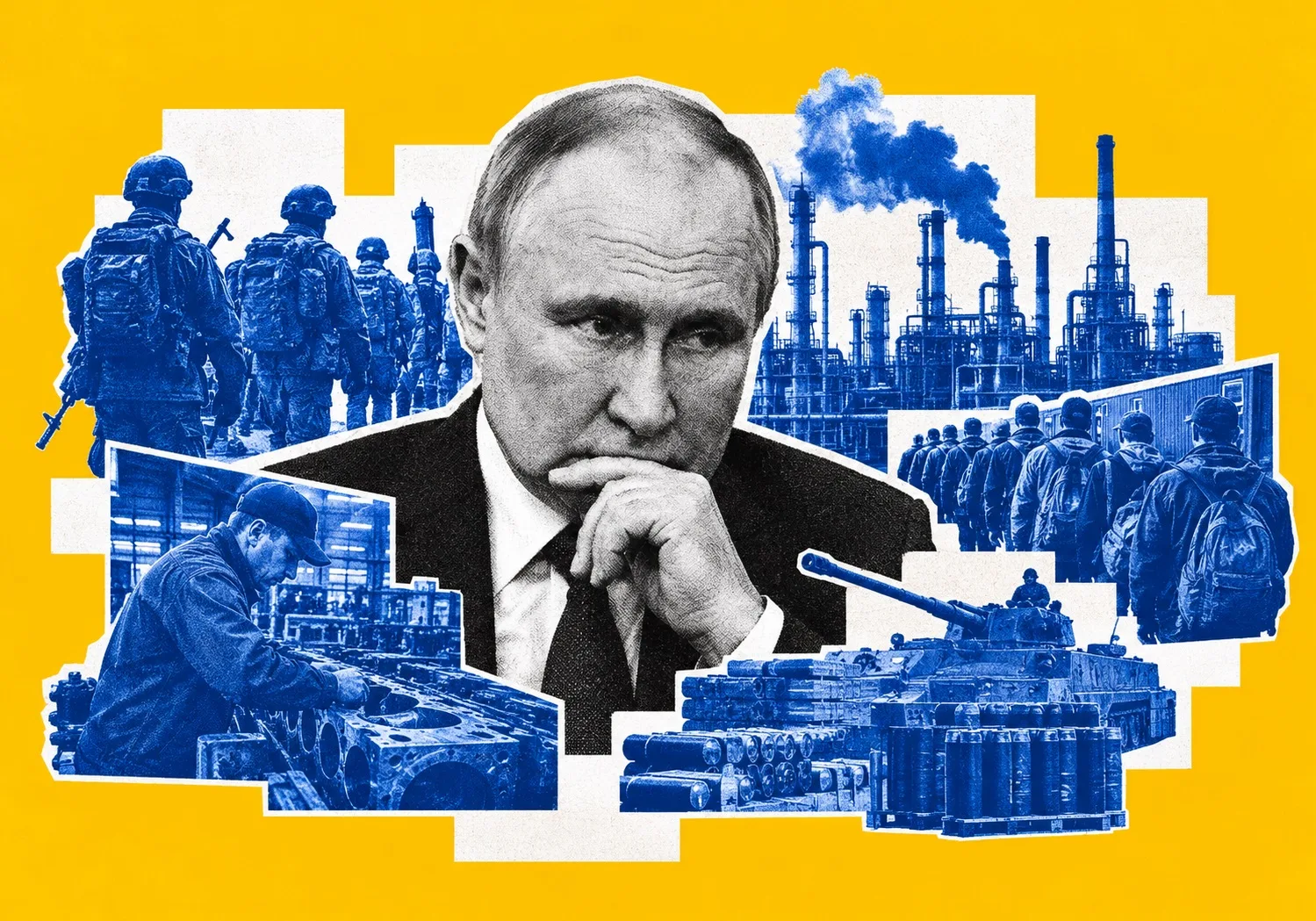
Russia’s war effort in Ukraine is reaching its physical boundaries due to a severe labor shortage and unsustainable recruitment costs, according to a new analysis by the International Institute for Strategic Studies (IISS). As battlefield casualties exceed voluntary enlistment, the Kremlin faces a stark dilemma: scale back its military ambitions or shift to coercive state control over its population and economy.
For European governments, this distinction between financial solvency and physical resources matters. Economic pressure may weaken Russia's ability to fight, but it does not necessarily mean the Kremlin will abandon the war. Moscow could instead respond by replacing financial incentives with coercion, accepting a more restrictive domestic system to preserve its military objectives.
When Military Spending Stops Delivering Results
Russia's wartime economy has proved more adaptable than many expected after the full-scale invasion of Ukraine in 2022. Energy revenues helped finance an enormous expansion in defence expenditure, while government contracts and higher wages encouraged factories to increase output.
That expansion, however, has brought Russia closer to the physical limits of its productive capacity.
A factory operating at full capacity cannot manufacture substantially more equipment merely because the government offers it a larger contract. Additional production requires skilled employees, machinery, components and reliable supply chains. These cannot always be purchased quickly, particularly in an economy affected by sanctions and widespread labour shortages.
The military and defence manufacturers are also competing for many of the same people. Engineers, technicians and industrial workers are needed both to manufacture weapons and to maintain the wider economy. Soldiers recruited into the armed forces are removed from the civilian workforce, while battlefield casualties and emigration further reduce the available labour pool.
Higher wages can persuade employees to change jobs, but they do not create new workers.
This competition has produced what the IISS assessment describes as a deeply distorted dual economy. Defence manufacturers benefit from state spending and preferential treatment, while civilian businesses contend with rising labour costs, inflation, higher interest rates and increased taxation.
Retailers, service providers and other civilian employers cannot necessarily match the salaries offered by military contractors. Meanwhile, expensive borrowing makes investment more difficult for businesses outside the defence sector.
The result is a system in which additional military expenditure can undermine the civilian economic activity on which the state also depends.
The Limits of Russia's Volunteer Army
The manpower problem is becoming equally difficult to manage.
Unlike the Soviet Union's command-based mobilisation system, contemporary Russia has relied heavily on financial incentives to sustain its military campaign. Contract soldiers have been offered substantial salaries and benefits, allowing the Kremlin to recruit personnel without imposing general mobilisation on society.
Politically, this arrangement has been useful. It has enabled Moscow to distribute much of the immediate burden of fighting through a paid recruitment system rather than requiring broad sections of the population to serve.
But the cost of maintaining that arrangement rises as casualties accumulate and the available pool of willing recruits diminishes.
According to the assessment, monthly battlefield losses are now exceeding voluntary recruitment. That imbalance creates a problem which higher enlistment payments alone may struggle to resolve.
Increasing bonuses can attract additional recruits, but it also raises the cost of replacing losses. Moreover, recruits drawn from civilian employment leave vacancies elsewhere, including in industries supporting military production.
The Kremlin is therefore competing against itself for manpower.
A soldier sent to the front may previously have been a factory employee, transport worker or technician. Replacing that person in the civilian economy becomes more expensive as employers compete for an increasingly scarce workforce.
This distinguishes Russia's current predicament from a conventional budgetary crisis. Even if Moscow can finance additional contracts, there may not be enough willing personnel to fill them without seriously damaging other economic activities.
From Financial Incentives to State Control
The Soviet economy relied on centralised allocation of labour and resources. Contemporary Russia has retained substantial market mechanisms, even as state intervention and military expenditure have expanded.
That distinction has allowed businesses and households to respond to wartime conditions through wages, prices and employment decisions. It has also imposed constraints on the Kremlin's ability to direct resources towards the armed forces.
If voluntary recruitment and market-based industrial expansion can no longer meet military requirements, those constraints become politically inconvenient.
Gould-Davies' assessment points towards a possible transition to more coercive forms of mobilisation. Labour conscription, restrictions on movement and compulsory redirection of workers towards priority industries could give the government greater control over scarce resources.
Price controls and tighter administrative management of production could accompany such measures.
Yet coercion would not automatically resolve Russia's industrial weaknesses. Directing employees into defence factories does not create additional skilled labour, and compulsory production targets cannot eliminate shortages of machinery or imported components.
The attraction of a command-oriented system lies elsewhere: it allows the state to decide who bears the costs.
Under the existing arrangement, businesses compete for labour and workers retain some freedom to choose between employers. A more coercive system would allow the government to override those choices in favour of military priorities.
Civilian production could contract further, with households and businesses absorbing the consequences of a state increasingly organised around sustaining the war.
Such a transition would represent more than another increase in defence expenditure. It would involve dismantling parts of the post-Soviet economic settlement that have survived even under Russia's increasingly authoritarian political system.
The Infrastructure of a More Coercive State
Moscow is already developing mechanisms that could make a more controlled mobilisation system easier to operate.
Electronic military registration provides the authorities with greater capacity to identify and track potential recruits. Digital systems can also support more targeted enforcement, reducing the need for a single, highly visible mobilisation campaign.
The distinction is politically important.
A sweeping mobilisation order would make the demands of the war immediately apparent to a broad section of Russian society. More selective measures could distribute those demands over time, drawing on particular groups or redirecting workers towards designated sectors.
The Kremlin's tightening control over internet communications and its monitoring of political elites fit into the same wider pattern of preparation.
Greater control over information can make opposition to mobilisation harder to organise. Closer oversight of elites can reduce opportunities for resistance within the governing system itself.
None of these measures proves that a comprehensive compulsory mobilisation programme is inevitable. They do, however, expand the government's options if financial incentives cease to deliver enough soldiers and industrial workers.
The security apparatus would gain influence under such an arrangement. Agencies responsible for enforcing restrictions, supervising mobilisation and monitoring compliance would acquire greater authority over both society and economic activity.
For ordinary Russians, the consequences could extend well beyond military service. Employment choices, travel and access to economic opportunities could become increasingly subject to state direction.
Why China, Iran and North Korea Cannot Solve the Shortage
Russia's external partnerships have helped it withstand some of the restrictions imposed by Western sanctions.
China supplies dual-use technologies and microelectronics, while Iranian expertise and components support drone production. North Korea has provided artillery ammunition and auxiliary military personnel.
These relationships give Moscow access to resources that would otherwise be more difficult to obtain. They also provide its partners with greater leverage as Russian dependence grows.
But imported components cannot fully compensate for shortages of domestic industrial capacity. Nor can foreign military assistance replace the broader workforce needed to sustain Russia's economy.
There is a difference between supplying ammunition and maintaining the industrial, logistical and human infrastructure required for a prolonged war.
China, Iran and North Korea can ease specific bottlenecks. They cannot remove the underlying competition between Russia's armed forces, defence manufacturers and civilian employers.
Continued dependence on these suppliers also complicates Moscow's strategic position. Partners capable of providing difficult-to-replace goods and services acquire bargaining power, particularly when Russia has fewer alternatives.
Europe's Problem Is Not Simply Russian Exhaustion
For Ukraine and its European partners, the IISS assessment presents a difficult strategic question.
Russia's economic and manpower constraints may limit its capacity to expand military operations. Yet those same constraints could encourage the Kremlin to impose harsher domestic measures rather than reconsider its objectives.
A more coercive mobilisation system might sustain Russian military activity despite worsening conditions in the civilian economy. It could also leave Europe confronting a state in which military requirements dominate industrial policy, labour allocation and political governance.
Such a Russia would not necessarily become more economically efficient. Indeed, forcing resources into military production could deepen existing distortions. But the government might be willing to tolerate considerable civilian hardship if doing so preserved its ability to fight.
That possibility has implications for European defence planning. Expectations of Russian economic exhaustion cannot substitute for sustained support to Ukraine or for the industrial capacity required to maintain European security.
Nor would an eventual reduction in Russia's military operations necessarily reverse the domestic changes introduced to sustain them.
Once electronic monitoring, compulsory labour allocation and expanded security powers become embedded in state institutions, the authorities may have little incentive to surrender them.
The Kremlin's immediate problem is how to obtain enough soldiers and industrial workers to continue the war. Its larger decision concerns how much of Russia's remaining economic freedom it is prepared to sacrifice in pursuit of that objective.
Sources: IISS, The Moscow Times, CNN, CBC, Belfer Center