
Russia’s Grey Zone: How Lukashenko Traded Belarusian Identity to the Kremlin

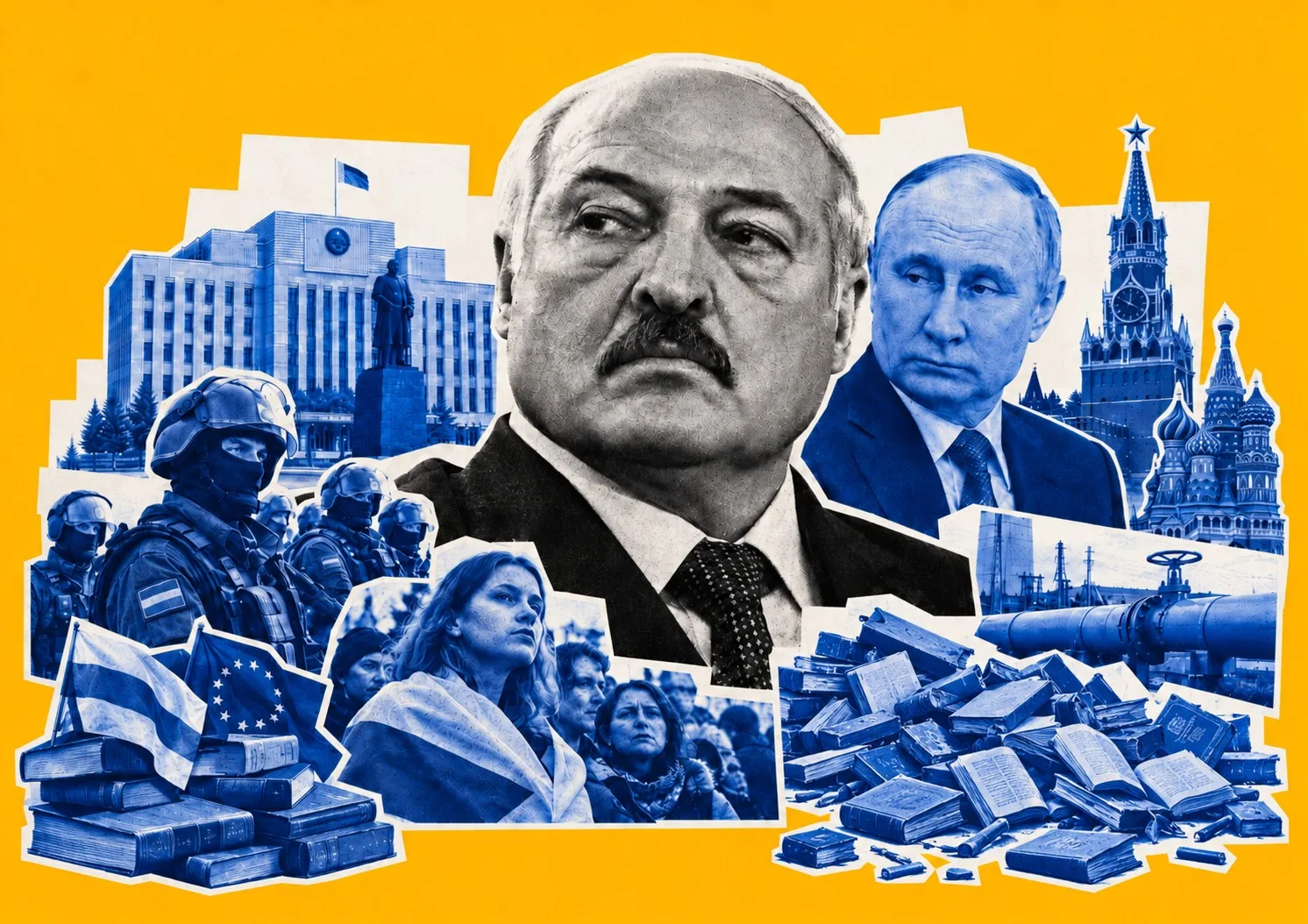
Alexander Lukashenko spent three decades surviving by playing Moscow off against the West, keeping a wary distance from Vladimir Putin’s grand plans for integration. Today, that balancing act is dead. To secure his bunker against a restive population, Belarus’s aging dictator is paying the Kremlin in the hard currency that matters most:national identity and sovereignty. From the sudden shuttering of folk-art boutiques in Minsk to history textbooks rewritten to glorify the war in Ukraine, a silent annexation is unfolding across Europe’s eastern fringe—one that is systematically scrubbing the Belarusian language, culture, and sovereignty off the map.
Look closely at the quiet residential courtyards of Minsk, or step into the sleepy provincial hubs scattered across the country, and you will see a subtle, devastating border shift underway.
Over a single week in July, iconic boutiques specializing in Belarusian-language literature, traditional embroidered clothing, and local heritage crafts suddenly closed their doors.
Within forty-eight hours, empty shelves stood behind locked glass, signs came down, and long-planned regional music festivals simply evaporated from community calendars.
When Adelia—a local resident who used a pseudonym to shield herself from police retaliation—learned that Honar, a well-known Minsk boutique offering contemporary clothes with traditional red-and-white cross-stitch motifs, was shutting down forever, she knew the hammer had finally fallen on her community. She rushed through the doors alongside dozens of quietly defiant neighbours attempting to buy whatever remained on the racks.
"Honar is a shop for brave people," she remarked later, her voice carrying the quiet exhaustion of her peers. "Wearing clothes with national motifs in Belarus requires courage."
For Lukashenko, these purges are no ordinary administrative sweep.
They represent the final, irreversible stage of a quiet structural annexation.
He is dismantling his own country's cultural identity to pay for personal regime survival, turning a historically resilient buffer state into a satellite zone before Western foreign ministries even figure out what went missing.
Purging the Heritage
The apparatus driving this campaign works with cold, administrative regularity.
Ever since the stolen presidential election of August 2020—when Lukashenko claimed a farcical 80.1% victory and met the largest mass demonstrations in modern Belarusian history—his regime has clung to power through raw police terror.

Security forces tortured protesters, crammed overcrowded detention cells, and chased hundreds of thousands of educated citizens across international borders. Independent researchers, writers, and journalists fled in droves.
Viasna, the exiled human rights group that tracks political prosecutions from abroad, estimates that authorities have jailed over 4,500 citizens on political charges over the last six years. By August, 2026 at least 879 confirmed political prisoners were still languishing in harsh penal colonies.
Among them were 125 people convicted purely for walking in peaceful rallies, and another 159 locked away for the vague crime of "insulting the President."
Look deeper into those arrest logs, however, and a calculated pattern emerges.
The state is no longer satisfied with neutralizing street opposition; it is systematically tearing down the structural foundations of Belarusian historical memory.
The Belarusian Council for Culture reports that at least 81 artists, authors, performers, and museum specialists currently sit behind bars, under house arrest, or assigned to hard labour. State prosecutors routinely slap "extremist" labels on independent book publishers, literary translators, and small antique dealers before hauling them into court. In state theatres, directors quietly dropped native-language plays, hiring imported Russian directors and cast members to fill the silence. Regional museum staff received strict orders to redesign their main galleries, reframing regional history to emphasize eternal devotion to Moscow.
"The significance of these places was huge," says Hanna Liubakova, an exiled Belarusian journalist who watched her country's cultural infrastructure crumble from afar. "Not just because this was a nice hoodie or a great book, but because it’s the kind of place where you could see people who think in a similar way."
For ordinary people living under this crackdown, finding any safe public outlet for national expression feels nearly impossible.
Displaying the historic white-red-white flag—a national symbol dating back to the short-lived 1918 republic and revived during the 2020 uprisings—brings brutal prison terms and ruinous fines.
Now, even speaking the native tongue in public marks someone as a potential submissive or saboteur. Human rights investigators tracking daily police activity note that "use of native language has become a tool of pressure and repression, and speaking Belarusian even on everyday topics can draw attention from the security forces." Step inside a police precinct or an interrogation room, and officers flatly refuse to process documents written in Belarusian. They demand citizens speak Russian instead, casually noting that "those being questioned do not understand him and ask him to speak Russian."
 ## The Kremlin's Price
You cannot separate this cultural assault from the brutal geopolitical deal Lukashenko struck to stay in power.
Back in February 2022, he opened his borders to Russian military divisions, allowing Kremlin commanders to launch armored columns and missile strikes against Kyiv directly from Belarusian soil. In doing so, he burned his last diplomatic bridges with the West.
Sanctions from the European Union swiftly cut off Belarusian state factories from Western supply lines and financial markets, leaving the economy gasping for air. To keep his regime afloat, Lukashenko offered up his country's economic independence in exchange for Kremlin subsidies, cheap energy, and military guarantees.
The sheer speed of this economic absorption is staggering.
Economists working in exile, including Dzmitry Kruk, tracked a massive shift in trade patterns following the 2022 invasion. Within twenty-four months, the share of Belarusian exports going to Russian buyers jumped from 40% to an extraordinary 60%.
Under the legal umbrella of the Russia-Belarus "Union State" treaty, Kremlin officials effectively folded Belarusian manufacturing, agricultural networks, and transport links directly into their own domestic economy.
Vladimir Putin, however, does not grant financial lifelines out of generosity.
The Kremlin expects absolute ideological submission in return.
Taciana Niadbaj, who directs the banned in Belarus literary organization PEN from exile, points out that the regime is methodically erasing independent civic institutions, swapping them out for a new cultural framework "that is politically loyal and increasingly integrated into Russia’s." This is no longer a temporary arrangement between two calculating dictators. It is a complete institutional surrender. When an autocrat faces total domestic rejection, he cannot afford to tolerate a unique, independent national identity within his borders. To keep his seat, he must embrace the imperial mythology of his benefactor.
Capturing the Classroom
This top-down Russification did not appear out of nowhere; it builds on decades of quiet institutional decay.
You can trace this decline most clearly through the national school system.
When Lukashenko first took office back in 1994, roughly 40% of all primary and secondary school pupils in Belarus studied primarily in the native Belarusian language. Fast forward to 2024, after thirty years of deliberate neglect, and that number has crashed to less than 9%.
What started as slow institutional neglect has now morphed into an aggressive, top-down rewrite of school education.
Researchers at iSANS, a Warsaw-based research center tracking regional authoritarianism, conducted a detailed text analysis of secondary school history books introduced for the 2024–2025 academic year. What they found was a total overhaul of modern historical memory.
Look at a history textbook printed in 2021 for 16- and 17-year-old high school students.
That edition managed to present a relatively balanced, if cautious, view of post-Soviet developments. It acknowledged that post-1991 Russia faced deep internal crises, specifically pointing to "the monopolization of several resource sectors and the energy system, the deterioration of capital assets, insufficient adoption of new technologies, widespread corruption within the state apparatus and organized crime in the economic sphere."
Pick up the new textbook printed for those same classrooms in 2025, and every single word criticizing Russian corruption, economic stagnation, or institutional failure has vanished.
Instead, students read paragraphs of pure praise for Vladimir Putin’s political regime.
For the very first time, the official school curriculum adopts Kremlin military propaganda about the war in Ukraine.
The textbook tells teenagers that on February 24, 2022, Russia embarked on a "Special Military Operation (SMO) in Ukraine" aimed at protecting vulnerable local populations, "denazification and demilitarization."

The authors lay the blame for the conflict entirely on Western capitals, asserting that "Western states deliberately thwarted a diplomatic resolution to the conflict, nullifying the peacekeeping efforts of Russia, Belarus, the countries of the 'Global South', and other entities interested in peace in Ukraine."
Even more strikingly, the 2025 textbook rewrites the painful memory of the 2020 street protests.
While the 2021 edition simply stated that Lukashenko won reelection with 80.1% of the vote without mentioning the demonstrations, the new text brings up the uprising only to frame it as a foreign military conspiracy. Students are instructed that "the uprising was not successful" and that as "protest activity was gradually pushed outside the borders of the Republic of Belarus... Western countries began to exert political and economic pressure on our country."
Under these hostile conditions, the book explains, Minsk had no choice but to "strengthen integration with the Russian Federation within the framework of the treaty on the creation of the Union State."
Uniforms in Kindergarten
This indoctrination effort spreads far beyond high school history classrooms.
Analysts reviewing state broadcasts and educational bulletins have highlighted a sweeping drive to set up "military-patriotic clubs" across technical colleges, vocational schools, and primary institutions.
The Ministry of Education wants one of these clubs in every single technical college in the country.
Run in close partnership with state police units and Russian youth organizations, these programs teach kids to view military service through a pro-Kremlin lens. State holidays have been reshuffled to match this new reality.
The April 2 "National Day of Unity"—once a sleepy administrative anniversary marking early integration talks—has turned into a major event in the school calendar. Even kindergarten teachers are now required to run events "dedicated to the friendship between our two brotherly countries."

This push to militarize young children frightens human rights advocates and exiled leaders who survived the regime's prisons.
Maria Kalesnikava, a key opposition figure from the 2020 protests who spent years in solitary confinement before her recent release, recalled watching state television from her prison cell and seeing toddlers marching in miniature military fatigues. "The future of Belarus depends to a large extent on whether young Belarusians understand their own country as an independent state with its own history and culture," Kalesnikava warned, "or through the prism of the Soviet past and Russian historical interpretations."
Underground Survival
Western diplomatic efforts to counter this trajectory have proven limited and increasingly transactional.
While the European Union keeps its economic sanctions on state factories and regime cronies in place, Washington has experimented with direct release deals. American envoys negotiated the release and deportation of around 500 political prisoners over the past year in exchange for targeted sanctions relief.
Yet these releases have done nothing to slow down the regime's domestic machine.
Even as diplomats negotiated releases behind closed doors, police launched fresh raids against cultural figures at home.
In April, right after three separate rounds of prisoner releases, security agents stormed a prominent Minsk architectural firm celebrated for promoting modern Belarusian design, detaining 52 employees in a single sweep.
Regime ideologues talk openly about their goal.
Vadim Gigin, a member of parliament who runs the National Library, went on state television to issue a direct warning to anyone trying to keep local heritage alive.
"All these attempts to sell T-shirts, all these half-hints… we see all of it," he declared sneeringly. "We’ll sweep away all this nationalist contagion with a dirty broom."
Faced with this total crackdown, resistance has retreated into dark corners and private homes.
In hidden storage rooms and damp basements across Minsk, small acts of defiance quietly continue. A few weeks after Honar closed down, Adelia tracked down a box of banned Belarusian-language books stashed in a shop basement. She bought the whole batch on the spot, telling the owner it was a win-win: "I’d save the books, and they wouldn’t get in trouble."
She has since quietly passed those volumes to trusted friends, sending the money to relief funds for families of political prisoners.
As state offices, classrooms, and public stages are systematically retrofitted to serve a foreign imperial narrative, the core question facing Belarus grows starker by the day. It is no longer just a question of who holds power in Minsk, but whether a nation's culture can survive when its own government works tirelessly to erase it.
Sources: The Economist, New Eurasian Strategies Centre, VA