
Romanian F-16s Shoot Down Drones Over Black Sea Following Wave of Ship Attacks

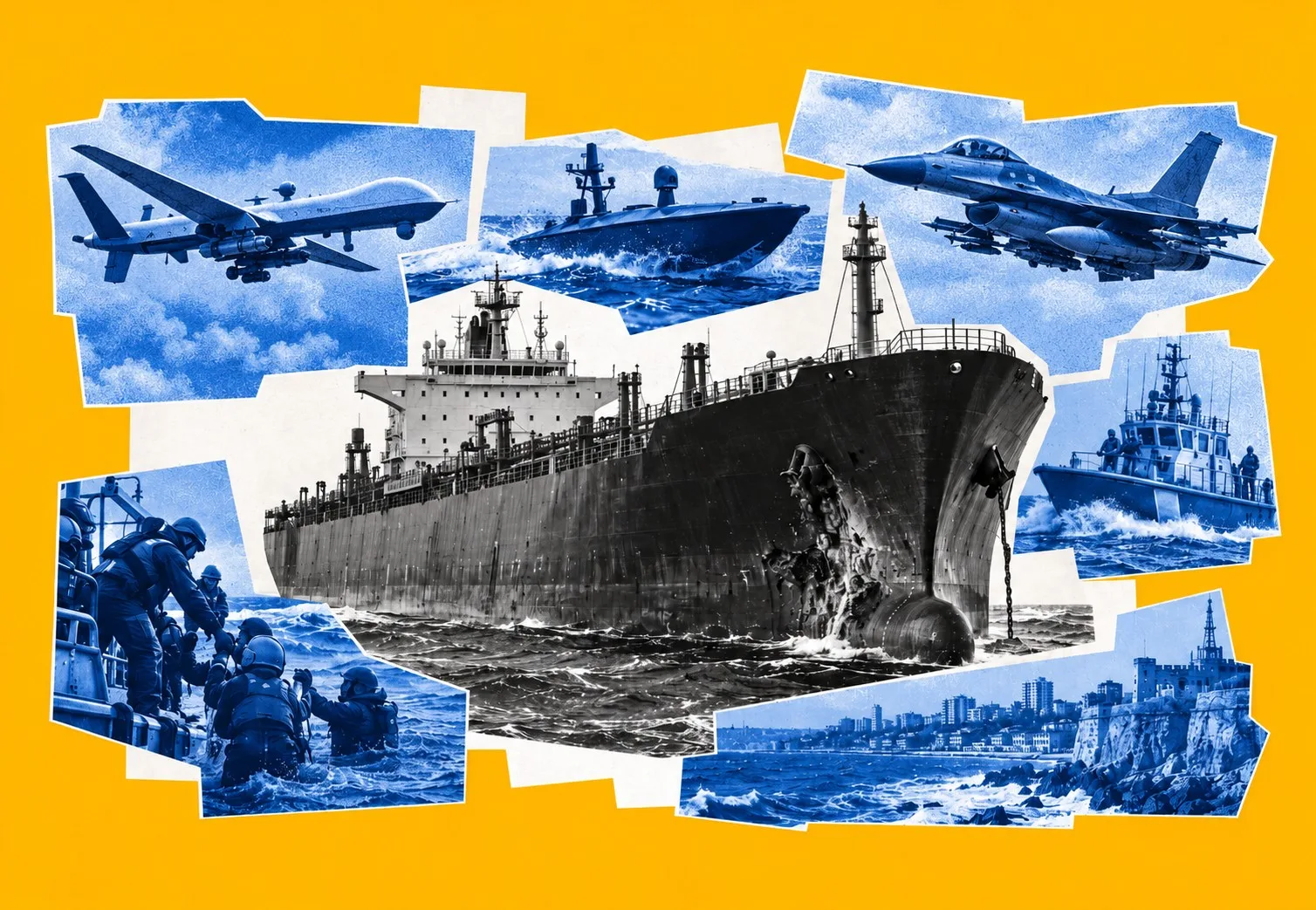
Two Romanian F-16 fighter jets scrambled from the 86th Borcea Air Base shot down two drones near the port of Sulina on Saturday, 17 October. The military interception over Romanian territorial waters occurred after radar systems tracked targets originating near Ukraine’s Snake Island.
This direct kinetic engagement by an allied air force occurred after a ten-day series of air and naval drone strikes hit seven commercial vessels in the Black Sea. Those attacks left over 25 seafarers dead or missing. The drone campaign has now expanded into the exclusive economic zones of NATO members Romania and Bulgaria.
Ten Days of Chaos at Sea
Within ten days, the western Black Sea became an active military theater for commercial shipping.
Between 6 and 16 October, seven merchant vessels—grain bulkers, chemical carriers, and general cargo ships—sustained direct missile or drone impacts. Crucially, these explosions were not confined to Ukrainian ports.
They spilled directly into the Exclusive Economic Zones and territorial seas of Romania and Bulgaria.
Hull destruction and crew casualties across the region have accumulated at a pace unseen in regional navigation since February 2022, exposing acute security gaps along NATO’s southeastern maritime frontier.

The logbooks outline a precise chronology of disaster.
At 04:00 on 6 October, crew members aboard the Bulgarian ferry Dioscuria recorded a heavy explosion 70 nautical miles off Byala. Reaching the scene, they found the Turkish-owned cargo ship Alfa Watan—laden with corn for Sulina—burning and listing after simultaneous air and sea drone strikes.

The Dioscuria spotted an overturned lifeboat and floating lifejackets, but none of the ten crew members. Rescuers later recovered two bodies, while 11 sailors disappeared as the ship went down.
Subsequent strikes followed in rapid succession.
Early in the month, a Togo-flagged bulker sank inside the Bulgarian EEZ after a drone impact, leaving 12 sailors missing.
Shortly after, the Dioscuria evacuated 18 crew members from a damaged Palau-flagged vessel.
Off Bulgaria on Tuesday, three aerial drones struck the deck and hull of the Ukrainian-operated, Maltese-flagged Chelsea 3, though all 15 crew members survived.
That same day, an attack on the Guinea-Bissau-flagged HS Dignity killed 11 seafarers.
On Wednesday, a drone strike ignited the Comoros-flagged tanker Yara J on its passage from Turkey to Romania.
By Thursday, the San Marino-flagged tanker Wine Trader was hit inside Romanian territorial waters—five sailors were pulled from the burning hull, while seven disappeared into the sea.

October's campaign alone accounts for two confirmed dead and between 25 and 27 missing at sea.
These recent casualties push total seafarer deaths in the Black Sea past 60 since February 2022, with a heavy concentration recorded over the past year.
"Commercial ships – and innocent crews – are being targeted, with lives already lost at sea," noted European Commission President Ursula von der Leyen following the loss of the Alfa Watan.
The Mechanics of Asymmetric Maritime Warfare
The strategic motive behind these operations is clear: restricting Ukraine’s agricultural export capacity.
Following Ukrainian maritime strikes against Russia’s shadow tanker fleet in the eastern basin, Russian tactics against commercial vessels adapted.
As merchant captains shifted routes closer to NATO coastlines for physical protection, attack patterns evolved.
Fixed naval mines were largely superseded by long-range aerial drones and uncrewed surface vessels carrying explosive charges up to half a tonne.
Smaller merchant ships operating near the Danube canal system are especially vulnerable to these heavy surface craft and aerial swarms, as severe structural damage frequently causes smaller hulls to founder within minutes upon impact.
Tomas Alexa, a senior analyst at maritime risk firm Ambrey, tracked a sharp rise in attack frequency starting in July, attributing 80 percent of all strikes to Russian assets. "
While attacks against merchant vessels in the Black Sea are not new, we are seeing an escalation both in terms of the number of attacks and in the geographical scope," Alexa observed. On vessel selection, he emphasized that "the Russian intent is clear, which is to degrade the export of Ukrainian grain and agricultural products."

\### Soaring Insurance and Choked Shipping
Financial panic spread quickly through global shipping networks.
In September, the Joint War Committee representing the London insurance market remapped the region, extending its designated high-risk area across the entire Black Sea basin—sparing only the narrow territorial strips of Turkey, Romania, Bulgaria, and Georgia. Port calls to Ukrainian harbors dropped precipitously as crew members and shipping lines refused passage, even on vessels carrying non-Ukrainian cargoes.
Agricolumn founder Cezar Gheorghe noted that while daily operations at the port of Constanta continue, war-risk surcharges impose heavy costs on every voyage. "The premium for the risk is increasing," Gheorghe explained, adding that "everyone that wants to come to Constanta, let’s say from Turkey, from the Bosphorus Strait and across that area, will have a premium on insurance costs." Gheorghe stressed that the primary fear among operators remains a direct incident near Constanta itself—a concern heightened by a Ukrainian maritime drone that exploded nearby in June alongside three others.
"It’s a matter of time," he warned.
A clear operational chain has formed: strikes on Russia's shadow fleet trigger retaliatory drone attacks on grain carriers inside NATO exclusive economic zones, forcing kinetic interceptions by fighter jets, driving up insurance premiums, and raising complex questions about Article 5.
Collective Defence in the Gray Zone
Romania’s F-16 interception brings NATO’s operational dilemmas into sharp relief.
Article 5 of the North Atlantic Treaty guarantees collective defense in the event of an armed attack on an alliance member, but its legal standing inside Exclusive Economic Zones remains subject to intense debate.
EEZs grant sovereign rights over marine resources—fish, oil, seabed minerals—rather than full territorial sovereignty over the waters themselves. This creates a difficult legal distinction when foreign-flagged civilian vessels are attacked beyond the 12-nautical-mile territorial sea.
The Limits of Official Attribution
Political leaders across the region have approached these legal boundaries with caution.
In Brussels, Romanian President Nicusor Dan confirmed that two drones had struck vessels within national waters and warned of a state response, though he stopped short of an immediate formal attribution.
In Sofia, Bulgarian Prime Minister Rumen Radev told parliament that "there is no logic in Ukraine attacking its own ships and crews, given that the outcome of all these attacks favors Russia — and indeed, the logic points in that direction."
Yet Radev acknowledged the strict technical criteria required for legal proof: "the problem is that we cannot prove it."
Moscow, for its part, maintains an official stance of formal denial.
When questioned by local authorities regarding the strikes off Bulgaria, Russia's ambassador in Sofia claimed she "didn't have any information from the Russian defense ministry" regarding drone operations against merchant ships.
Testing Article 5 in International Waters
Alliance leadership and international organizations have been forced to update their posture.
NATO Secretary-General Mark Rutte held discussions with Radev and Dan on maritime security, confirming publicly that "NATO has strengthened our posture along the eastern flank including with increasing counter-drone capabilities" and that the alliance will continue "adjusting our deterrence and defense posture as needed."
On the legal side, Colonel Joby Rimmer, a senior British military adviser speaking at the OSCE, pointed to fundamental international law: "attacks that fail to distinguish between military objectives and civilian vessels, or that are expected to cause excessive incidental harm to civilians and civilian vessels in relation to the anticipated military advantage, may violate international humanitarian law and the UN convention on the law of the sea."
Military analysts urge stronger action.
"Tens of incidents are happening and Russia is getting closer to NATO borders," observed Romanian defense expert Radu Tudor. "Words are not enough. It’s a matter of discussion whether the exclusive economic zone is included in the Article 5-type reaction or not."
Naval forces face severe practical limitations, even with existing mechanisms like the Black Sea Mine Countermeasures Task Force, established by Romania, Bulgaria, and Turkey, and expanded in July to cover critical seabed infrastructure.
Most Romanian military vessels lack integrated short-range air defense systems necessary to guard commercial convoys against incoming drone swarms.
Establishing naval escorts also creates immense legal and financial complications.
As one defense sector insider put it: "Why would Romania and Turkey escort a ship from Bermuda with, I don’t know, an Argentinian owner just to transport a few hundred tons of grains from Egypt? It’s difficult."
The emergence of uncrewed platforms has permanently transformed the Black Sea security environment. Inexpensive, asymmetric weapons systems have demonstrated that they can effectively blockade semi-enclosed seas and disrupt freedom of navigation without requiring the deployment of major surface warships.
Strategic Consequences and $40bn Pivot
The strategic impacts ripple across every actor in the region.
Moscow secures tactical leverage by choking Ukrainian grain revenue and testing NATO’s air defense perimeter, all while remaining just below the threshold of direct military conflict with the alliance. Defense procurement is responding as governments reallocate budgets toward specialized counter-drone hardware, with Bulgarian Defense Minister Dimitar Stoyanov confirming Sofia's intention to join NATO’s Drone Edge project—a major initiative launched in July aimed at directing over $40 billion into advanced counter-drone capabilities over five years.
On the economic front, Ukraine suffers elevated shipping costs and restricted port access, driving its export economy toward overland and river transit routes, while commercial fleets face ongoing physical danger and steep insurance costs.
A source in Romania's defense sector pointed out that the strikes are engineered primarily to damage Ukraine economically: "Romania is not the target right now. All summer we’ve been hunting all kinds of drone debris, water drones, sea drones, air drones, debris in the water, on the beaches. If this continues, someone should do something about that."
Coastal states are increasingly adapting their military postures toward active air defense.
Romania’s previous deployment of F-16 fighters in August to destroy an explosive-laden naval drone near an offshore gas rig reflected a clear commitment to safeguard national energy assets. Yet as long as uncrewed strikes in international waters yield maximum economic disruption at minimal political cost, the legal gray zones of the Black Sea will remain among Europe’s most dangerous security flashpoints.
Sources: Euronews,The Guardian, ABC News, DW