
Red Line in the Black Sea: Romania Shoots Down Russian Drones, Summons Ambassador

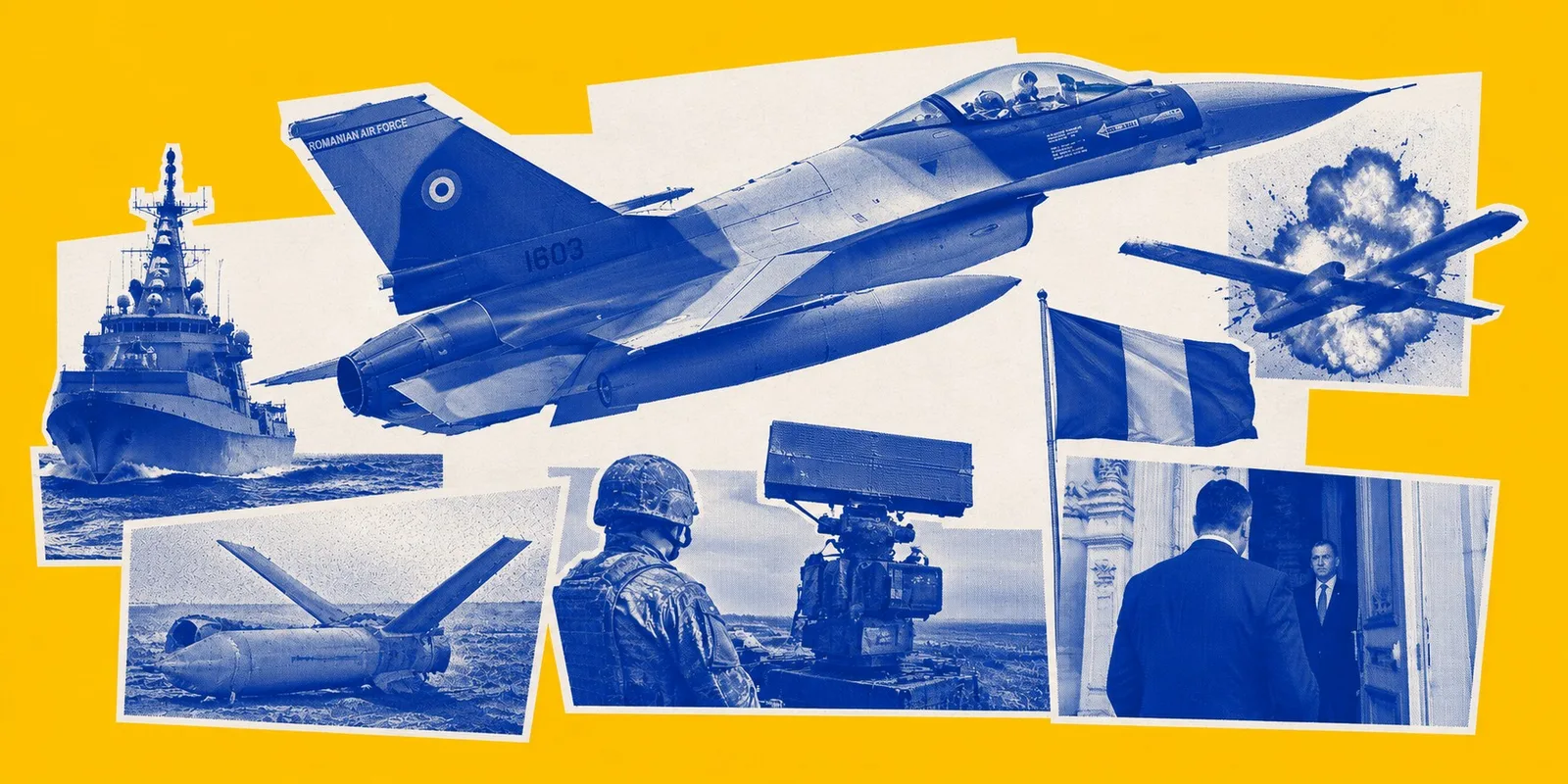
Tensions along NATO’s eastern flank reached a sharp escalation after Romanian military forces shot down three unmanned aerial vehicles (UAVs) in as many days. In response to the repeated intrusions into sovereign airspace, the Romanian Ministry of Foreign Affairs announced it was summoning Russia’s ambassador to Bucharest to lodge a formal diplomatic protest.
Three Days of Interceptions in the Danube Delta
Еhe military engagements began on Friday, July 24, 2026, when a Romanian F-16 Fighting Falcon intercepted and destroyed an unidentified drone flying deep over an unpopulated region near the Ukrainian border. Forensic analysis conducted by the Romanian Prosecutor General’s Office quickly identified the fragments as belonging to an Iranian-designed Shahed-type attack drone, a loitering munition routinely deployed by Russian forces against Ukrainian civil and port infrastructure.
A second interception occurred early Saturday, July 25, when the same Romanian pilot intercepted another low-flying target approximately 10 kilometers west of Sfântu Gheorghe.

The sequence culminated on Sunday morning, July 26, at approximately 10:13 a.m. local time, when an F-16 shot down a third drone over territorial waters roughly 12 kilometers northeast of the Black Sea port of Sulina, near the mouth of the Danube River.
The incidents mark a significant operational shift for the Black Sea nation, which shares a 650-kilometer (400-mile) border with Ukraine. While Romania has recorded over 30 airspace breaches since Moscow launched its full-scale invasion of Ukraine in February 2022, this three-day span represents the first time Romanian fighter jets have actively engaged and destroyed target drones inside or immediately approaching its territory.
Romanian President Nicușor Dan praised the aircrews and ground teams for their swift response, emphasizing that the military took decisive action to guarantee public safety."It is inadmissible and intolerable for the Russian Federation to continue violating Romania’s airspace, which is simultaneously NATO and European Union airspace," President Dan stated.
Romanian Foreign Minister Oana Țoiu confirmed that Russian Ambassador Valery Kuzmin was summoned to the Foreign Ministry in Bucharest to receive an official condemnation of Moscow's actions.
Meanwhile, Defense Minister Radu Miruță stressed that while Romania does not seek regional escalation, "these provocations must stop, and Romania will continue to firmly defend its sovereignty."
Shift in Engagement Rules and Air Defense Upgrades
For over two years, Romanian authorities faced domestic and international scrutiny for maintaining a conservative posture during drone incursions, often tracking stray Russian munitions via radar without firing due to legal ambiguities and risks of civilian fallout on the ground.The dynamic shifted significantly after Romania’s parliament enacted a specialized air defense framework allowing the military to neutralize unauthorized unmanned systems breaching sovereign airspace. Furthermore, Bucharest recently integrated advanced counter-drone technologies into its border defenses—including the Merops system, an AI-driven mobile interceptor optimized for low-altitude radar targets. The heightened frequency of Russian strikes targeting Ukrainian grain export hubs—such as Reni, Izmail, and Kiliya along the Danube River—has made the border zone increasingly volatile, with munitions routinely falling near Romanian villages.

Moscow’s Reaction: Denial, Deflection, and Counter-Accusations
Official responses from Moscow followed a well-established diplomatic pattern of denial, shifting blame toward Kyiv, and accusing NATO of escalating regional tensions.
Following the formal summoning of Russian Ambassador Valery Kuzmin to the Ministry of Foreign Affairs in Bucharest, the Russian Embassy in Romania issued a statement claiming lack of forensic proof connecting debris directly to active Russian mission and dismissing the allegations as "unfounded anti-Russian rhetoric". Moscow asserted that Russian forces operate strictly within the geographic scope of their military campaign against Ukrainian port infrastructure along the Danube and Black Sea.
Russian Foreign Ministry Spokeswoman Maria Zakharova rejects allegations and accuses NATO and EU of "politicizing air safety."
Kremlin officials argued that the fragmented debris collected by Romanian forensic teams could not be conclusively attributed to active Russian operations without a joint technical audit.
Russian state media and diplomatic representatives claimed that stray or electronic-warfare-jammed Ukrainian air defense interceptors and drones were responsible for cross-border incidents, describing the situation as a "staged provocation" by Kyiv to force NATO's direct involvement in the conflict.
Despite Moscow's pushback, Romanian authorities reiterated that technical investigations confirmed the intercepted UAVs were Russian-deployed Shahed-type loitering munitions, maintaining that military action was necessary to secure sovereign NATO airspace.
Probing Allied Defenses and Political Resolve
Dr. Jacek Raubo from Adam Mickiewicz University in Poznań, Poland, cautioned that the incursions are not accidental errors, but part of a broader Russian strategy targeting NATO’s eastern and southern flanks.
According to Dr. Raubo, Moscow uses low-altitude loitering munitions to achieve multiple strategic objectives.
First, system testing and measuring the response times, radar coverage, and interception capabilities of NATO integrated air defenses.
Second Russian objective is political assessment and probing the political unity and societal reactions of allied nations when faced with border violations.
And, of course, false-flag potential, that means utilizing modified or captured drones to create ambiguity and shift blame onto third parties, including Ukraine.
Dr. Raubo noted that similar gray-zone operations have previously affected Poland and the Baltic nations, warning that such tactics could expand toward Northern European countries supporting Ukraine’s defense.
Sources: The Guardian, Polskie Radio, Brussels Signal, Liga.Net