
Germany and European Commission Back Montenegro’s EU Accession Push

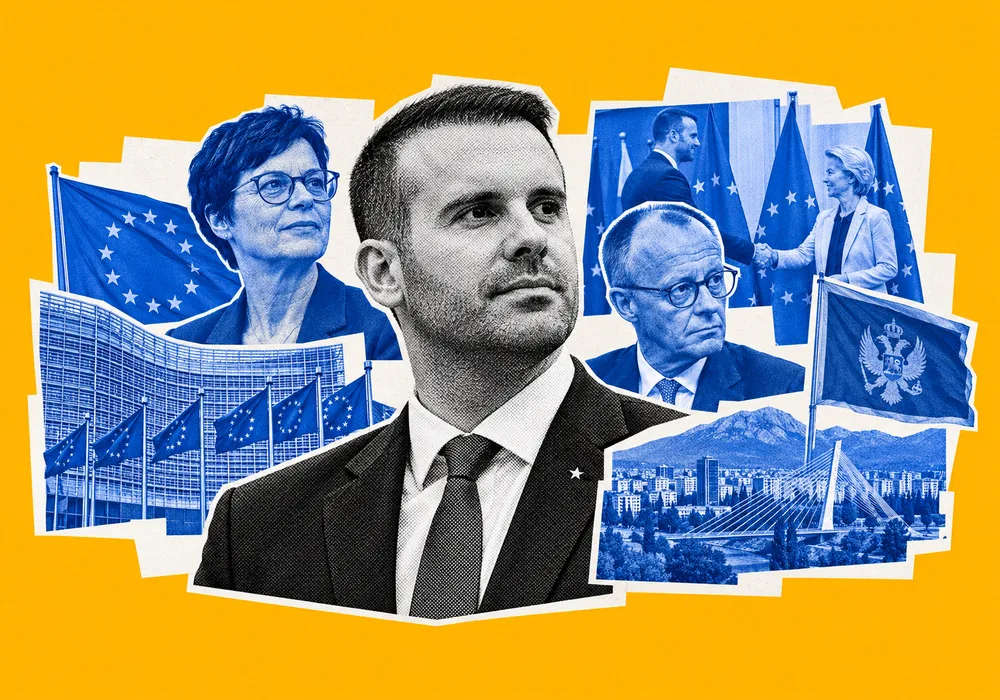
German Chancellor Friedrich Merz and European Commissioner for Enlargement Marta Kos have reaffirmed support for Montenegro’s accession to the European Union, as the country enters the final stages of its negotiations. The October 22 Berlin Process summit highlighted the need to accelerate enlargement while maintaining reform requirements.
Germany and the European Commission have reaffirmed their support for Montenegro’s accession to the European Union, as European leaders seek to turn the bloc’s enlargement commitments into tangible progress. Speaking at the Berlin Process summit in Montenegro on 22 October, German Chancellor Friedrich Merz called for the accession process to move forward as quickly as possible, while European Commissioner for Enlargement Marta Kos warned that the Western Balkans were entering a decisive period for their European future.
The statements came as Montenegro concluded its year-long chairmanship of the Berlin Process, a German initiative launched in 2014 to strengthen regional cooperation and support the Western Balkans’ integration into European structures. The summit brought together regional leaders, EU representatives and officials from participating European countries to discuss political cooperation, economic development and security. For Berlin, the gathering provided an opportunity to reaffirm that the region’s future membership is not merely a promise to candidate countries but a strategic objective for Europe itself.
Merz argued that the EU must continue expanding if it is to preserve its influence and sovereignty in an increasingly competitive international environment. He described enlargement as a geopolitical necessity and stressed that countries in the Western Balkans should not be left to pursue their European ambitions alone. The German government has maintained that integrating the region would strengthen stability, security and economic competitiveness across the continent.
Montenegro occupies a particularly important position in this debate because it has progressed further through the accession negotiations than other Western Balkan candidates. Its advancement offers the EU an opportunity to demonstrate that membership remains achievable for countries that implement the required reforms. However, political support from Berlin and Brussels does not remove the conditions attached to accession, nor does it guarantee that the timetable set by Podgorica will be met.
Montenegro moves closer to the final stages of negotiations
Montenegro applied for EU membership in December 2008 and received candidate status in December 2010. Accession negotiations began in June 2012, making its membership bid one of the longest-running in the region. The process has advanced significantly in 2026, with additional negotiating chapters provisionally closed during a series of accession conferences.
At the latest conference, held on 12 October, Montenegro and the EU provisionally closed negotiations on three chapters covering economic and monetary policy, statistics, and social policy and employment. This brought the total number of provisionally closed chapters to 21 out of 33, with all negotiating chapters having been opened. Further chapters had already been provisionally closed earlier in the year, including those covering competition policy and the customs union.
The progress gives Podgorica a stronger basis for pursuing its stated ambition of becoming the EU’s 28th member in 2028. Yet the distinction between provisionally closing negotiating chapters and completing accession remains important. The remaining chapters must be addressed, the overall outcome must be agreed, and membership must pass through the relevant EU approval and ratification procedures.
The most demanding part of the process concerns the implementation of reforms rather than the formal opening of negotiations. The EU’s accession framework places particular emphasis on the rule of law, the independence and effectiveness of institutions, the fight against corruption and organised crime, and the ability of public administration to implement European legislation. Progress must be sustained in practice, not limited to the adoption of laws or the fulfilment of technical benchmarks.
For the European Commission, Montenegro’s performance is therefore also a test of the credibility of the enlargement policy. A successful accession would demonstrate that the EU can reward measurable progress, while a prolonged delay despite substantial reforms could weaken confidence in the membership perspective across the Western Balkans.
Disputes with Croatia remain a potential obstacle
Despite the political momentum, Montenegro still faces bilateral issues that could complicate the final stages of its accession. Croatia has raised several demands concerning unresolved disputes with its neighbour, including questions connected to historical memory and the treatment of events from the wars of the 1990s.
On 20 October, Croatian Prime Minister Andrej Plenković welcomed two decisions by Montenegro: the installation of a commemorative plaque in Morinj and the renaming of a municipal swimming pool in Kotor. Zagreb regarded these measures as initial progress on two of its eight demands, while Plenković indicated that further discussions would follow.
The issue matters because accession requires the agreement of existing member states, and bilateral disagreements can become politically significant when a candidate approaches membership. Although the EU has established formal criteria for evaluating candidates, unresolved disputes between a candidate and a member state can complicate the political negotiations surrounding accession.
Merz expressed confidence that the remaining Croatian reservations could be resolved. Following discussions with Plenković and Montenegrin Prime Minister Milojko Spajić, the German chancellor said he did not consider the outstanding objections substantial enough to prevent Montenegro’s eventual membership. His position signals Berlin’s intention to help keep the accession process moving while encouraging the two countries to reach an agreement.
The dispute nevertheless illustrates the limits of political assurances. Germany can facilitate dialogue and encourage compromise, but it cannot unilaterally determine the outcome of Montenegro’s accession negotiations. Progress will depend on the willingness of both governments to resolve outstanding issues and on the broader consensus among EU member states.
Berlin advocates gradual integration before membership
Merz has also called for a more flexible approach to enlargement, arguing that candidate countries should be able to participate progressively in parts of the EU single market before becoming full members. The proposal, developed jointly with French President Emmanuel Macron, seeks to narrow the gap between the candidate status and formal accession.
Under this approach, countries that demonstrate sufficient progress could gain access to selected elements of the single market and other European structures while continuing to meet the conditions for membership. The aim is to make the benefits of integration more tangible before accession is completed, creating incentives for reforms and strengthening economic links between the EU and candidate countries.
For Montenegro, gradual integration could bring practical advantages in trade, investment and business development. Closer participation in the European economic system could help businesses operate under more predictable conditions, improve the country’s attractiveness to investors and reinforce its links with EU markets. However, the specific benefits would depend on the arrangements agreed with the bloc, including the regulatory obligations attached to participation.
The proposal also reflects a broader debate about how the EU can expand without weakening its institutional functioning. Accession negotiations can take many years, while geopolitical competition and economic interdependence create pressure for closer cooperation in the meantime. A phased model could provide a way to advance integration without abandoning the requirement that candidates meet the full conditions for membership.
Such an approach would not replace accession or guarantee it. Candidate countries would still have to implement reforms, comply with relevant EU rules and secure the approval required for membership. Its effectiveness would depend on whether the EU can define clear conditions for participation and offer meaningful benefits without creating uncertainty about the ultimate destination of the process.
Enlargement becomes a strategic question for Europe
The renewed support for Montenegro comes as the EU reassesses the role of enlargement in its foreign and security policy. The Western Balkans remain geographically surrounded by EU member states, but several countries in the region have spent years waiting for progress towards membership. The credibility of the process affects not only their domestic reform agendas but also the EU’s ability to maintain influence in its immediate neighbourhood.
For Germany, integration of the region is closely linked to European stability and security. Stronger economic ties, more effective institutions and sustained political cooperation could reduce vulnerabilities and improve the region’s resilience. The Berlin Process provides a framework for pursuing these objectives alongside formal accession negotiations, bringing together countries whose bilateral relations and political priorities do not always align.
The process also has implications beyond Montenegro. Progress by a candidate that has advanced through all negotiating chapters could help establish a clearer relationship between reforms and membership. Conversely, unresolved disputes or repeated delays could reinforce doubts about whether accession depends primarily on a country’s performance or on the political calculations of existing member states.
Kos’s warning that the region faces a decisive period reflects the urgency attached to this question. The challenge for the Commission is to maintain pressure for reforms while ensuring that candidates receive a credible response when they meet the required standards. For member states, the challenge is to reconcile national concerns with the EU’s collective commitment to enlargement.
Montenegro’s 2028 target remains ambitious. The country has made measurable progress, and the latest statements from Berlin and Brussels provide political encouragement. However, the remaining negotiations, the resolution of bilateral concerns and the completion of formal accession procedures will determine whether that ambition can become reality.
The summit has therefore reinforced the political direction of Montenegro’s European path rather than settled its outcome. The next phase will require continued reforms at home, sustained cooperation with neighbouring countries and agreement among EU members. For the bloc, the result will help determine whether enlargement can function as a credible strategic policy rather than remain a long-term aspiration.
Sources: Agence Europe, German Federal Government