
Bosnia’s Election Tests the Limits of Its European Path

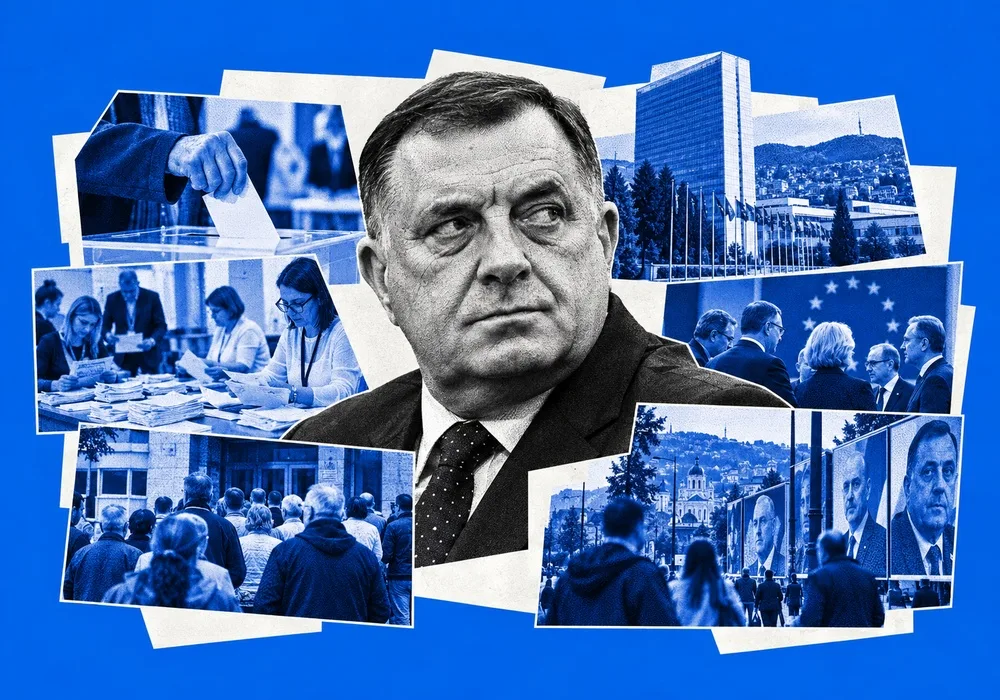
Bosnia and Herzegovina’s October 4 election is testing more than the country’s next political leadership. It could determine whether Sarajevo can overcome its post-Dayton political paralysis and restart its stalled EU accession process, while Russia and the United States compete with Brussels for influence in the Western Balkans.
Bosnia and Herzegovina went to the polls on October 4 in an election that could shape the country’s stalled path towards the European Union while testing the resilience of a political system still divided along ethnic lines. Around 3.4 million voters are choosing members of the country’s tripartite presidency, national parliament and institutions governing its two entities, the Federation of Bosnia and Herzegovina and Republika Srpska.
The election is taking place against a backdrop of economic stagnation, institutional paralysis and renewed nationalist rhetoric. While many voters are primarily concerned with living standards and the departure of young people, political campaigns have again focused heavily on the divisions that have shaped Bosnia since the 1992–95 war. That leaves the election as a test not only of the next governing coalition, but of whether the country can make its political system work more effectively.
An EU candidate still waiting to move forward
Bosnia received EU candidate status in December 2022 and was given the green light to open accession negotiations in 2024. Yet the negotiations have not actually begun, with judicial reform, anti-corruption measures and the functioning of state institutions among the areas where progress remains insufficient.
The problem is structural as much as political. Bosnia's post-war system distributes power between Bosniaks, Serbs and Croats and gives extensive authority to the country's two entities. Political parties remain largely organised around these ethnic constituencies, making national decision-making vulnerable to prolonged disputes and blockages.
The election could therefore determine whether Bosnia produces a governing configuration capable of advancing reforms demanded by Brussels or returns to another period of fragmented government. Continued dominance by the main ethnic parties would make it harder to build the political consensus required to move the accession process forward.
Dodik remains central even without being on the ballot
One of the clearest signs of Bosnia's political instability is the continued influence of Milorad Dodik, the nationalist former president of Republika Srpska. Although he has been banned from holding public office after being convicted of defying decisions by the international envoy overseeing implementation of the Dayton peace agreement, Dodik has remained at the centre of the campaign.
His Alliance of Independent Social Democrats is expected to remain dominant in Republika Srpska. Dodik also returned to the campaign after meeting Russian President Vladimir Putin in Moscow shortly before the election, reinforcing the perception that the political contest in Republika Srpska is closely connected to the wider competition between Russia and the West.
At a final SNSD rally in Banja Luka, Dodik again used separatist rhetoric, declaring that Bosnia was effectively “dead”. The presence of Russia's ambassador to Bosnia and Herzegovina at the rally further highlighted the international dimension of the campaign.
The significance of Dodik's position is that removing him from formal office has not removed his political influence. His party remains a major force, while his rhetoric continues to shape the debate over the future of Republika Srpska and the Bosnian state itself.
Russia's influence remains a European concern
Dodik's relationship with Moscow gives the election a significance beyond Bosnia's domestic politics. Russia has consistently supported Republika Srpska's leadership and opposed stronger centralisation of the Bosnian state, while Dodik has rejected closer alignment with NATO and resisted measures bringing Bosnia fully into the EU's sanctions policy towards Moscow.
That creates a persistent obstacle for Brussels. Bosnia can formally remain an EU candidate while political forces inside one of its two entities oppose parts of the European foreign and security-policy framework.
The result is a country moving towards the EU institutionally while remaining internally divided over its strategic orientation. That tension is likely to remain regardless of the final electoral balance.
New election technology faces its first real test
This year's election also introduced a significant technological change. For the first time, Bosnia is using biometric identification of voters and ballot scanners intended to reduce manipulation, improve voter verification and accelerate the transmission of results. The Central Election Commission said the new system had passed preliminary testing before the vote.
But the technology immediately faced problems when voting began. AP journalists reported that several polling stations were unable to start voting on time because of difficulties with the new digital equipment. The system was introduced partly in response to previous concerns about electoral manipulation and organised interference, making the reliability of the technology itself politically significant.
The technology does not turn Bosnia into a fully electronic voting system. Voters still mark paper ballots, while biometric devices are used for identification and scanners process the ballots. The objective is to make voter verification and counting more transparent and reduce opportunities for organised manipulation.
The difficulties on election day therefore carry significance beyond a technical glitch. Bosnia is attempting to strengthen confidence in its electoral institutions at precisely the moment when political trust remains weak. If the new system proves unreliable, it could reinforce existing scepticism; if it works effectively despite the initial problems, it could become an important institutional reform.
The gap between voters and political elites
The election also exposes a growing disconnect between Bosnia's political establishment and its population. AP reported that many voters are more concerned about poor living standards, economic stagnation and the continued emigration of young people than the nationalist disputes dominating political campaigns.
That gap is increasingly important for the country's European trajectory. EU integration is not only a question of foreign policy or institutional reform. It is also tied to whether citizens see the state as capable of improving economic prospects and providing functioning public institutions.
If political parties continue to mobilise primarily around ethnic identity while economic and institutional problems remain unresolved, frustration could deepen even if the country formally continues along the accession path.
A wider test for the Western Balkans
Bosnia's election therefore represents a broader test for European policy in the Western Balkans. Brussels wants to use enlargement to consolidate democratic institutions and reduce space for outside powers, but Bosnia's political structure gives domestic actors considerable capacity to slow that process.
Russia benefits from precisely this fragmentation. It does not need Bosnia to formally abandon its European aspirations if political divisions can prevent the country from making meaningful progress towards membership.
The United States also retains a significant stake in Bosnia's strategic direction, including through energy and security initiatives. That leaves Brussels competing not simply with Moscow, but within a more complicated international environment in which different Western actors also have competing approaches to Bosnia's political and economic future.
The central question after the election will therefore be whether Bosnia can translate electoral results into functioning institutions. Without that, its EU candidacy risks remaining a formal status rather than a sustained process of integration.
For the EU, Bosnia is increasingly a test of whether enlargement can work in a country where political power remains deeply fragmented and where external actors can exploit domestic divisions. For Bosnia itself, the election is another test of whether the post-Dayton system can evolve beyond the political logic that has kept the country divided for three decades.
Sources: Central Election Commission of Bosnia and Herzegovina, Reuters