
Divided Progress: How the EU’s €6 Billion Growth Plan Split the Western Balkans

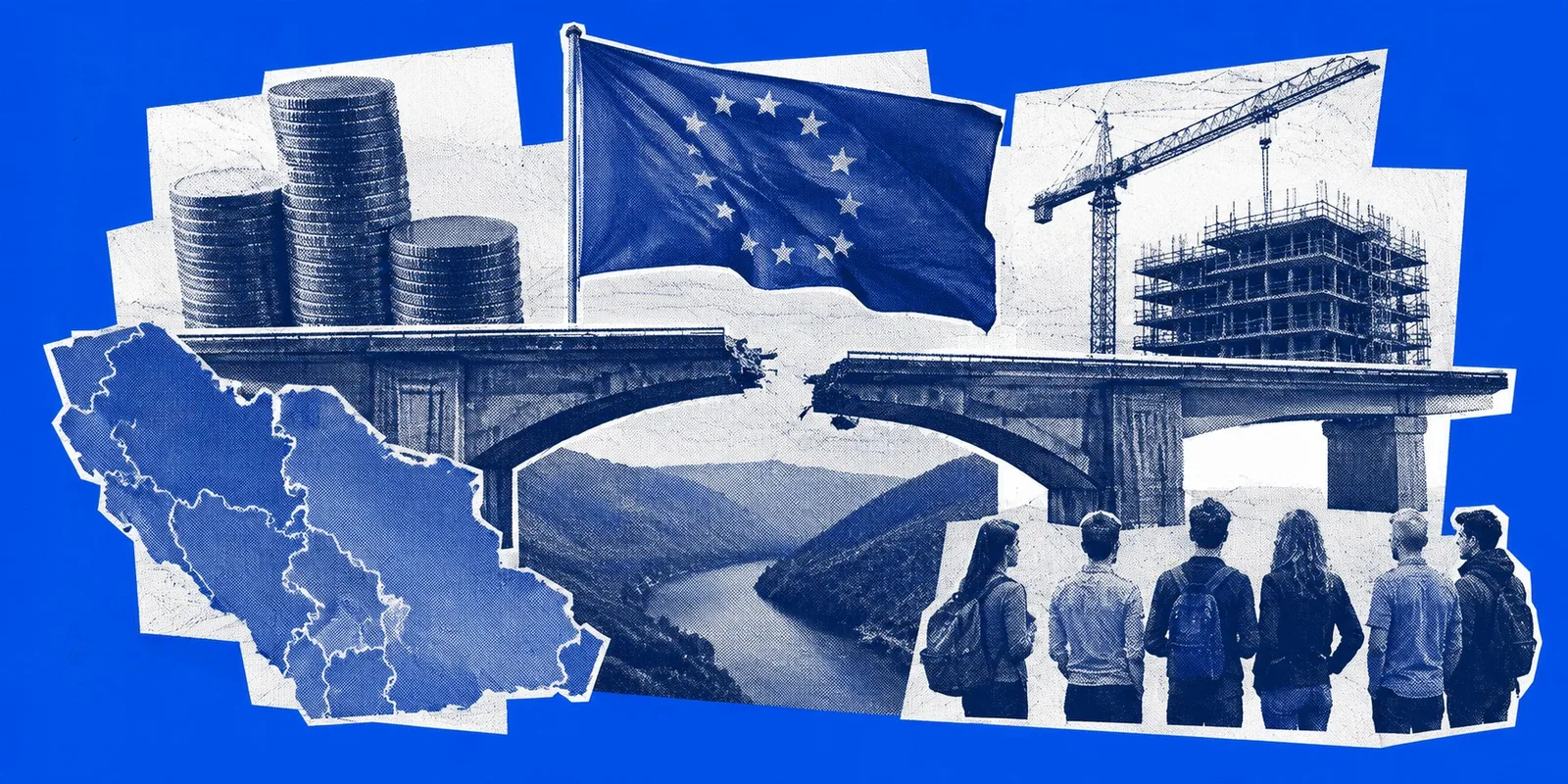
Over a year after the European Union launched its ambitious €6 billion Growth Plan for the six Western Balkans's country - Albania, Montenegro, North Macedonia, Serbia,Kosovo, Bosnia and Herzegovina - the financial blueprint has begun to expose deep-seated geopolitical and institutional divides across the region. Conceived in late 2023 as an unprecedented device to accelerate socio-economic convergence and integration into the European single market, the plan links substantial financial disbursements to strict economic, institutional, and rule-of-law benchmarks.
At the time of the Plan's implementation, the lack of economic convergence was a serious problem for the Western Balkans region, reaching approximately 35% of the EU average. The Growth Plan aims to double the size of the Western Balkans economies over the next decade. To support this process, a new €6 billion financial instrument was adopted – the Western Balkans Reform and Growth Facility – for the period 2024–2027.
Enlargement Commissioner Marta Kos previously championed the initiative as the Western Balkans' ultimate accelerator into the European family. However, the practical rollout has painted a far more complex picture. Rather than fostering uniform progress across all six candidate nations, the flow of EU billions has inadvertently highlighted a stark "two-speed" trajectory—separating countries with stable governing majorities from those mired in political paralysis and democratic backsliding.

The Frontrunners: Montenegro, Albania, and North Macedonia
The total disbursement under the Growth Plan for the Western Balkans now reaches 12% of the total allocation after the European Commission made available €158.9 million in EU funds to Albania, Montenegro and North Macedonia in May 2026.
The decision followed the third request for payment and the positive assessment of the reform steps implemented by the three EU candidate countries to receive grants and loans under the Reform and Growth Facility – namely €49 million to Albania, €44.2 million to Montenegro, and €65.7 million to North Macedonia.
Montenegro, Albania, and North Macedonia stand at the head of the convergence line. These three nations are currently the only candidates in the region to have successfully secured more than one reform-linked disbursement under the EU facility.
In Albania, a stable parliamentary majority has enabled the government to push through complex legislative packages without facing crippling legislative deadlocks. Montenegro has similarly leveraged political compromise within its coalition structures to meet key rule-of-law and institutional milestones. In North Macedonia, despite ongoing political friction and domestic debate over the pace of accession, authorities have maintained the necessary momentum to meet quantitative reform targets on schedule.
However, policy analysts caution that securing funds does not automatically equate to structural transformation. Independent evaluations reveal a recurring structural pattern across several frontrunner nations: while quantitative targets and legislative deadlines are consistently met or exceeded on paper, the underlying documentation required to independently verify real-world implementation is frequently missing, unpublished, or structured in ways that evade rigorous scrutiny. This discrepancy raises fundamental questions about whether governments are enacting deep, sustainable reforms or simply performing procedural compliance to unlock European tranches.
Political Paralysis in Kosovo and Bosnia & Herzegovina
In stark contrast to the frontrunners, Kosovo and Bosnia and Herzegovina demonstrate how political crises can freeze access to essential European funding.
Kosovo received an initial pre-financing tranche of €61.8 million in April, but an 18-month political crisis has paralyzed its legislative assembly, leaving the government unable to pass the necessary reform packages. European Parliament rapporteur Riho Terras stressed that Kosovo cannot advance until its domestic political impasse is resolved. The financial consequences are already severe: the Kosovo government recently confirmed the loss of an estimated €40 million after failing to meet critical reform targets set for June. Officials warn that if a functioning parliament fails to enact required legislation, Kosovo risks forfeiting up to €250 million by the end of the year.
The situation in Bosnia and Herzegovina is even more dire. The president of Republika Srpska, Milorad Dodik, who is under strong Russian influence, is seeking to weaken central institutions and undermine the country's unity. Severe institutional fragmentation and ongoing political disputes have prevented Sarajevo from completing a single reform milestone under the plan, leaving the country entirely unable to access the growth facility. During a recent visit to Sarajevo, EU foreign policy chief Kaja Kallas issued a blunt warning, highlighting that continued delays will inflict permanent financial penalties. Bosnia has already forfeited €108 million and risks losing more than €370 million by the end of the year—vital capital that would otherwise modernize transport networks, digital infrastructure, and energy grids.
Serbia and the Question of Political Priority
Serbia occupies an ambiguous middle position within the region's reform landscape. While Belgrade possesses a highly capable administrative apparatus and a comfortable parliamentary majority—giving it the institutional capacity to implement reforms quickly—its participation has stalled due to broader political choices and concerns over democratic backsliding.
European Parliament rapporteur Tonino Picula highlighted serious concerns regarding rule-of-law standards and democratic governance in Serbia. Although Serbia received an initial disbursement in January, momentum has since slowed, prompting calls from several European lawmakers to suspend future payments until Belgrade demonstrates a clearer, unequivocal commitment to core EU values.
Independent policy analysts note that unlike nations struggling with systemic state weakness, Serbia's missed targets are fundamentally a matter of political priority. Because the rules of the growth plan allow unspent or forfeited funds to be reallocated to regional frontrunners, pressure on Belgrade is expected to escalate significantly as neighboring states absorb available European capital.
The Mechanism's True Test
Considering all six Western Balkan countries, €673.6 million has already been disbursed, out of a total of €5.5 billion in allocations up to 2027. Of the required reform steps, only 90 out of 731 have been completed. Under the Growth Plan for the Western Balkans, the disbursement of funds is directly linked to the fulfillment of the EU-related reforms.
The European Commission continues to defend the €6 billion growth plan as both an integration engine and a rigorous test of national governance. Yet, the first year of implementation offers a sobering lesson for European policymakers: while financial incentives can empower committed governments, money alone cannot overcome deep-seated political paralysis, institutional fragility, or a lack of genuine political leadership. As unspent funds risk being redistributed to the most agile actors, the divide between the two speeds of the Western Balkans threatens to widen into a permanent economic gap.
Sources: Euraktiv, European Commission