
Russia Modernises Bomb Shelters in Moscow and St Petersburg as War Reaches the Capital

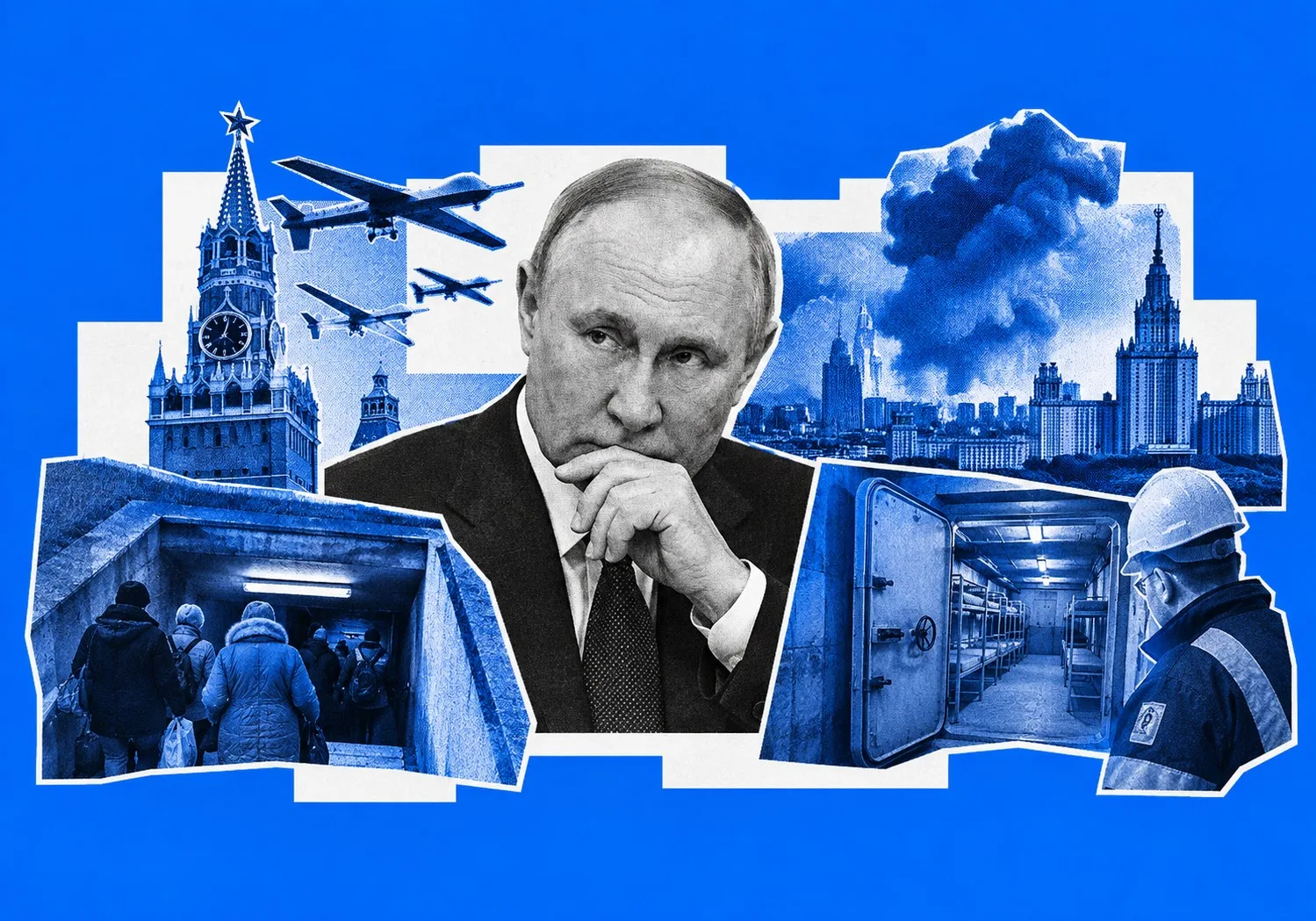
The most accurate measure of Russia’s shifting security posture is no longer found in military briefings. It is buried in the dry ledgers of state procurement portals.
Across Moscow and St Petersburg, a highly accelerated campaign is underway to modernise civil defence infrastructure. As Ukrainian long-range strikes push the realities of the war directly into Russia’s political and cultural capitals, the state is quietly pouring tens of millions of roubles into urgent structural repairs.
The timeline is unusually strict. Contractors working across Moscow have been handed completion deadlines set for November 30, 2026.
 The geography of the refurbishment is extensive. It moves far beyond central government quarters and straight into ordinary residential areas.
Down in the eastern district of Novogireevo, along the busy Leninsky Prospekt and deep within the subterranean networks of New Moscow, construction crews are racing to rebuild bunker entrances. They are overhauling long-dormant water and electricity supplies.
This autumn push follows a quieter, preliminary phase. During the summer, authorities disbursed 200m roubles to target shelters across 17 different Moscow districts.
Taken together, the spending reveals a state apparatus abandoning the pretence of absolute domestic security.
For nearly five years, the Kremlin’s domestic social contract relied on total insulation. The public was assured that the campaign in Ukraine was a distant expeditionary effort, entirely divorced from metropolitan life.
The deal offered to the urban middle class was straightforward: ignore the politics, and the conflict will not touch your streets.
That illusion is now breaking against the reality of poured concrete, reinforced steel and air filtration systems.
The geography of the conflict has fundamentally changed. And the sudden rush to fortify the Russian heartland is the most visible proof.
The Ballistic Trigger
The catalyst for this subterranean overhaul arrived in mid-August.
Mykhailo Fedorov, the former Ukrainian defence minister, announced the deployment of the FP-9 ballistic missile. Carrying an 800kg warhead and boasting an 850-kilometre range, the weapon placed the Russian capital squarely within the active threat zone.
Previously, Ukraine had relied on a persistent but lighter campaign of long-range drones. That strategy proved highly disruptive, successfully hitting energy infrastructure as far away as Samara and chemical plants in Perm.
But the FP-9 alters the arithmetic of the war entirely.
It transforms the threat to Moscow from a nuisance of shattered glass and isolated fires into a risk of catastrophic structural collapse.
Moscow initially responded to the growing threat by bolstering its aerial shield. More than 100 launchers and 50 mobile Pantsir air defence systems now form a dense protective ring around the capital. On the ground, authorities recently began draping critical electrical substations in heavy anti-drone netting.
Yet air defences only offer a political promise to intercept threats.
The sudden, heavily funded rush to retrofit bomb shelters serves as an institutional acknowledgement that some weapons will eventually get through.

Toxic Risks and Secondary Disasters
The scope of the Kremlin's worst-case scenario planning is most evident in St Petersburg.
The state Metro operator is currently advancing feasibility studies to convert massive sections of civilian transport infrastructure into advanced protective facilities. The plans encompass nine specific stations, four underground tunnel sections and 35 kilometres of track.
The technical specifications listed in the St Petersburg tender documents are revealing.
The metro operator explicitly requires the installation of advanced ventilation systems. Crucially, these must be capable of filtering radioactive dust, chemical aerosols and toxic substances.
Planners are clearly anticipating more than just conventional explosive impacts. The demand for toxic filtration shows a growing state awareness of Russia's inherent industrial vulnerabilities.
Following successful Ukrainian drone strikes on major chemical enterprises — most notably a facility in Perm owned by the chemical giant Uralchem — the Russian state is calculating the municipal risks of secondary disasters.
A direct missile strike on a residential block is a localised tragedy.
A successful strike on a chemical plant, an oil refinery or a nuclear facility on the periphery of a major city is an urban catastrophe.
St Petersburg is quietly bracing for the latter.
These infrastructure projects also expose the severe decay of Russia’s legacy security apparatus. Most of the shelters currently undergoing emergency refurbishment date back to the height of the Cold War.
The New Moscow bunker, for instance, was constructed in 1971. It was largely left to rot after the collapse of the Soviet Union. The entire civil defence network was heavily neglected until the 2022 invasion of Ukraine prompted a sudden reassessment.
The scale of that neglect became apparent recently. When authorities in St Petersburg conducted a massive inventory of 2,633 shelter sites in 2025, they discovered a systemic failure. The vast majority required extensive capital repairs simply to be deemed habitable.
The Russian state is now being forced to retrofit 20th-century Soviet infrastructure to survive a 21st-century conflict. It is attempting to compress decades of deferred maintenance into a few frantic months of construction.
The Economics of Homeland Defence
The strategic implications of this overhaul are significant.
Russia is undergoing a forced, highly resource-intensive transition from a purely offensive military posture to one of deep homeland defence. Protecting urban centres the size of Moscow and St Petersburg is an immensely expensive logistical undertaking.
This domestic fortification program demands a massive diversion of resources. Financial capital, high-grade engineering talent and administrative bandwidth that would otherwise support the offensive in the Donbas must now be redirected to protect the rear.
There are, of course, clear economic beneficiaries to this shift.
Russian construction firms and civil defence contractors are quietly securing highly lucrative state contracts. They are essentially transforming the threat of deep Ukrainian strikes into a domestic economic stimulus. Private engineering firms are profiting from the state’s sudden, desperate demand for upgraded bulkheads, air filtration units and industrial netting.
Yet the political costs for the Kremlin are mounting rapidly.
The physical militarisation of Russia's cultural and political capitals visibly contradicts the state's official narrative of absolute control and stability.
You cannot hide the pouring of concrete. Nor can you easily explain away the sudden appearance of blast walls in civilian areas.
In Kronstadt, the island town hosting a key Baltic Fleet base, authorities have already bypassed subterranean planning entirely. They have begun installing heavy concrete surface shelters to mitigate the immediate threat of drone swarms.
The move directly followed a successful strike on the Boikiy corvette while the vessel was undergoing repairs.
For the civilians walking past these surface fortifications, the war is no longer a distant television broadcast.
Ukraine has secured a significant strategic and psychological advantage. By demonstrating the reach of its FP-9 missiles and the persistence of its drone swarms, Kyiv is successfully forcing Moscow to expend vast domestic resources without having to launch a daily barrage.
The threat alone is achieving a strategic effect. It is compelling the Russian state to dig in and look upward.
It is unravelling the manufactured, carefully curated calm of the capital.
The residents of Moscow and St Petersburg are awakening to the reality that their government cannot entirely shield them from the consequences of its own foreign policy.
As the November 2026 deadlines approach, the sound of subterranean construction provides a constant, rhythmic reminder of a conflict that has slipped its boundaries.
The Russian state might succeed in fixing the ventilation shafts in its Cold War bunkers.