
Trump-Xi Summit 2026: How the US-China Deal on Rare Earths and AI Leaves Europe Exposed

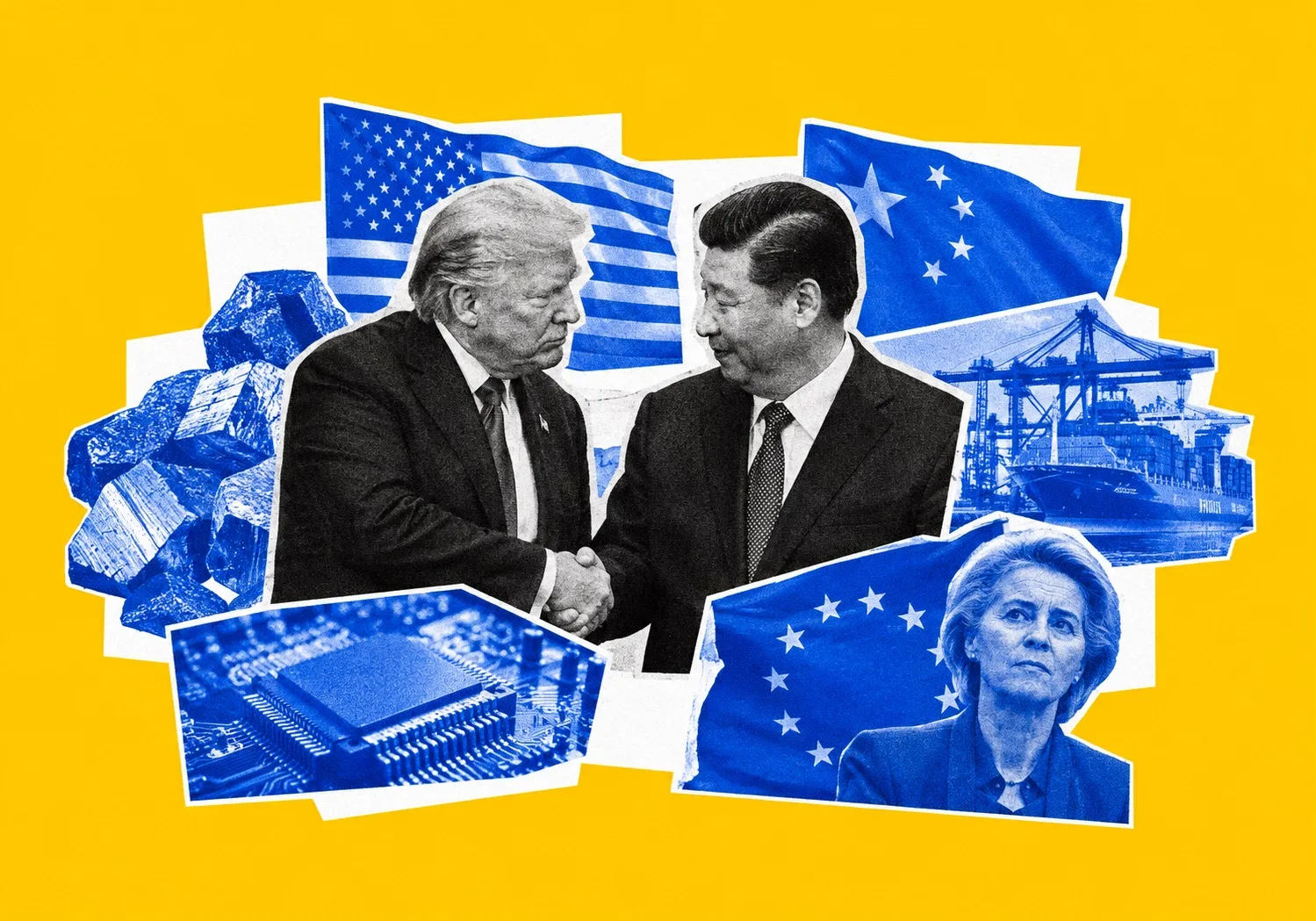
As Xi Jinping arrives in Washington for his first US state visit in 11 years, Donald Trump and the Chinese leader are racing against a five-week deadline before the "Busan truce" expires. From rare earth supply guarantees and $30 billion in tariff exemptions to a landmark bilateral AI safety mechanism, Washington and Beijing are building a framework of managed economic rivalry - one that risks marginalising the European Union and reshaping global supply chains without Brussels at the table.
This is the third meeting between the two leaders in less than a year, after Busan and their May 2026 summit in Beijing. Yet the architecture emerging from those encounters looks increasingly different from traditional trade diplomacy.
Washington and Beijing are not resolving their strategic differences. They are learning how to compartmentalise them.
The bargain is becoming transactional
The economic negotiations illustrate the new model.
Washington is considering tariff reductions or exemptions covering roughly $30 billion of Chinese imports, while Beijing is expected to fulfil purchase commitments agreed in May. US agricultural exports are part of that equation, alongside negotiations over wider Chinese market access and a possible reduction or removal of China's 15 per cent tariff on US liquefied natural gas.
LNG matters because it gives the negotiations another lever. Chinese purchases of American energy can be used alongside agricultural commitments to balance concessions on Chinese manufactured goods. Rather than negotiating a comprehensive settlement covering every disputed area of trade, the two governments are assembling packages in which specific concessions correspond to specific economic interests.
The mechanism agreed in May - a “Board of Trade” for non-sensitive products - takes that logic a step further. Instead of allowing tariff disputes to accumulate until they require another political intervention at the highest level, the two sides are creating a channel through which selected categories can be managed separately.
It is a striking adaptation to a relationship in which neither side appears prepared to abandon strategic competition.
China needs predictable access to major export markets and energy supplies. The US needs Chinese inputs that cannot easily be replaced, particularly critical minerals and rare earths. Neither dependency has disappeared because the political relationship has deteriorated.
The answer is therefore not decoupling. It is controlled interdependence.
Rare earths turn trade into security policy
Critical minerals are where that interdependence becomes most politically consequential.
China controls more than 80–90 per cent of global processing capacity for key critical raw materials and rare earth elements, which are essential to semiconductor, defence and electric-vehicle production. Washington wants explicit assurances that those supply lines will remain stable, not merely for American industry but for global markets.
The linkage with the tariff negotiations is important. The proposed $30 billion package is not simply a conventional exchange of market access. Tariff treatment is being discussed alongside supply-chain guarantees and Chinese purchase commitments.
That changes the character of trade policy.
A tariff on an imported product can ordinarily be understood as an economic instrument. A restriction on a mineral needed for advanced manufacturing can become a strategic weapon. Once governments treat access to those materials as a national-security question, trade negotiations inevitably move closer to defence policy.
The same transformation is visible in Washington's approach to artificial intelligence.
AI becomes part of strategic stability
The September 20 discussions between US Treasury Secretary Scott Bessent and Chinese Vice Premier He Lifeng prepared the ground for a formal bilateral channel on AI risks. The proposed mechanism would address national-security concerns, system safety, and notification of critical AI failures.
That is a significant development because the two countries are attempting to create a practical safety mechanism without resolving the much larger strategic competition surrounding advanced technology.
The distinction matters. A notification channel does not constitute agreement on how AI should be regulated. It does, however, establish a direct line for dealing with failures or risks that both governments consider serious enough to threaten national security.
For the European Union, this creates an uncomfortable problem.
The EU already has its own regulatory framework through the AI Act. But if Washington and Beijing begin defining operational standards for the safety of critical AI systems between themselves, some of those arrangements could acquire international weight simply because they involve the world's two largest economies.
Europe would then face a familiar strategic dilemma: maintaining its own rules while adapting to standards shaped elsewhere.
The issue is broader than AI. The Washington summit points towards a world in which technological governance is increasingly negotiated by the states with the greatest strategic leverage over the underlying infrastructure and supply chains.
Europe is exposed on both sides of the relationship
The EU's vulnerability is particularly visible in critical raw materials.
European Commission President Ursula von der Leyen warned on September 16 of a “second Chinese shock”, while European policy is moving towards the creation of a European Critical Raw Materials Corporation. The urgency comes from a combination of dependence on Chinese processing capacity and the scale of Europe's economic relationship with Beijing.
The EU runs a trade deficit with China of approximately €1 billion a day and relies on China for around 80-90 per cent of critical raw materials.
If Washington and Beijing negotiate preferential access to strategic goods directly, European companies cannot assume that the resulting arrangements will take European interests into account.
That does not mean the US-China negotiations automatically disadvantage Europe in every sector. European manufacturers could benefit from greater predictability in global supplies of rare earths, for example. But the political mechanism matters. Decisions about access, tariffs and technology standards are increasingly being made through bilateral executive bargaining rather than through institutions designed to accommodate a wider group of economies.
The World Trade Organisation is consequently less central to the process. The “Board of Trade” is designed precisely to handle selected categories outside a broader multilateral settlement.
The result is a more fragmented form of globalisation: markets remain interconnected, but the rules governing those connections are increasingly negotiated between major powers on a case-by-case basis.
The truce has a clock attached to it
The immediate test will come in late November.
The Busan truce currently gives businesses a temporary degree of protection from another escalation in US-China tariffs. But its expiration means that the Washington summit cannot simply produce political symbolism and leave the underlying economic arrangements unresolved.
Failure to extend the standstill would reopen the possibility of tariff escalation across global supply chains. The uncertainty would be particularly significant for sectors dependent on Chinese minerals, US agricultural exports, energy flows and the categories covered by the proposed tariff exemptions.
The five-week interval between the summit and the deadline is therefore more important than the ceremonial choreography of the state visit. The negotiations must produce mechanisms capable of surviving beyond a single meeting between presidents.
That is why the technical architecture matters so much.
A tariff board, supply commitments and an AI incident channel may appear narrow compared with a comprehensive trade agreement. Their significance lies precisely in their narrowness. They allow Washington and Beijing to manage individual points of vulnerability without requiring either government to resolve disputes over Taiwan, Ukraine, Iran or the broader strategic balance.
Those geopolitical issues will still be discussed in Washington. They simply do not need to be settled for the economic machinery to function.
That separation may be the most durable feature of the emerging relationship.
From free trade rules to executive risk management
For decades, the logic of globalisation rested on the assumption that economic interdependence could be managed through broad rules and institutions. The US-China relationship is moving towards a different model.
Strategic competition remains. So does commercial interdependence. What is changing is the mechanism used to reconcile the two.
Rare earths are being treated as strategic supply lines. AI safety is becoming a national-security issue. LNG and agricultural purchases are negotiating instruments. Tariff exemptions can be allocated through bilateral mechanisms. Trade policy is increasingly supervised at the level of national executives because the goods involved are no longer considered purely commercial.
The Washington summit therefore matters less for whether Trump and Xi can announce another temporary accommodation than for whether this system of managed rivalry can become operational.
For Europe and other economies outside the US-China axis, the difficult question is not whether globalisation is ending. It is whether access to its most important markets and technologies will increasingly depend on bargains in which they have no seat at the table.
And as Washington and Beijing build mechanisms to manage their own interdependence, the distinction between a trade system and a security system is becoming harder to maintain.