
EU-China Trade War: Why Šefčovič’s Beijing Talks Signal the Start of "China Shock 2.0"

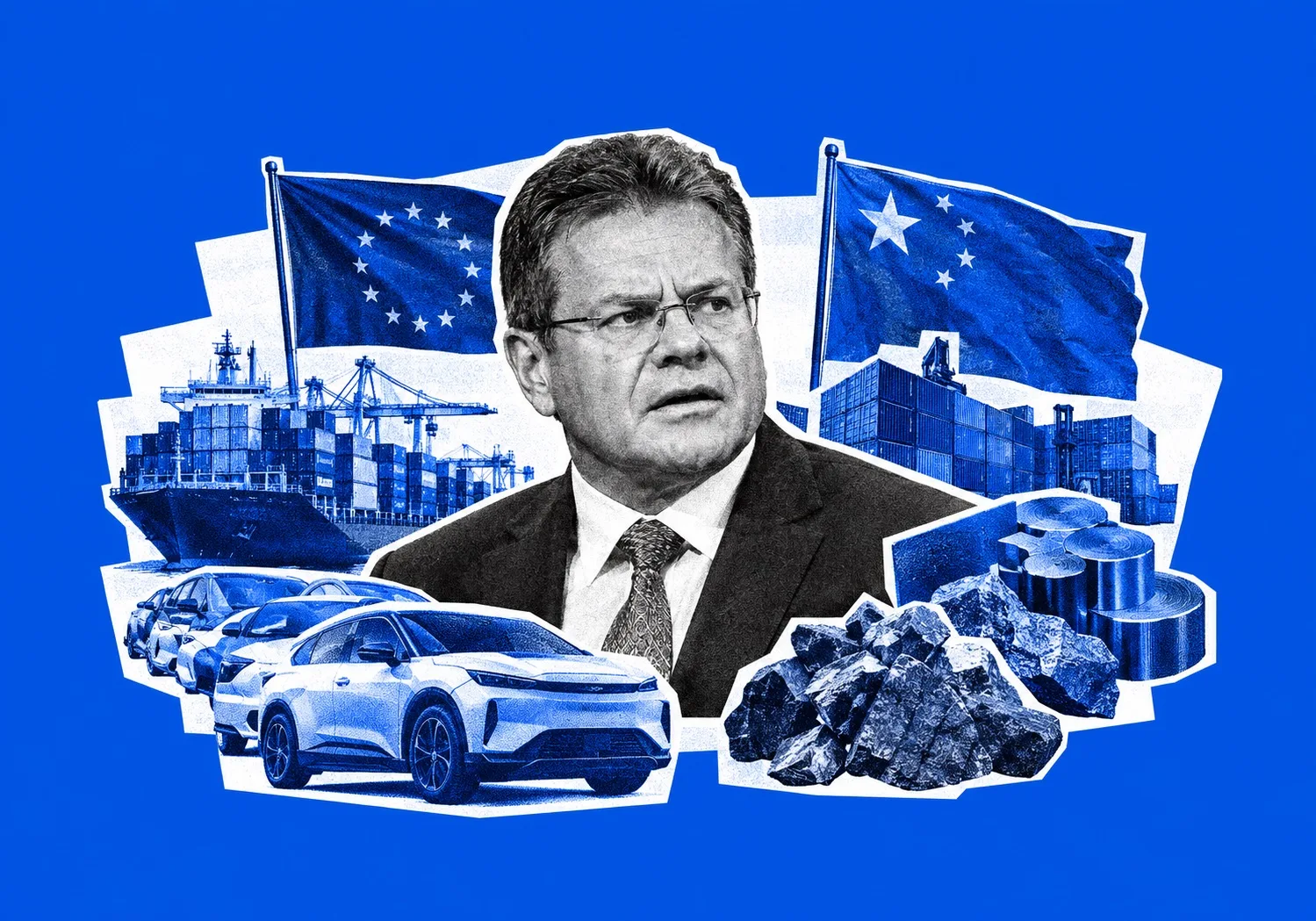
As EU trade chief Maroš Šefčovič meets Chinese Commerce Minister Wang Wentao in Beijing, negotiations are exposing a deeper crisis than a standard commercial dispute. Confronted by a €360 billion trade deficit and the threat of a "China Shock 2.0", Brussels is abandoning conventional compromise in favor of aggressive market protection.
The immediate dispute is familiar: a huge European trade deficit, rapidly rising Chinese imports, and growing concern that state-backed industrial capacity is overwhelming European producers. But the numbers now point to something larger. EU data puts the bilateral deficit at about €360bn in 2025, close to €1bn a day. Chinese figures put it lower, at roughly $292bn, but neither side disputes the direction of travel.
What has changed is the nature of the competition.
Europe is confronting a second, more consequential China shock - one that reaches into the industrial sectors it has traditionally regarded as the foundation of its economic power.
From cheap imports to industrial competition
The first China shock followed Beijing’s entry into the WTO in 2001. European economies faced an enormous expansion of low-cost manufacturing, particularly in textiles and basic consumer goods. Production moved towards Asia, and European companies adapted around the new division of labour.
The current wave is different. Chinese companies are increasingly competing in areas such as advanced machinery, chemicals, automotive manufacturing, green technology and pharmaceuticals - sectors where Europe still expects to maintain technological and industrial strength.
That distinction explains why the argument in Beijing is becoming harder to resolve through conventional trade policy.
EU Trade Enforcement Chief Denis Redonnet has told the European Parliament that “sustained and abnormal” import surges now affect almost a quarter of EU import categories. The pressure is particularly visible in machinery, basic metals, textiles, chemicals and plastics, as well as solar panels, pharmaceuticals and automotive products.

Electric vehicles provide the clearest example. In the 12 months to September 2026, Chinese plug-in hybrid imports into the EU rose 86%, while their average prices fell by around 20%. Battery-electric vehicle imports increased 40%, with more than half coming from China despite existing European anti-subsidy tariffs.
For Brussels, this is no longer simply a question of whether Chinese manufacturers are selling individual products below fair market prices. It is whether Europe's existing trade machinery can respond quickly enough to an industrial system capable of generating persistent export surpluses.
The answer, by the EU's own proposed reforms, is increasingly no.
Brussels reaches for a faster weapon
The most important development surrounding the Beijing talks may therefore be taking place in Europe rather than China.
On October 5, French President Emmanuel Macron and German Chancellor Friedrich Merz called for a new European trade defence mechanism modelled on the logic of the US Section 301 system. Their proposal would give the European Commission the ability to respond to systemic market distortions - including state subsidies, industrial overcapacity, dumping and currency non-convertibility - without waiting for the lengthy procedures associated with conventional anti-dumping cases.
The difference is speed.
Standard EU trade defence investigations can take 12–15 months. The Franco-German proposal would allow market-access restrictions to be imposed within days of identifying systemic distortions. It would also use a reverse qualified majority mechanism, under which a Commission proposal would take effect unless a qualified majority of member states voted to block it.
That is a significant change in the philosophy of the single market. The EU would retain its rules-based trade system, but equip itself with a mechanism designed to act before a dispute has run through years of evidence gathering and legal procedures.
The implication is hard to miss: market access itself is becoming an instrument of industrial policy.
France has pushed this argument for years. Germany's decision to join it matters more.
Berlin’s calculation has changed
Germany has traditionally had more to lose from confrontation with China than many of its European partners. Its industrial model depends heavily on exports, and its automotive companies have substantial commercial and manufacturing interests in the Chinese market.
That helps explain the divided European response to earlier Chinese EV tariffs. Ten member states supported them, led by France, Italy and Poland. Five opposed them, including Germany, Hungary, Slovenia, Slovakia and Malta, while 11 abstained, among them Spain, Austria and Sweden.
Germany is now backing stronger systemic trade defence alongside France.
The shift reflects a change in where the risk is perceived to lie. For an export-dependent economy, restricting Chinese access to Europe can threaten established commercial relationships. But allowing subsidised Chinese industrial capacity to expand unchecked creates a different danger: the erosion of the manufacturing base on which German exports depend.
That tension is becoming particularly acute as China's competition moves into high-value industries.
The Franco-German initiative is therefore less a triumph of French protectionism than evidence that the old division between French industrial intervention and German export-led openness is becoming harder to sustain.
China holds a different kind of leverage
Europe's problem is that it cannot simply turn market access into a weapon without considering what Beijing can do in return.
China has rejected the EU's proposals for voluntary export restraints on hybrid vehicles and broader import quotas. Ahead of the Beijing talks, it also launched an anti-dumping investigation into EU imports of p-nitrotoluene and signalled that European cognac, dairy and pork could face tariffs.
Those measures would hurt specific European exporters. But the more strategic vulnerability lies elsewhere.
China dominates the extraction, separation and production of permanent magnets involving rare earth elements that are essential to wind turbines, electric vehicle motors and defence electronics. Beijing tightened export licensing rules in 2025, giving those supply chains an additional layer of political sensitivity.
That makes Europe's negotiating position unusually complicated. Brussels can threaten Chinese companies with restrictions on access to the world's largest single market. Beijing can affect the availability of inputs required by European manufacturers to produce goods for that same market.
The resulting interdependence is asymmetric in ways that traditional tariff negotiations do not capture.
European automotive manufacturers could face higher costs and disruption in EV components. Wind and battery industries could encounter delays and licensing bottlenecks. Defence manufacturing could also be exposed to shortages of critical materials and permanent magnets.
The problem becomes more acute where Chinese-origin materials or processing remain embedded in supposedly diversified supply chains. The briefing for the talks points to Chinese export controls potentially reaching products manufactured outside China when they contain even small amounts of Chinese-origin rare earth content or rely on Chinese processing technology.
Europe is therefore trying to reduce dependence on China while negotiating with a country whose industrial reach extends deep into the production systems it wants to protect.
The cost of decoupling
That leaves the EU facing a dilemma that cannot be solved by tariffs alone.
Restricting Chinese high-tech imports could give European manufacturers greater room to rebuild capacity. Domestic producers of metals, chemicals, industrial equipment and other goods exposed to subsidised Chinese competition would gain protection. Alternative suppliers of critical raw materials in North America, Australia and non-Chinese Asian markets would also gain strategic importance.
But protection has a price.
European consumers could face higher prices if cheaper Chinese EVs and other industrial products are restricted. European manufacturers would have to absorb higher input costs while developing alternative supply chains. The green transition could become more expensive and slower if wind turbines, batteries and electric vehicles lose access to competitively priced components and critical materials.
And Europe's exporters are exposed to retaliation in sectors with little connection to the original dispute. Agricultural producers, luxury-goods companies and chemical manufacturers could find themselves paying for a conflict centred on industrial policy.
This is why the Beijing negotiations are producing limited room for compromise rather than a comprehensive settlement. The two sides are not simply bargaining over tariffs. They are defending fundamentally different approaches to industrial capacity, market access and economic security.
The EU wants China to reduce the export pressure generated by subsidised overcapacity while giving European companies greater access to the Chinese market. Beijing has little incentive to accept restraints that would weaken an export-led model at a time when domestic demand is weak.
Europe's answer is beginning to take shape in its own legislation.
If Macron and Merz succeed in creating a fast European mechanism capable of shutting foreign competitors out of the single market within days, the EU will have moved a long way from treating trade disputes as isolated cases for slow regulatory adjudication. And if China responds by tightening control over the raw materials on which European industry depends, the distinction between trade policy and security policy will become increasingly difficult to maintain.
The strategic question for Europe is no longer whether it should remain open to China. It is how much industrial dependence an open market can sustain before openness itself becomes a vulnerability.
Sources: Euobserver, Politico, France 24, Euronews