
The Washington Truce: How Trump and Xi Are Replacing Decoupling with Containment

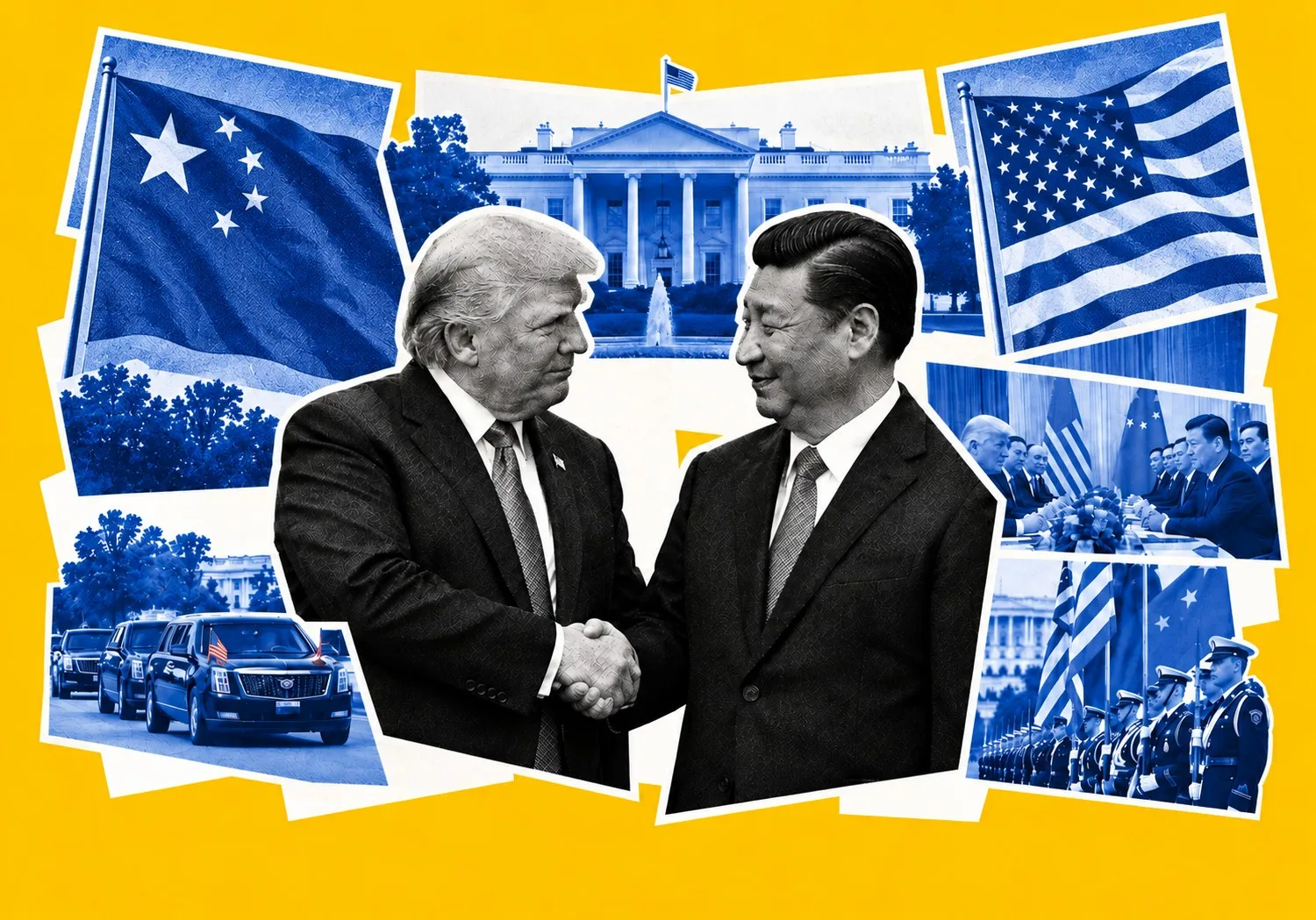
Behind the military pageantry of Xi Jinping’s US visit lies an emergency negotiation over rare earths, AI security, and the November tariff deadline.
Donald Trump does not usually wait on the tarmac. Yet when Xi Jinping’s plane touched down at Joint Base Andrews on Wednesday, 23 September, the US president broke protocol to meet his Chinese counterpart at the aircraft steps. Two B-1 bombers flew low overhead as a military band played on the red carpet. The following morning on the White House South Lawn, Washington put on another heavy military display: nearly 500 service personnel, four F-22 fighters, and a B-2 Spirit stealth bomber.

Xi’s three-day state visit—his first to Washington in 11 years—ends on Friday after a private tea and a trip to the National Archives. Coming four months after Trump’s own visit to Beijing in May 2026, the trip has been framed as a historic summit. But behind the military flypasts and the state dinner, the mood in the negotiation rooms was purely transactional. This was not two powers repairing a relationship. It was two deeply intertwined rivals trying to manage a stalemate.
The Myth of Clean Separation
For years, politicians in both capitals have talked up the idea of economic decoupling. Washington argues that cutting off critical tech supply chains is essential for national security. Beijing insists on total domestic self-reliance to shield its factories from American sanctions. The Washington summit shows that both positions are largely political theatre.
What is happening behind closed doors is a negotiation over dependencies neither side can actually break. Direct trade between the United States and China did fall by almost 30 per cent in 2025 under the weight of bilateral tariffs—a figure often cited by trade hawks as proof that disengagement works. Yet over the very same 12 months, China posted a record $1.2 trillion global trade surplus.
The explanation is straightforward. US tariffs have not stopped American demand for Chinese goods; they have simply changed the shipping routes. Chinese factories now route components, raw materials, and finished goods through third countries—most notably Vietnam—before they cross the Pacific. Tariffs capped near 20 per cent have raised costs for consumers and created work for customs lawyers, but they have done very little to weaken China’s industrial base or reduce its manufacturing overcapacity.
The economic relationship has not been severed. It has simply adapted. Rather than achieving the clean break promised by politicians, Washington and Beijing are discovering that structural dependencies—especially in critical minerals and artificial intelligence—are forcing them to accept a reality of managed containment.

A Ticking Clock in Washington
The driving force behind this summit is not sudden diplomatic goodwill, but a hard calendar deadline. In October 2025, during a meeting on the sidelines of a summit in Busan, South Korea, Trump and Xi agreed a fragile 12-month truce. That deal capped mutual tariffs and froze new American tech export controls alongside Chinese restrictions on raw materials.
That truce expires on 10 November 2026. Without an extension, both countries face an automatic return to escalating tariffs and trade embargoes. In the weeks leading up to the summit, US Treasury Secretary Scott Bessent and US Trade Representative Jamieson Greer held quiet, intensive talks with Chinese officials led by Vice Premier He Lifeng.
The goal was never a sweeping trade deal. Negotiators were focused on securing a pragmatic extension to keep the Busan framework alive. American officials pushed for modest commitments on Chinese purchases of US farm goods and the removal of specific non-tariff barriers. For the Trump administration, pushing the tariff deadline down the road provides valuable political breathing space ahead of upcoming domestic elections, while giving financial markets some temporary certainty.
Business leaders on both sides are relieved by the prospect of a pause. But as trade analysts point out, these administrative extensions do nothing to address the underlying causes of the dispute. Disagreements over state subsidies, intellectual property, and market access remain entirely unresolved.
Why Beijing Holds the Cards
While Washington uses its control over capital markets and advanced semiconductors as its main bargaining tools, Beijing holds an equally powerful lever: its dominance over critical minerals. China currently controls roughly 70 per cent of global rare-earth extraction and about 85 per cent of world refining capacity.
These materials are not easily replaced. Refined rare earths and permanent magnets are essential for electric vehicle motors, wind turbines, defense electronics, and military hardware. The F-22 fighters and B-2 bombers featured in Washington’s flypasts rely on refined Chinese rare earths for their actuators, radar systems, and engine coatings.
Over the past year, Beijing made clear it was prepared to restrict export quotas—a move that would have halted Western high-tech manufacturing within months. That implicit threat worked. It pushed Washington to hold back its most aggressive planned controls on semiconductor design software and manufacturing equipment. By using its grip on mineral processing, China established a clear balance of power at the negotiating table, proving that its control over raw materials can match America's hold on silicon.
This dynamic illustrates how fundamentally global trade has changed. The era of free-market globalization, where supply chains were designed purely for efficiency and low cost, is over. In its place is a system of state-directed industrial policy and supply-chain security. Economic policy in both capitals is now driven by national defense and risk management. Supply chains are no longer just commercial pipelines; they are tools of geopolitical pressure.
 ## Silicon Valley Enters the Room
This focus on national security is clearest in artificial intelligence, which has become the main battleground between the two powers. AI now underpins everything from military hardware and cyber operations to surveillance and industrial automation.
The guest list for Thursday evening's state dinner at the White House made the connection between government power and private tech explicit. Sitting alongside senior diplomats were key figures from America's tech industry: Tim Cook of Apple, Jeff Bezos of Amazon, Sam Altman of OpenAI, Elon Musk of Tesla, and Jensen Huang of Nvidia. Their presence was not decorative. These executives control the infrastructure of American tech, maintaining informal backchannels to protect their supply chains and overseas sales while advising the US government on national security risks.
While Washington continues to restrict exports of advanced AI chips, such as Nvidia’s high-end processors, officials recognize the dangers of an unmanaged technological race. A key outcome of the Washington talks is a proposal for a cross-border AI incident notification system.
This system is intended to create direct channels between American and Chinese defense officials to prevent automated miscalculations. As both militaries integrate autonomous systems into their command structures, the risk of an unintended crisis increases. The notification system is effectively a digital hotline, similar to the crisis channels set up during the Cold War. The aim is not to stop competing over AI, but to ensure that an algorithmic error does not trigger an accidental military conflict.
Casualties on the Sidelines
As Washington and Beijing focus on managing their own relationship, other countries are finding their interests set aside. Mexico became the most obvious example when high-level talks on the United States-Mexico-Canada Agreement (USMCA) were abruptly postponed by American officials to clear the schedule for Xi's visit.
The delay sent a plain message to regional trade partners: when direct negotiations with Beijing are on the line, other trade agreements take secondary importance. Mexican negotiators were left waiting as American officials focused on avoiding a fresh economic clash with China.
At the same time, regional security issues loomed over the meetings. Xi arrived in Washington aiming to press Trump on reducing or stopping US arms sales to Taiwan, arguing that American military support for the island violates previous diplomatic commitments.
Trump, meanwhile, tried to use the summit to secure Chinese help in other international conflicts, pressing Xi to use Beijing's influence with Iran to prevent further instability in the Middle East. Whether China is willing to use its leverage in Tehran in exchange for American movement on Taiwan remains one of the summit's unresolved questions.
Living With the Stalemate
The flypasts over Andrews, the parade on the South Lawn, and the dinner with Silicon Valley chief executives were staged to project confidence and control. But behind the ceremony, the summit shows two governments limited by their reliance on each other.
Neither country can break away without causing major self-inflicted damage. From China’s 85 per cent share of rare-earth refining to America’s semiconductor technology, the tools of modern industry are now tied directly to national defense.
The 10 November deadline will likely pass with a negotiated extension, keeping tariffs capped and trade moving through indirect routes in Southeast Asia. Tech executives will continue to navigate American export rules alongside Chinese market access. National security advisers will try to set up basic ground rules for artificial intelligence.
This summit does not mean a return to open trade or a genuine thaw in relations. It represents the formal acceptance of a managed stalemate. Complete economic separation was never a realistic option. The result is a prolonged standoff, where the main goal of statecraft is no longer to win an economic war, but to stop an inescapable dependency from turning into an economic breakdown.
Sources: Reuters, Bloomberg, The Washington Post, Euronews