
Riyadh Airport Closure: How Houthi Strikes Strained Saudi Air Defenses and Disrupt Gulf Aviation

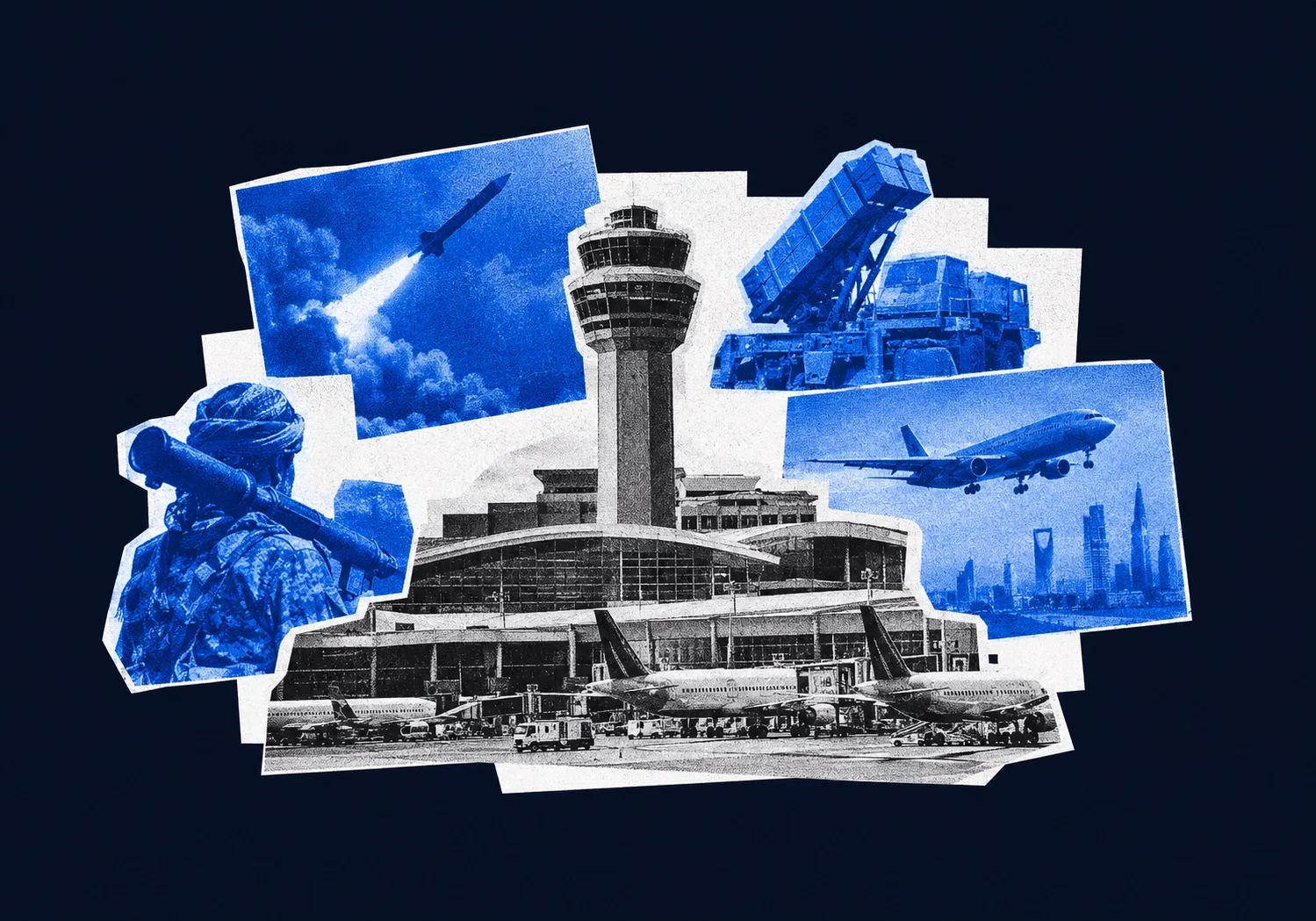
The closure of Riyadh’s King Khalid International Airport following fatal Houthi missile and drone attacks has triggered flight cancellations by major European carriers and exposed critical vulnerabilities in Saudi Arabia’s security umbrella. As EASA expands risk warnings for Saudi airspace, the crisis directly threatens the Kingdom's economic ambitions and raises the prospect of direct US military involvement.
The immediate damage is only part of the story. The Houthis have declared Saudi airports and airspace, except for Mecca and Medina, an active war zone, explicitly warning airlines, passengers and airport staff to stay away. Their message is intended for anyone deciding whether to operate in Saudi Arabia, not just for the Saudi military.
The cost of making the Gulf a no-go zone
Airlines have responded by cutting their exposure. Lufthansa Group, Air France-KLM, British Airways, Emirates, Etihad, flydubai, Air Arabia and Air India have suspended or reduced flights to Riyadh, Jeddah and Dammam. The disruption has accounted for around 1,500 cancellations across Saudi routes.
The European Union Aviation Safety Agency has expanded its warnings on Saudi airspace, while the US Federal Aviation Administration has issued cautions for American carriers. Neither regulator can eliminate the danger simply by issuing guidance. Airlines must decide whether the remaining risks are acceptable, and those decisions affect passengers, connecting routes and the movement of people on business.
There is no clear timetable for reopening Riyadh airport. The longer the disruption lasts, the harder it becomes to treat it as a temporary interruption rather than a commercial risk. The briefing does not establish the likely duration of the closure or quantify the damage to tourism and investment. But the immediate consequences are plain: international carriers are changing their schedules, and Saudi Arabia's main aviation gateway has become a security problem in its own right.

That is an awkward development for a country seeking to attract international business and broaden its economy. Airports are not merely transport facilities. They connect investors, executives, tourists and major commercial events to the kingdom. If those connections become unreliable, the effects can spread well beyond the aviation sector.
Riyadh has continued to host the 25th WPC Energy Conference despite the disruption. Energy Minister Prince Abdulaziz bin Salman insisted that "fear has no place in the Saudi lexicon". The decision to press ahead is an assertion of normality. Yet normality is difficult to maintain when airlines are cancelling flights and the capital's principal international airport is closed.
An expensive shield, a persistent threat
Saudi Arabia's predicament exposes a basic problem with modern air defence. Advanced systems can intercept incoming weapons, but defending a large territory against repeated attacks involving different types of missiles and drones is a different task from stopping a single strike.
The latest campaign has involved several weapons systems and multiple targets. Defenders must contend with ballistic missiles, cruise missiles and drones while protecting airports spread across the country. The available information does not reveal how many weapons were intercepted, how many reached their targets or why particular attacks succeeded. It would be wrong to infer from the casualties alone that Saudi air defences have collapsed.
The wider difficulty is harder to dismiss. A defender may have to invest heavily in detection, interception and the protection of critical sites. An attacker can still impose substantial costs by forcing closures, interrupting transport and creating enough uncertainty to change commercial behaviour.
An airport need not be destroyed to lose its usefulness. A sustained threat can be enough to keep aircraft away.
For the Houthis, that gives the campaign significance beyond its immediate military results. By targeting civilian aviation, the movement has demonstrated that a conflict centred on Yemen can interfere with international travel and place pressure on Saudi Arabia's economic ambitions. Its declaration of a wider airspace danger zone reinforces that message, whether or not every threatened target is struck.
The problem for Riyadh is that better interception rates would not necessarily end the disruption. Airlines need confidence that routes are safe to operate, not simply assurances that defensive systems are in place. Restoring that confidence may prove more difficult than reopening a runway.
Retaliation carries its own risks
Saudi Arabia has continued to attack Houthi positions in Yemen. Its military conducted 124 air raids on Sunday, while heavy fighting around Taiz killed about 60 combatants. The scale of the response shows that Riyadh is not relying on diplomatic pressure alone.
But the kingdom has reason to be cautious about the next step. A prolonged campaign could draw it deeper into a war that has already lasted years, while failing to eliminate the threat to its own territory. The Houthis' ability to disrupt airports has made the cost of restraint more visible. Escalation, however, comes with no guarantee that the attacks will stop.
Washington is considering whether to join Saudi military strikes. President Donald Trump has said a decision could come "very quickly". Direct US involvement would raise the military stakes and potentially increase pressure on the Houthis, but it would also widen the conflict's political and strategic dimensions.
The available information does not specify what an American operation would involve or how many resources it might require. The risk is nevertheless clear: an expanded campaign could create additional demands on US forces while making it harder to contain the conflict within Yemen.
For Riyadh, American participation might strengthen the response to the attacks. It would not remove the underlying dilemma. Saudi leaders would still need to decide how much military pressure is necessary, what outcome it could realistically achieve and how to avoid another open-ended commitment that undermines the kingdom's wider economic plans.
Tehran has a narrow opening
Diplomacy has not disappeared amid the fighting. Iranian Foreign Minister Abbas Araghchi spoke with Saudi Foreign Minister Faisal bin Farhan on Sunday about possible mediation between Riyadh and the Houthis.
The contact offers a potential route towards de-escalation, but the gap between a diplomatic conversation and a workable agreement remains considerable. Iran is an important regional actor with links to the Houthi movement; that does not mean it can guarantee the movement's decisions. Nor does the fact that Riyadh and Tehran are talking establish that either side is ready to compromise.
The attacks have given the Houthis leverage by demonstrating their capacity to impose costs outside Yemen. Saudi Arabia, meanwhile, must weigh the political pressure to respond against the risk of expanding the war. The prospect of US participation adds another complication: it could increase the pressure for a settlement, but it could also encourage further retaliation.
The United Nations, the Gulf Co-operation Council, the Arab League and numerous governments have condemned the attacks. Such statements reinforce the international opposition to strikes on civilian infrastructure, but they do not provide a mechanism for guaranteeing that the next missile will not be launched.
The war behind the airport closures
In Yemen, the consequences are measured in more than cancelled flights. Taiz Governor Nabil Shamsan has warned that intensive care services are at risk of collapse because of severe medicine shortages under the Houthi siege. The warning comes as air raids and ground fighting intensify.
The conflict began its current phase with the Houthi takeover of Sana'a in 2014, followed by the Saudi-led military intervention in 2015. Years of fighting and intermittent negotiations, including Omani-mediated efforts, have failed to produce a durable settlement. The latest escalation shows how a war that has resisted political resolution can continue to generate new security risks for its neighbours.
The pressure on Taiz also exposes the limits of a strategy centred on military targets. Air strikes may weaken armed forces, while attacks on Saudi airports may increase pressure on the kingdom. Neither approach resolves the political struggle that sustains the war. For civilians caught in besieged areas, the consequences are immediate: medicine is scarce, intensive care services are threatened, and the fighting continues.
Saudi Arabia is now confronting two connected problems. It must defend infrastructure that is essential to its international economic role, while deciding whether a stronger military response can deliver lasting security. The closure of Riyadh airport has made the first problem impossible to ignore. The prospect of direct American intervention threatens to make the second considerably harder to manage.
Sources: The Guardian, Reuters, NPR, The Straits Times