
US Sanctions on Iran Aviation: How a Middle East Airspace Dispute Is Disrupting European Flights and Fuel

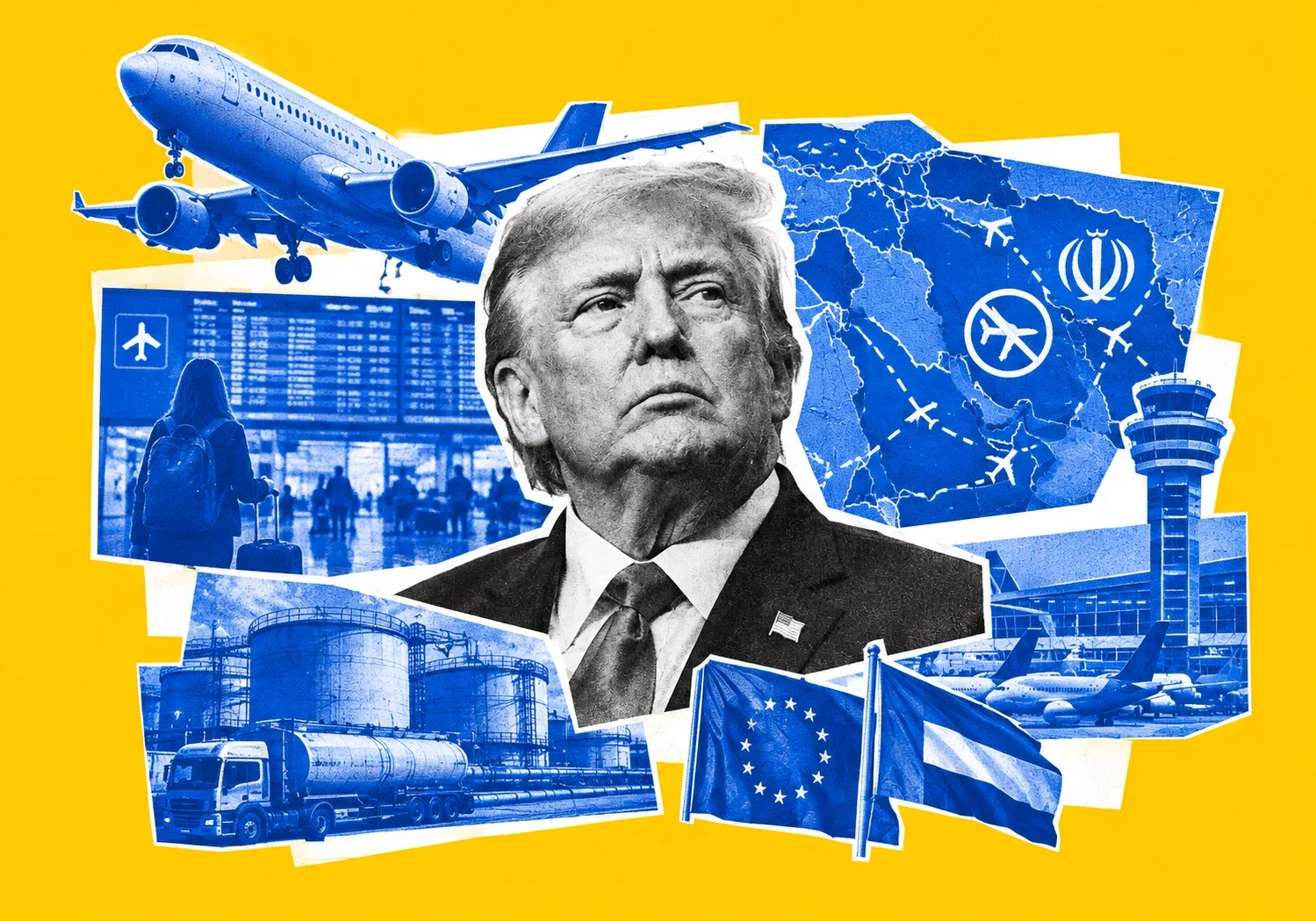
The confrontation between Washington and Tehran over Iranian airlines has expanded into a global aviation crisis. Following U.S. secondary sanctions effective September 23, regional hubs from the UAE to Caucasus restricted service to Iranian carriers. Beyond grounding Tehran's fleet, the escalating dispute forces European airlines onto longer Asia bypass routes and worsens a projected Q4 European jet fuel deficit.
What makes the episode significant is not simply the disruption to Iranian aviation. Washington is testing how far financial power can be used to reshape physical transport networks without formally closing another country's skies.
The blockade that does not look like one
The mechanics are straightforward. An airline can retain the legal right to enter another country's airspace and still become unable to use it commercially if airports will not provide fuel, maintenance, ground handling, or payment infrastructure.
That is the leverage created by secondary sanctions.
On September 8, the US Treasury's Office of Foreign Assets Control designated 36 entities connected to Iran's aviation sector, including 27 airlines. Foreign companies were given until September 23 to stop supporting those carriers or risk losing access to the US financial system and dollar transactions.
The distinction between an airspace restriction and an operational restriction therefore becomes increasingly difficult to maintain.
A sovereign state still controls its airspace. But an aircraft needs much more than permission to cross a line on a map. It needs fuel, servicing, airport handling, ticket sales and financial settlement. If those links are controlled by companies or institutions exposed to US sanctions, the practical ability to operate can disappear without Washington ever declaring an aviation blockade.
That is the more consequential development.
The sanctions architecture is turning infrastructure normally treated as commercially neutral into a series of geopolitical choke points.
Regional hubs are being forced into the dispute
The UAE's decision on September 24 to suspend all Iranian airline flights into and out of the country indefinitely demonstrated how quickly the pressure can move through regional aviation networks.
Iraq, Oman, Azerbaijan and Georgia face a more complicated calculation. Their airports and service providers are not simply dealing with a commercial customer that has become politically inconvenient. They are caught between the financial consequences of ignoring Washington and the possibility of retaliation from Tehran.
Iran's response has already moved beyond diplomatic protest.
On September 23, Mohsen Rezaei, secretary of Iran's Supreme National Security Council, warned that airports in neighbouring countries enforcing US sanctions could "cease functioning". The following day Tehran imposed reciprocal restrictions on UAE carriers using Iranian airspace. On September 25, Mohammad Mokhber, a senior adviser to Iran's Supreme Leader, warned that regional flights should either remain open to everyone or to no one.
The precise scale of Iran's ability to make airports "inoperable" is not established by these statements. But the threat itself changes the operating environment for countries that sit between Iranian aviation and the wider international system.
For governments such as Iraq, Azerbaijan and Oman, compliance is no longer a narrow sanctions question. Airport infrastructure becomes part of the security relationship with both sides.
Europe is absorbing the shock
The disruption is already extending well beyond Iranian carriers.
The European Union Aviation Safety Agency has extended its conflict-zone recommendations through September 30, advising European operators to avoid Iranian and Iraqi airspace, including the Baghdad flight information region, as well as Lebanese airspace. Operators are also being told to apply heightened risk assessments over surrounding areas, including the Persian Gulf, Gulf of Oman, Jordan, Kuwait, Bahrain, Qatar and the UAE.
That creates a second layer of disruption. Even airlines that have no commercial relationship with Iranian carriers can be affected because the safest available routes around the region are longer and more expensive.
Previous Middle East escalations added as much as 206,000 extra flight kilometres a day to regional traffic. Eurocontrol data from those episodes showed a 59 per cent decline in direct Europe-Middle East flights. On some Asia-Europe routes, economy fares increased between 24 per cent and 76 per cent during periods of peak rerouting.
The current crisis is therefore not simply an Iranian aviation problem. It is a test of how resilient Europe's wider air transport system remains when one of the world's most important aviation corridors becomes politically fragmented.
The fuel problem may prove harder to absorb
The most tangible European vulnerability is not necessarily the number of cancelled flights. It is fuel.
Europe has historically imported roughly half of its jet fuel from Middle Eastern refineries. Disruptions to those flows have already forced traders to look further afield. South Korean exports of jet fuel to Europe reached 129,000 barrels a day in September, their highest level since October 2022, while supplies are also being sought from the United States, Canada and Nigeria.
Energy Aspects projects a European jet fuel deficit of about 510,000 barrels a day in the fourth quarter of 2026.
That changes the economics of rerouting. A longer flight requires more fuel precisely when the supply chain is already under pressure. Airlines face higher operating costs, while passengers encounter higher fares and longer journeys.
Turkish Airlines illustrates the tension. The carrier can capture some passengers displaced from Iranian routes, yet it has also reported an approximately $900 million negative financial impact in the first half of the year from regional conflict and higher fuel costs.
Rerouting creates opportunities, but it does not make disruption profitable across the system.
Europe is gaining traffic while paying for fragmentation
Some European hubs are positioned to capture traffic diverted from Gulf and Iranian routes. Helsinki, Frankfurt and London can benefit as passengers and cargo seek alternatives, while Finnair's Asian route revenues have risen 20 per cent year on year and its shares have gained more than 30 per cent.
That redistribution of traffic is one of the less obvious consequences of geopolitical fragmentation.
Air transport has spent decades optimising itself around a relatively small number of global hubs. The Gulf carriers and airports in Dubai, Abu Dhabi and Doha built their positions partly by exploiting geography between Europe and Asia. Disruptions to Middle Eastern airspace weaken that model while strengthening northern and western European alternatives.
But the advantage is conditional. A hub can gain connecting passengers while the airlines using it face higher fuel bills, longer sectors and more complicated route planning.
The network becomes less efficient even as individual nodes gain traffic.
From global connectivity to geopolitical zones
The bigger change lies in the relationship between financial sanctions and aviation sovereignty.
The international civil aviation system was built around the principle that airspace is sovereign, but international transport should remain broadly connected through agreed rules and commercial arrangements. The current confrontation introduces a different logic: access to the financial system can determine whether aircraft can make practical use of those rights.
That distinction matters.
Washington does not need to close Iranian airspace or order foreign governments to ground Iranian aircraft directly. It can make the services required to operate those flights sufficiently risky for third-country companies that they withdraw voluntarily.
For Iran, the available response is more difficult. Tehran can restrict its own airspace and threaten regional airports, but those measures also affect the commercial networks on which its neighbours depend. The more aggressively the confrontation spreads, the more aviation becomes an instrument of reciprocal pressure rather than a neutral transport system.
For the states caught between the two sides, there is no clean technical solution. Fuel suppliers, airport operators, banks and airlines each sit inside a wider political calculation.
That is what makes the September confrontation different from another temporary Middle Eastern flight disruption. The question is no longer only which aircraft can safely cross the region. It is who controls the commercial infrastructure that makes crossing it possible.
Sources: Shafaq News, Iranintl, Reuters, Al Jazeera, FT