
Pogačar Wins Historic 5th Tour de France 2026 as Wildfires Force Stage 21 Cut

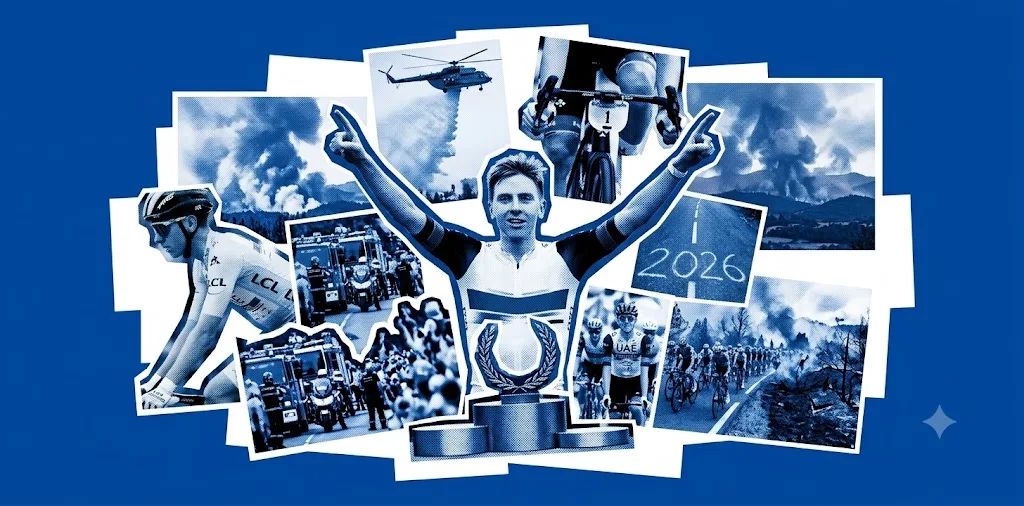
Tadej Pogačar has won the 2026 Tour de France, securing his fifth overall title to equal the all-time record set by Jacques Anquetil, Eddy Merckx, Bernard Hinault, and Miguel Indurain. However, the 27-year-old Slovenian’s historic triumph in Paris coincided with an unprecedented disruption, as severe wildfires in southwestern France forced organizers to cut the final stage from 133 to 89 kilometers.
Severe wildfires in southwestern France had destroyed more than 36,000 hectares of forest and forced nearly 200,000 people to evacuate. French police and emergency personnel assigned to protect the race were redeployed to the fire zone. The final stage was cut from 133 kilometres to 89, its opening road section was abandoned, and riders were transferred by bus to Paris before the race effectively began on the Champs-Élysées.
The Tour finished. But the conditions surrounding its finish offered a glimpse of a sporting future in which even Europe’s most carefully choreographed spectacles must yield to a more unstable physical reality.
A fifth title changes the scale of Pogačar’s career
Pogačar did not merely win another Tour. He crossed a historical boundary.
Before 2026, only four riders had officially reached five victories: Anquetil, Merckx, Hinault and Indurain. Pogačar now stands alongside them at 27, and he is the youngest rider ever to reach that mark. He has also finished on the podium in each of his seven Tour appearances, a level of sustained excellence that makes his career increasingly difficult to compare with the normal standards of professional cycling.

His path to the fifth title has its own narrative arc. He won in 2020 and 2021, lost the next two editions to Jonas Vingegaard, then returned to win three consecutive Tours from 2024 through 2026. The latest victory was not a narrow escape. Pogačar took control of the yellow jersey on Stage 6 in the Pyrenees and never surrendered it. The race was effectively settled across the back-to-back mountain stages finishing on Alpe d’Huez.
Remco Evenepoel finished second, 6:26 behind. Isaac Del Toro was third at 9:42.
That gap matters. Pogačar’s fifth title is not simply a statistical addition to a growing record. It marks the consolidation of a period in which one rider has become the defining competitive force of the Tour.
The numbers are beginning to tell their own story. Pogačar now has 26 stage victories and 70 days in yellow. He remains behind the records of Mark Cavendish, Merckx and Hinault for stage wins, and behind Hinault and Merckx for days in the leader's jersey. But the trajectory is unmistakable.
He is no longer chasing the legends as a young prodigy.
He is becoming one of them.
UAE’s dominance was larger than one rider
Pogačar's victory also concealed a broader transformation in the balance of power.
UAE Team Emirates – XRG won six stages, more than any other team. Pogačar took five of those victories and Del Toro added another. The team placed two riders on the general classification podium, claimed the white jersey through Del Toro and finished second in the team classification.
That is not simply the result of having the strongest individual rider. It is the product of an increasingly concentrated form of professional cycling in which the best-funded and most sophisticated teams can assemble extraordinary depth around a central leader.

Pogačar was the visible centre of the Tour. The team was the machinery that made sustained control possible.
The contrast with Visma | Lease a Bike is revealing. The team won the opening team time trial in Barcelona, a reminder of its continuing technical strength, but failed to place a rider on the general classification podium or win an individual road stage. A former centre of gravity in grand-tour racing now finds itself confronting a peloton whose hierarchy is shifting.
UAE's dominance does not mean every race will follow the same script. Cycling remains vulnerable to crashes, illness, terrain and tactical surprises. But the 2026 Tour showed how difficult it has become to challenge a team capable of combining the strongest overall contender with a young rider capable of finishing third.
The old model of a single champion carrying a team is giving way to something more formidable: an elite organisation capable of producing several forms of dominance at once.
Del Toro gives the new era a different geography
The third-place finish of Isaac Del Toro carries significance beyond UAE Team Emirates – XRG's internal strength.
At 22, the Mexican became the first rider from his country to reach the Tour de France podium. He also won the white jersey and a stage, confirming that his achievement was not simply the result of riding in support of Pogačar.

For professional cycling in Latin America, the moment has a symbolic weight that cannot be reduced to a single result. The Tour remains one of the sport's most powerful global platforms, and Del Toro's presence on the podium gives Mexico a place in its central narrative rather than at its margins.
It also complicates the story of concentration. The strongest team in the race is becoming more dominant, but the riders who may define the next generation are not necessarily emerging from the sport's traditional European centres.
Del Toro's breakthrough arrives at precisely the moment when Pogačar's career is becoming historic. One rider is consolidating a place among the all-time greats; another is beginning to establish a new route into the sport's highest ranks.
The future of the Tour may belong to both stories at once.
The final stage exposed a different kind of vulnerability
The most consequential change to the 2026 Tour did not come from the peloton.
It came from the fire zone.
The wildfires in Gironde and Landes transformed the final stage from a question of sporting tradition into a question of public-resource allocation. Thousands of firefighters, police officers and other personnel were needed for the emergency response. Security forces that would ordinarily have been assigned to the race were redeployed.

The response by the organisers and the Paris Police Prefecture was striking because the Tour was not cancelled. Instead, the event was reduced and rearranged.
The planned 133-kilometre route was cut to 89 kilometres. The section from Thoiry through Hauts-de-Seine was removed. After the team presentation in Thoiry, riders were transported to Paris. The official start was moved to the finish area on the Champs-Élysées, where the revised circuit added two extra loops while retaining three passages over the Montmartre climb.
The decision was framed around national solidarity. Its practical meaning was simpler: the race could continue, but it could not demand the same level of state support while an active disaster was consuming emergency capacity elsewhere.
That is a significant change in the operating logic of major sport.
For decades, the Tour's immense logistical system has been treated as something that can move across France according to a carefully prepared calendar. Roads close. Police lines form. Medical services deploy. Cities prepare. The event creates its own temporary geography.
The fires demonstrated the limits of that assumption.
When the state faces an emergency, the Tour is not a separate world. It competes for the same police, security and emergency infrastructure required by the wider population.
The climate problem is now a logistics problem
Climate disruption is often discussed in terms of heat affecting athletes or extreme weather threatening spectators. The Tour's final day pointed to a broader issue.
The problem is not only whether riders can race in dangerous conditions. It is whether the state can continue to provide the infrastructure required to stage a race at all.
A Grand Tour is a moving public event that depends on thousands of personnel and a vast network of roads, cities and emergency services. Its vulnerability is therefore operational. A fire hundreds of kilometres away can alter the event if the personnel needed to protect it are urgently required elsewhere.
That reality is likely to become more important across Southern Europe, where major sporting events increasingly take place against a background of heat, drought and wildfire risk.
The Tour's response in 2026 was flexible. The route was shortened. The final was relocated. The spectacle survived.
But flexibility has a cost. It changes the meaning of planning. A route designed months in advance can no longer be treated as a fixed commitment if environmental conditions can force authorities to redirect the infrastructure around it within hours.
The future of Grand Tours may therefore depend less on whether organisers can predict every disruption than on whether they can build enough redundancy into the event to absorb one.
The Tour ended with a victory - and a warning
There was still plenty of traditional cycling theatre in Paris. Mathieu van der Poel won the modified final stage. Mads Pedersen took the green jersey with 539 points. Richard Carapaz won the mountains classification and the super-combativity award. Lidl–Trek claimed the team classification, while Quinn Simmons was recognised as the Tour's best teammate.
The race retained its hierarchy of champions, sprinters, climbers and domestiques.
But the most revealing image of the 2026 Tour may be the one that connects the two stories that appear, at first, to have nothing to do with each other.
Pogačar's fifth victory represents the peak of control: one rider, supported by a team with the depth and resources to dominate the defining stages of the race.
The altered final stage represents the opposite: control surrendered to circumstances outside the sporting system.
That tension is likely to define the next era of elite cycling. The sport is becoming more professional, more concentrated and more capable of producing extraordinary individual performances. Its events, meanwhile, are being staged in a Europe where the physical environment is increasingly capable of interrupting the plans of even the most powerful institutions.
Pogačar entered the five-time winners' club on the Champs-Élysées.
The Tour arrived there only after the country around it had reminded everyone that no sporting spectacle, however historic, exists outside the emergencies of the world it passes through.