
Russia’s Real Estate Market Faces Wave of Bankruptcies as Developer Debt Soars

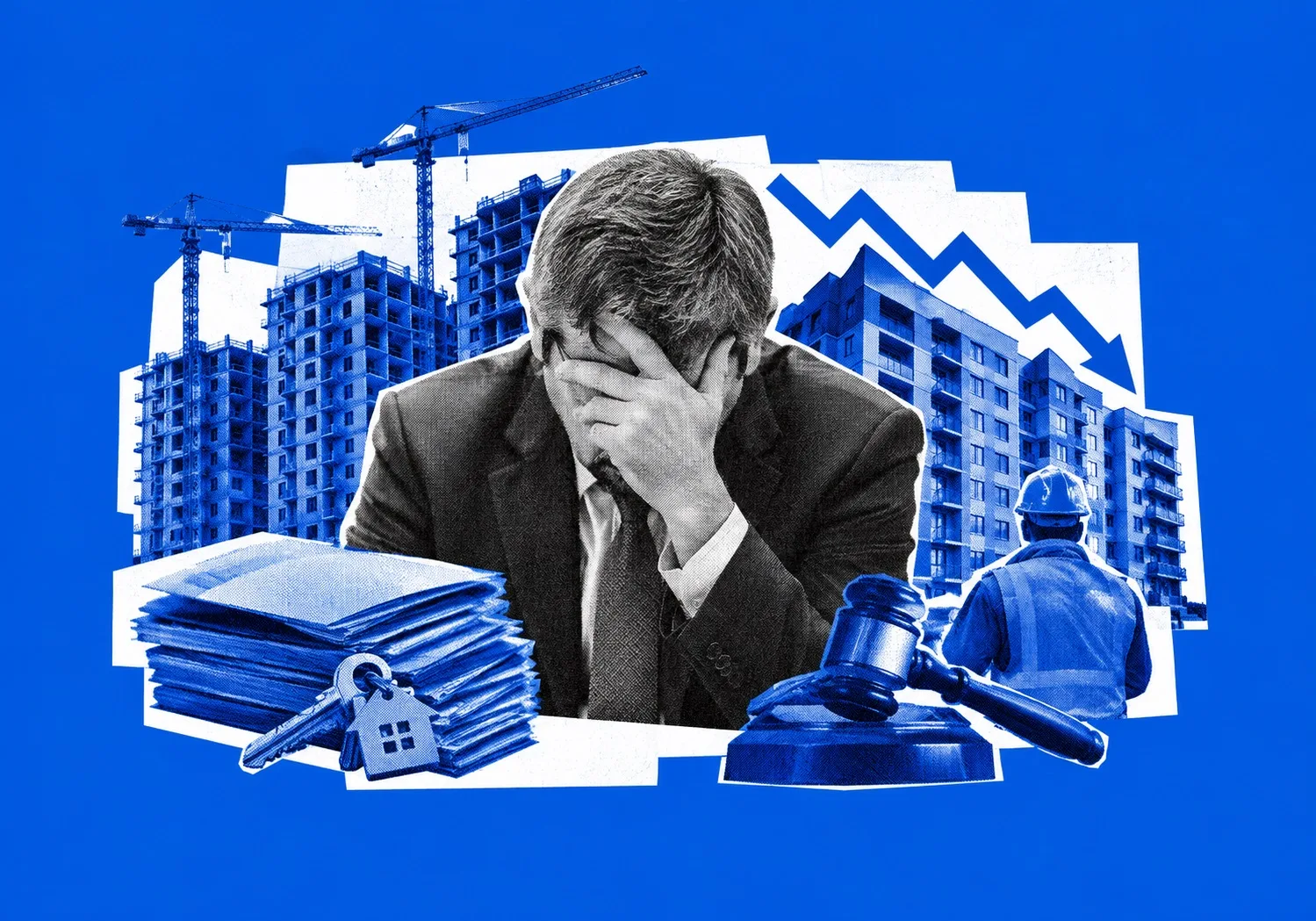
Over 30% of Russian property developers are at risk of bankruptcy in 2026 as total industry debt exceeds 3 trillion roubles ($33bn+). Stung by 18% financing costs, falling sales, and severe labor shortages, Russia's housing market is transforming from a post-pandemic boom into a systemic crisis for regional economies and banks.
The contradiction in the market is striking: more than 120 million square metres of housing remain under construction, yet millions of square metres are proving impossible to turn into cash. Buildings that once represented future revenue are rapidly becoming unserviceable liabilities, threatening to spread financial pressure far beyond the property sector itself.
The central problem is the widening gap between the cost of capital and the returns available from construction.
Project financing rates in 2026 remained around 14-18 per cent, while corporate borrowing costs hovered near 15.4 per cent. Typical project profitability, by contrast, had narrowed to roughly 5-10 per cent. Even before accounting for overruns, delays or weaker sales, the relationship between borrowing costs and expected returns is deeply unfavourable.
A developer earning a 7 per cent margin cannot comfortably finance a project at 16 per cent. The comparison is not a precise calculation of net profit, since financing costs and operating margins depend on the structure of each project. But the direction is unmistakable: debt becomes more expensive while the revenue available to service it becomes less certain.
The increase in the basic value-added tax rate from 20 to 22 per cent on 1 January added another burden to procurement and operating costs. Construction expenses had already climbed by an estimated 40–60 per cent between 2022 and 2025, driven by more expensive materials, disrupted logistics and rising wages.
Developers are consequently caught between costs they cannot easily reduce and prices that buyers may no longer be able to afford. Raising prices risks weakening demand further. Cutting prices can undermine already narrow margins. Delaying projects may preserve cash temporarily but creates additional contractual and financial risks.
This is not the environment in which a highly leveraged developer can rely on growth to solve its problems.
Millions of square metres, too few buyers
Russia’s housing market is now confronting a mismatch between construction activity and effective demand.
By mid-2026, between 1.5 million and 1.7 million apartments in new developments remained unsold, according to the industry figures in the briefing. Of the 120.8 million square metres under construction, approximately 81.7 million square metres were associated with the unsold inventory measure. The gap between housing launches and sales under shared-construction agreements was projected to reach as many as 832,000 apartments by early 2027.
The distinction between building homes and selling them has become critical. Construction volumes reflect decisions taken months or years earlier, often when financing conditions and expectations were more favourable. Completed housing, therefore, does not necessarily indicate a healthy market. It can instead reveal how much capital has been committed to projects whose commercial assumptions no longer hold.
The sold-out rate has fallen to 32 per cent. In 25 regions, it has dropped below the 60 per cent threshold identified as critical for project cash flow. In Krasnodar Krai and Tyumen Oblast, escrow balances cover only 34-45 per cent of total project loans.
Under Russia’s project-financing system, buyers’ money is held in escrow accounts until the relevant conditions for its release are met. Developers depend on bank credit to finance construction in the meantime. When apartment sales slow, the accounts fill more slowly, while interest and other financing obligations continue to accrue.
The mechanism is particularly punishing when sales weaken after a project has already absorbed substantial expenditure. Developers cannot simply stop spending without consequences, yet the expected flow of funds is no longer sufficient to support the original financial plan.
An expanding inventory is therefore not just a question of unsold property. It is a liquidity problem, and liquidity shortages can bring down companies before their underlying assets have lost all economic value.
Regional developers face the sharpest squeeze
The pressure is unlikely to fall evenly across Russia’s construction industry.
Large federal developers with diversified portfolios, substantial reserves and access to financing have more options when individual projects underperform. Smaller companies often depend on one or two developments to generate the cash needed to meet their obligations. A prolonged sales slowdown can leave them with little room to manoeuvre.
Regional construction markets are particularly exposed where escrow balances cover only a fraction of project loans. The figures for Krasnodar Krai and Tyumen Oblast point to substantial funding gaps, while the broader decline in housing completions suggests that the problem extends beyond individual developers.
Completions fell sharply in the Siberian Federal District, down 32 per cent, followed by the Southern Federal District, down 26.9 per cent, and the Northwestern Federal District, down 22.7 per cent. These declines indicate that financial pressure is already intersecting with physical contraction in construction activity.
The consequences reach beyond property companies. Developers support networks of subcontractors, materials manufacturers, transport operators and other service providers. When projects are postponed or cancelled, those businesses lose revenue as well. Local authorities may also face weaker economic activity and reduced tax receipts.
The increase in formal bankruptcy proceedings provides another indication of the strain. Construction-company cases rose 41 per cent year on year to 1,454 by early September. Meanwhile, 53 per cent of developers missed their initial construction deadlines in the first half of 2026, and delayed housing accounted for 44.6 per cent of all completed square metres.
Those figures expose a market in which financial distress and operational disruption are reinforcing each other. Delays can increase costs and undermine buyers’ confidence, while weaker confidence makes sales more difficult and further constrains cash flow.
Labour shortages are becoming a structural constraint
Financing is only part of the problem. Russia’s construction sector is also struggling to secure the workforce needed to deliver its existing commitments.
The estimated shortage of construction workers stands at 200,000–400,000 people. Wages have risen by 20–40 per cent, while restrictions on foreign labour have reduced the permitted share of foreign workers in construction from 80 to 50 per cent.
For developers, the combination creates a difficult choice. Paying more to recruit and retain workers raises project costs; failing to find enough workers risks extending construction schedules. Neither option offers an easy route back to profitability.
Material supply is also under pressure. Cement production has fallen by an estimated 16–26 per cent, brick output by 24 per cent and reinforced-concrete production by 17 per cent. Manufacturing plants have been operating at around 60 per cent of capacity.
The available figures point to a sector facing both excess housing inventory and constraints in its production chain. These pressures are not necessarily contradictory. Unsold homes reflect the amount of supply committed relative to what buyers can absorb, while lower material output and reduced capacity utilisation indicate weakening activity across the wider construction economy.
The result is a less forgiving operating environment. Developers cannot assume that additional building will generate sufficient revenue to offset rising costs, nor can they count on labour and materials becoming readily available at lower prices.
Banks inherit the problem
Commercial banks occupy an uncomfortable position in this adjustment.
Project financing has enabled construction to continue even when developers do not receive buyers’ money directly during the building process. But that arrangement also concentrates exposure within the banking system when sales stall and escrow balances remain insufficient.
Developers’ obligations to service commercial bank loans are estimated at more than $131.5 billion. With cumulative industry debt exceeding three trillion roubles, lenders face the challenge of distinguishing between projects that can recover with additional time and companies whose financial models have become unviable.
Banks with strong collateral positions may gain control over distressed projects or help transfer them to better-capitalised operators. Yet such outcomes are not cost-free. Managing troubled developments ties up capital and resources, while unfinished buildings and delayed sales can complicate the recovery of outstanding loans.
The scale of the problem also limits the usefulness of treating each failure as an isolated corporate event. If a substantial share of developers encounters difficulties simultaneously, lenders must assess projects against a common deterioration in financing conditions, costs and purchasing power.
State-backed mortgage support remains relevant because housing demand is sensitive to the availability and affordability of credit. But subsidies cannot automatically reverse the economics of a project when financing costs substantially exceed its expected margin. Measures that sustain purchases may help sales and liquidity, yet their effectiveness depends on whether buyers can afford the resulting payments and whether developers can deliver homes at commercially sustainable costs.
Consolidation may reshape the housing market
The likely direction of change is towards a more concentrated industry.
Well-capitalised federal developers are better placed to survive a prolonged squeeze and may acquire distressed assets, land banks or competitors at reduced valuations. Regional operators with limited liquidity and concentrated portfolios face a much narrower set of options.
That shift could improve the financial resilience of surviving companies, but it raises questions about competition and affordability. A market with fewer developers may be better able to absorb financial shocks, yet the departure of smaller operators could reduce the range of projects available to buyers, particularly in regional markets.
The pressure is already visible in the size of new homes. Average apartment sizes have fallen to 44.5 square metres as buyers adjust their expectations to tighter budgets. Smaller units may lower the initial purchase price, but they also reveal the limits of what households can afford under current conditions.
For buyers who have committed to developments, the immediate concern is delivery. With nearly half of completed housing stock associated with delayed projects, the financial condition of the developer has become an increasingly important consideration alongside location and price.
Russia’s property sector is moving away from an era in which continued expansion could conceal weak project economics. The inventory overhang, rising debt burden and labour constraints are forcing companies to compete for a smaller pool of affordable demand while carrying commitments made under very different conditions.
The decisive question is no longer how much housing the industry can put on the market. It is how many developers can finance, complete, and sell what they have already started without turning a prolonged property correction into a wider regional and banking problem.
Sources: The Telegraph, Everything about construction, Reuters, Restate