
2026 Nobel Prize in Physics: How Francis Halzen and IceCube Built a New Astronomy in Antarctic Ice

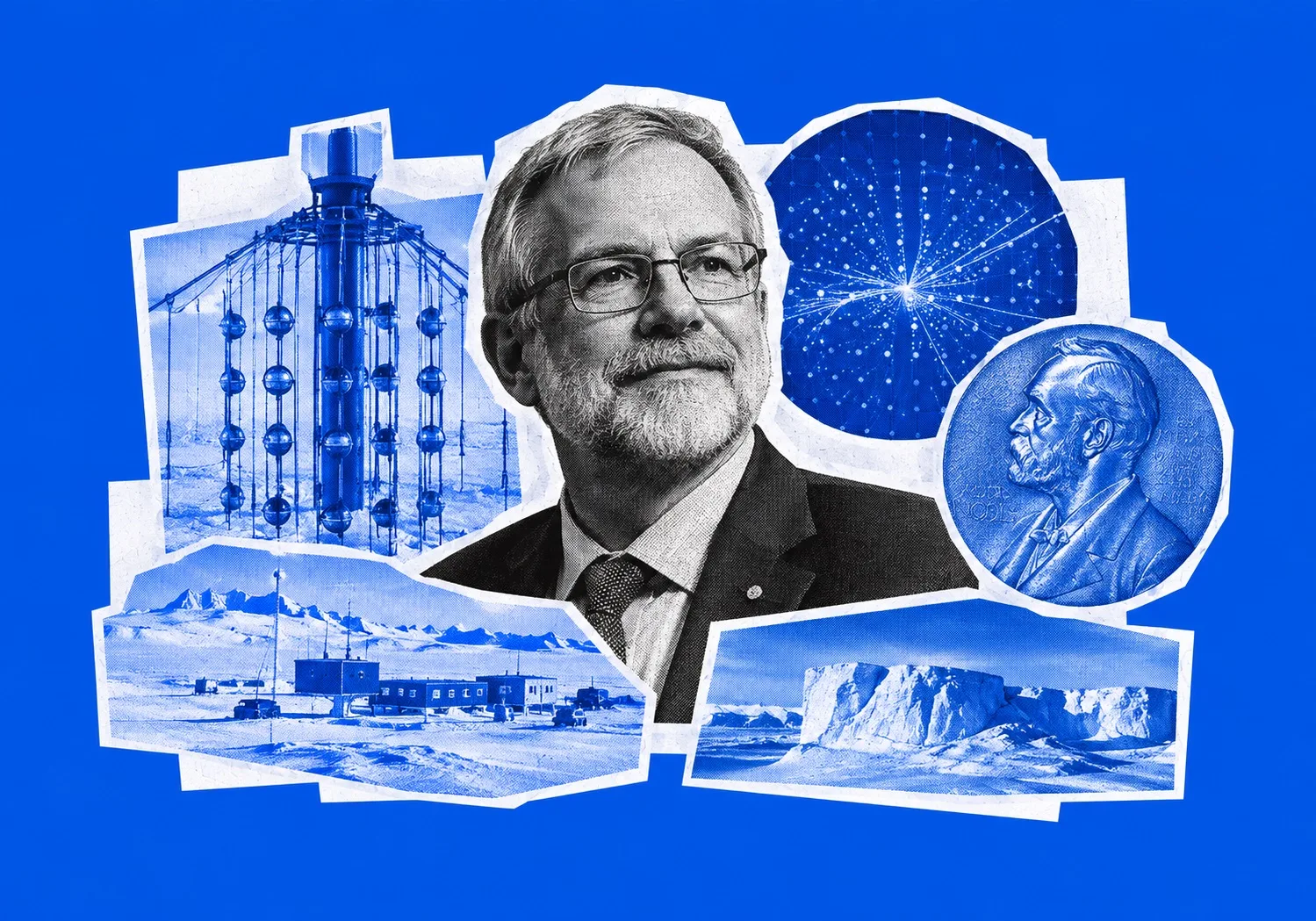
The awarding of the 2026 Nobel Prize in Physics to Francis Halzen recognises a fundamental shift in how humanity observes the universe. By turning a cubic kilometre of Antarctic ice into the IceCube Neutrino Observatory, the UW–Madison physicist helped establish neutrino astronomy - a breakthrough that coincides with the completion of IceCube's first major upgrade.
The telescope is no longer the only way to look into the cosmos.
The idea that required a kilometre of ice
Halzen's original proposition, made in 1988, was deceptively simple: use the enormous volume of Antarctic ice as the detecting medium for high-energy neutrinos.
Neutrinos are electrically neutral and interact with matter only through gravity and the weak nuclear force. Trillions pass through the Earth every second without leaving a detectable trace. Unlike light, they are not absorbed by interstellar dust. Unlike charged cosmic rays, they are not bent by magnetic fields.
That gives them a property conventional astronomy cannot reproduce. A neutrino can travel from the interior of an extreme astrophysical event in a relatively straight line and arrive at Earth carrying information about where it was produced.
The difficulty is detecting it.

IceCube solved the problem by making the Antarctic ice itself part of the instrument. More than 5,000 Digital Optical Modules, or DOMs, were installed on 86 vertical strings extending between 1.5 and 2.5 kilometres beneath the surface. Together, they instrument roughly one cubic kilometre of ice.
When a high-energy neutrino finally interacts with matter in the ice, it can produce a charged particle travelling at relativistic speed. That particle generates Cherenkov radiation - a faint blue flash - which the optical modules record.
The concept had to survive an extraordinary engineering test before it could become an observatory. Researchers first developed the technology through AMANDA, IceCube's predecessor, establishing that Antarctic ice was sufficiently clear for the transmission of Cherenkov light over the necessary distances.

The full IceCube detector then required 86 deep boreholes drilled with hot water to depths of around 2.5 kilometres. Its Digital Optical Modules had to operate with extremely low power consumption, while their electronics recorded light with timing precision measured in nanoseconds.
The result has been remarkably durable. About 98 per cent of the original DOMs remain fully operational more than a decade after being frozen into the ice, with another 1 per cent partially operational. Their timing performance has exceeded the original specification.
That reliability is part of the story behind the Nobel.
From a detector to a new map of the universe
IceCube's importance is not simply that it found neutrinos. It demonstrated that neutrinos could be used as astronomical messengers.
The observatory has accumulated tens of thousands of high-energy neutrino events across the northern and southern skies. Researchers have traced some of these particles to distant active galactic nuclei and identified neutrino emission associated with the plane of the Milky Way.
This changes what can be asked of an observatory.
Traditional astronomy relies predominantly on electromagnetic radiation: visible light, radio waves, X-rays and gamma rays. Those signals remain indispensable, but they often reveal the environment around an energetic object rather than allowing scientists to probe directly into its most violent regions.
Neutrinos offer a different channel.

The shift has produced what is now known as multi-messenger astronomy: combining information carried by electromagnetic radiation, gravitational waves, and high-energy particles. Each messenger reveals a different aspect of the same cosmic system.
IceCube has helped make neutrinos part of that vocabulary.
That is why the timing of Halzen's Nobel matters. The prize does not simply validate an experimental technique that worked. It recognises a transition in observational science from asking what the universe looks like to asking what different physical messengers can tell us about how it works.
The South Pole became part of the instrument
There is another reason the IceCube story is significant. It shows how modern fundamental physics increasingly depends on infrastructure normally associated with engineering rather than astronomy.
The detector is effectively embedded in a natural medium that cannot be manufactured on anything approaching the same scale. The ice is the instrument.

Building it meant designing a 5-megawatt hot-water drilling system capable of creating deep boreholes in Antarctic conditions. Fuel and equipment had to reach the South Pole by ski-equipped C-130 aircraft, with the scientific installation ultimately spanning a cubic kilometre beneath the station.
The technological architecture had to be exceptionally conservative. Once a DOM was frozen into the ice, replacing it was not a realistic option.
That constraint shaped the electronics. The original modules combined photomultiplier tubes with custom low-power integrated circuits capable of digitising signals within two nanoseconds. Lawrence Berkeley National Laboratory was central to that development.
The achievement is easy to overlook because the finished detector is largely invisible. There is no giant telescope dome, no moving dish and no conventional lens. Much of IceCube is simply sitting inside Antarctic ice, waiting for particles that almost always pass straight through it.
That invisibility is precisely what makes the infrastructure so powerful.
The upgrade changes what the old data are worth
IceCube's next phase began before the Nobel announcement.
In early 2026, an international engineering team completed a major upgrade after three consecutive polar field seasons. Six new deep boreholes were drilled, and new optical sensors were installed with two to three times the sensitivity of the original modules.
The upgrade also incorporated advanced calibration equipment, prototype sensors intended for the proposed IceCube-Gen2 expansion, the world's deepest sub-ice seismometers in partnership with the US Geological Survey, and deep-ice water sampling equipment for biological research.

The most consequential improvement may not be what the new sensors see from this point onwards. It is what they can do to the past.
With more sensitive instrumentation and improved calibration, scientists can revisit 15 years of archived observations. IceCube's historical dataset therefore becomes more valuable as the hardware improves. The physical detector remains frozen in place, but its digital record can be reinterpreted with greater precision.
That is a distinctive feature of large-scale scientific infrastructure. The useful life of an observatory no longer ends when the original experiment has been completed. Better sensors can change the scientific value of data collected years earlier.
A Nobel with consequences for the next detector
The institutional scale of IceCube also complicates the idea of a Nobel as a purely individual achievement.
More than 450 scientists from 58 institutions in more than 14 countries have contributed to the project. The University of Wisconsin–Madison has led it, while the US National Science Foundation has been its primary funder. European and Asian research agencies, the US Department of Energy and institutions including Lawrence Berkeley National Laboratory have provided additional support.
Halzen receives the Nobel alone, but the experiment is inseparable from this international scientific and engineering network.
The recognition could also strengthen the case for what comes next: IceCube-Gen2, a proposed expansion to a detector spanning several cubic kilometres. The upgraded sensors already include prototypes intended for that future system.
That matters because the next questions are harder than simply proving that astrophysical neutrinos exist.
IceCube has constrained models of neutrino production in gamma-ray bursts and placed limits on the accumulation of hypothetical WIMP or neutralino dark matter in the Sun. It has also contributed to the search for the sources of ultra-high-energy cosmic rays.
The absence of a decisive dark-matter signal is itself scientifically useful. IceCube's results narrow the range of possibilities for theories that predict detectable high-energy neutrinos from the Sun.
The larger competition is no longer simply between one telescope and another. Funding and scientific attention are increasingly divided among different ways of observing the same universe.
For optical astronomy, that means sharing territory once largely its own. For particle physics, it means constructing detectors on geographical and engineering scales once associated with national infrastructure rather than individual laboratories.
And for IceCube, the paradox is becoming sharper: the more successful the original detector becomes, the stronger the case for building something substantially larger.
Halzen's 1988 idea turned a continent of ice into an astronomical instrument. The 2026 Nobel recognises what that experiment proved. The next question is how far the same principle can be pushed when a cubic kilometre is no longer enough.
Read also:
- The 2026 Nobel Prize in Physiology or Medicine, awarded to Karl Deisseroth, Peter Hegemann, and Georg Nagel, recognizes a profound shift in neuroscience. By converting light-sensitive algal proteins into a precision switch for mammalian neurons, their work transformed the brain from something scientists merely observe into an engineered system they can directly control - and potentially heal.
Sources: The Nobel Prize, WISC, PHYS, The Brandon Sun