
Naval Group bets on Europe’s naval rearmament as defence spending accelerates

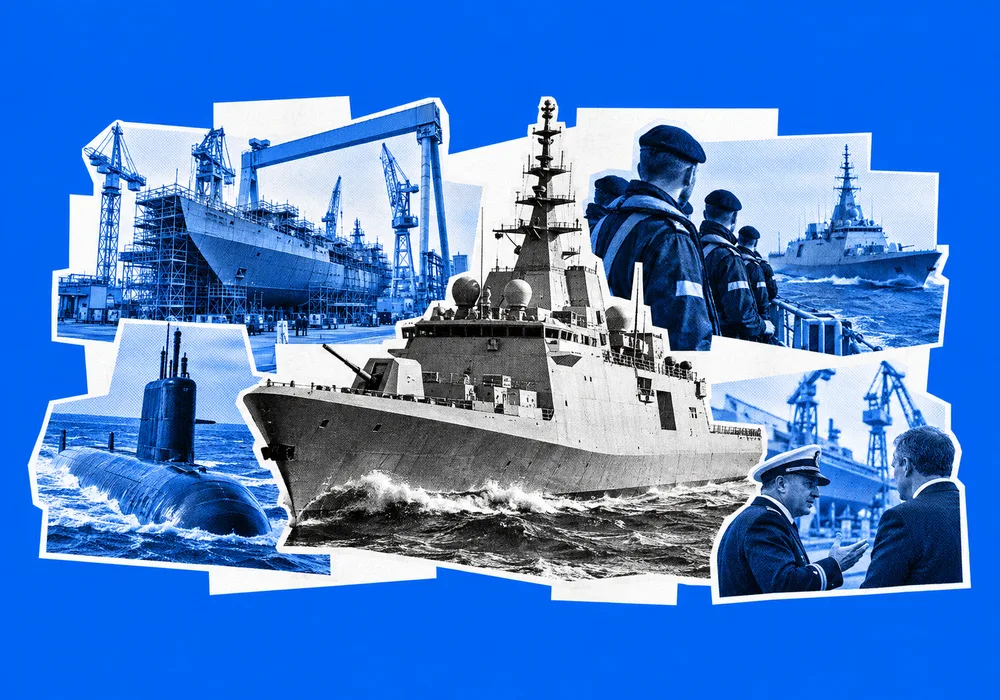
Europe’s accelerating defence spending is transforming the naval industry into a strategic competition for production capacity, delivery speed and industrial partnerships. France’s Naval Group is positioning itself to benefit, using its existing frigate production line and growing network of European partners to compete for new contracts as governments seek faster and more reliable ways to rebuild their fleets.
French shipbuilder Naval Group is expanding its push into European defence markets as governments increase military spending and look to rebuild naval capabilities after years of underinvestment. The company is betting that its ability to deliver frigates from an existing production line will give it an advantage over European competitors struggling with delays and rising programme costs.
The shift is part of a much broader increase in European defence procurement. EU member states are expected to spend around €454 billion on defence in 2026, up 8.6% from 2025 and 75.3% from 2021. Defence investment is projected to reach almost €163 billion this year, with equipment procurement accounting for the overwhelming majority of that investment.
Naval capabilities are becoming an increasingly important part of this spending. Russia’s war against Ukraine, growing concern over maritime security and uncertainty surrounding the long-term US security commitment have pushed European governments to strengthen their fleets, protect sea lines of communication and expand their ability to operate independently.
Naval Group sees an opening
Naval Group, which is controlled by the French state and 35% owned by Thales, says clients outside France now account for 20–25% of its €4.7 billion annual revenue. In 2019, European customers outside France accounted for virtually none of its business. Contracts in the Netherlands, Belgium, Greece and Sweden have since turned the European market into a significant growth area.
The company is now preparing a bid for Denmark, one of the most closely watched naval procurement competitions in Europe. The Danish decision will be significant not only because of the size of the contract, but also because it illustrates how European governments are increasingly looking for systems that can be delivered within realistic timeframes rather than programmes that may take a decade or longer to mature.
Naval Group is presenting its existing FDI frigate production line as one of its main advantages. The company says its Lorient shipyard can produce two Defence and Intervention Frigates a year, with delivery times of less than four years and an eventual target of around three years.
That matters in a European market where delays have become a major problem. Germany cancelled a major frigate programme in June after six years because of problems with deadlines and costs involving Dutch shipbuilder Damen. Belgium has also faced delays in a frigate programme involving the same company. Germany has subsequently turned to TKMS for smaller MEKO frigates.
Procurement is becoming an industrial race
The competition between Naval Group, Britain’s BAE Systems, Germany’s TKMS, Italy’s Fincantieri and other European shipbuilders is increasingly about more than individual tenders. Governments are simultaneously trying to rebuild military capabilities and strengthen domestic industrial capacity.
The European Commission identifies Naval Group as the largest producer of maritime defence vehicles in the EU by output value, with around 24% of the sector in 2025. Fincantieri followed with 15%, TKMS with 8% and Spain’s Navantia with 7%. The sector covers not only frigates and other surface combatants but also submarines, unmanned systems and underwater warfare technologies.
This creates a strategic advantage for companies that can combine scale with national industrial participation. Naval Group has increasingly adapted its model to local requirements, working with Greek shipyards and Sweden’s Saab and integrating national equipment into its platforms. The objective is to make foreign procurement compatible with domestic industrial policy rather than simply exporting a finished French product.
That approach reflects a wider European policy shift. In June, EU governments endorsed a maritime industrial strategy that explicitly linked shipbuilding to competitiveness, economic security, resilience and defence readiness. The strategy calls for stronger investment in advanced shipbuilding, critical industrial capacities, technology and supply chains while warning about strategic dependencies on production outside Europe.
The end of cheap and slow defence procurement
The naval sector illustrates a broader problem facing Europe's rearmament. Increasing budgets do not automatically translate into greater military capability if European industry cannot manufacture equipment quickly enough.
For decades, many European militaries operated with relatively small fleets and long procurement cycles. That model was easier to sustain when the perceived security environment was less demanding. Russia’s full-scale war against Ukraine has changed the calculation, while tensions in the Middle East and growing competition over maritime routes are adding further pressure on European governments to maintain credible naval forces.
The result is a market where delivery speed itself has become a competitive capability. Naval Group executives argue that having a production line already operating gives the company an advantage over competitors whose programmes are still being developed or have encountered delays.
This is particularly important because European defence spending is increasingly moving from personnel and maintenance towards investment in equipment. EU data show that defence equipment procurement reached €115 billion in 2025 and is expected to account for around 87% of defence investment in 2026.
A more fragmented but more capable European defence industry
The expansion of Naval Group also highlights a tension at the centre of Europe's defence strategy. European countries want stronger domestic industrial capacity and greater strategic autonomy, but they continue to compete against one another for major contracts.
That competition can encourage innovation and prevent a single supplier from dominating the market. At the same time, fragmented procurement can make European defence production more expensive and limit economies of scale. The EU's maritime industrial strategy therefore places particular emphasis on integrating industrial capacities and reducing strategic dependencies while preserving Europe's technological base.
For Naval Group, the opportunity is to turn France's established naval-industrial base into a wider European business model. Its partnerships in Greece and Sweden show how major defence contractors are increasingly expected to bring investment, technology transfer, maintenance capabilities and local suppliers alongside the weapons themselves. Naval Group has also been developing local maintenance cooperation in Sweden, including a partnership with Öresund Drydocks.
The broader trend is clear: Europe's defence build-up is beginning to reshape the continent's industrial map. Naval shipbuilding is becoming one of the areas where governments are simultaneously trying to close military capability gaps, secure supply chains and preserve high-value manufacturing inside Europe. The companies able to combine rapid production with cross-border industrial partnerships are likely to capture an increasing share of the new spending.
Sources: Council of the EU, European Commission, Naval Group