
Ukraine Seeks European Alternatives to US Air Defence and Starlink as Transatlantic Tensions Grow

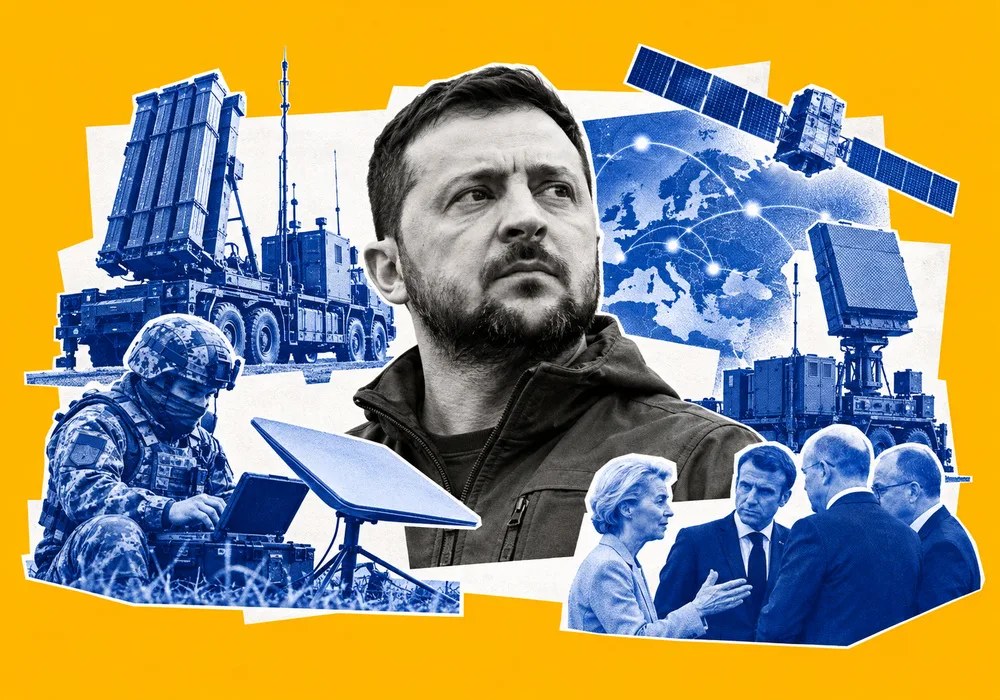
Kyiv is pursuing European alternatives to American air defence systems and satellite communications as uncertainty over Washington’s support exposes critical vulnerabilities in Ukraine’s military infrastructure. The effort could accelerate Europe’s defence integration, but replacing US capabilities will require sustained investment, technological development and closer cooperation with Ukraine.
Ukraine is stepping up efforts to develop European alternatives to US-made air defence systems and Starlink satellite communications, as growing tensions with Washington raise questions about the long-term reliability of American military support. Ihor Zhovkva, deputy head of the Office of the President of Ukraine, confirmed that Kyiv has begun substantive discussions with European countries and defence companies on both fronts. Speaking to Euronews ahead of the European Union summit in Brussels on 16 October, Zhovkva said Ukraine intended to participate directly in developing these capabilities rather than remain dependent on systems controlled outside Europe.
The initiative reflects a broader reassessment of Ukraine’s military and technological dependencies. American systems have become integral to the country’s ability to detect incoming threats, coordinate forces and sustain operations across a battlefield increasingly shaped by drones, real-time intelligence and satellite connectivity. Although Kyiv continues to regard the United States as an essential security partner, uncertainty over future American policy has increased the urgency of developing alternatives that European countries can support and maintain independently.
The immediate concern is not simply the possibility of reduced military assistance. It is the extent to which critical operational capabilities depend on infrastructure whose availability, performance and use are subject to decisions made in Washington. For Ukraine, reducing this vulnerability is becoming part of its longer-term defence planning. For European governments, the same problem highlights the limits of their own technological and military autonomy.
European Air Defence Plans Move Towards Industrial Cooperation
One of the central elements of Kyiv’s strategy is the development of a European air defence system capable of addressing threats that existing national and allied systems cannot fully cover. Zhovkva pointed to FREYJA, a European anti-ballistic missile initiative launched in Paris in July, as an example of work that has moved beyond political declarations towards direct engagement between defence companies. Ukraine intends to play a leading role in the process, bringing operational experience gained during Russia’s full-scale invasion into the development of future European capabilities.
For European defence industries, cooperation with Ukraine offers access to practical experience in countering sustained missile and drone attacks, integrating different systems and operating under conditions of continuous pressure on military resources. Ukraine has also developed a substantial domestic defence technology sector, particularly in unmanned systems, which could contribute to joint research, production and the adaptation of European equipment to battlefield requirements. The challenge will be to translate this experience into programmes that can deliver reliable systems at scale while remaining compatible with the armed forces of different European countries.
Air defence is particularly difficult to replace because it depends on more than the availability of missile launchers. Effective protection requires radar coverage, command-and-control infrastructure, interceptor supplies, early-warning intelligence and the ability to coordinate different systems against simultaneous threats. Europe already operates a range of national air defence platforms, but developing a comprehensive European alternative to American capabilities would require substantial investment, industrial coordination and long-term commitments from participating governments.
For Ukraine, the immediate priority remains obtaining enough interceptors and operational systems to protect cities, energy infrastructure and military facilities against Russian attacks. A European programme under development cannot meet those needs on its own in the short term. Kyiv will therefore continue to seek deliveries from existing partners while pursuing a longer-term arrangement that reduces its exposure to changes in American policy.
Starlink Dependence Exposes a Critical Communications Vulnerability
Satellite communications represent a more immediate technological challenge. Starlink has become a crucial part of Ukraine’s communications infrastructure since Russia launched its full-scale invasion in February 2022, supporting military units, government services and civilian connectivity. On the battlefield, reliable satellite links allow drone operators to receive live video, coordinate missions and exchange information between units operating in areas where terrestrial networks are damaged, unavailable or vulnerable to attack.
The distinction between Starlink and Starshield is important. Starlink is primarily a commercial satellite internet service, whereas Starshield is designed for government and national security users and incorporates capabilities intended for sensitive operations. Although the services are not interchangeable, they share technological foundations and infrastructure. The disruption affecting Starshield terminals in October demonstrated how restrictions on a specialised military service can interfere with operations even when the wider civilian network remains available.
Ukrainian military personnel reported that the interruption affected drone missions and caused losses when communications were cut. The reasons for the restrictions were not immediately established, and the incident did not by itself demonstrate that Washington had deliberately withdrawn support. Nevertheless, Elon Musk’s statement that the US military and ultimately the president determine limits on Starshield’s speed and usage reinforced the strategic concern: Ukraine cannot independently guarantee access to a capability on which parts of its military operations depend.
European governments and companies have been exploring alternatives, but there is no immediate substitute capable of replicating Starlink’s combination of coverage, performance and suitability for frontline use. Eutelsat’s OneWeb network has attracted attention as a potential European option, yet its existing architecture and user terminals present limitations for military applications. Replacing Starlink would also require changes to thousands of terminals and potentially the equipment and operating procedures built around the existing system.
The European Union’s IRIS² satellite constellation is intended to strengthen Europe’s secure communications infrastructure, while Germany is developing a separate military satellite constellation. Both initiatives form part of a wider effort to reduce dependence on external providers. However, these projects are not ready-made replacements for Ukraine’s current battlefield communications, and their development timelines leave a substantial gap between the strategic objective and the immediate operational requirement.
The issue extends beyond connectivity alone. Modern military operations increasingly depend on the continuous transmission of data between drones, reconnaissance platforms, command centres and individual units. A communications system that works adequately for civilian internet access may not provide the speed, resilience or security required for military operations. Any European alternative will therefore need to be assessed against battlefield performance rather than simply the number of satellites deployed or the geographical area covered.
Europe Faces a Wider Intelligence and Defence Gap
The debate over Starlink is unfolding alongside concerns about Ukraine’s access to American missile-warning intelligence. On 13 and 14 October, President Volodymyr Zelenskyy said Ukraine had received no advance warning from its partners about Russian ballistic missile attacks on Kyiv for two consecutive nights. The circumstances surrounding the intelligence gaps remained unclear, while US President Donald Trump maintained that Washington was still sharing intelligence with Ukraine.
American space-based infrared systems provide an important capability for detecting the heat signatures of missiles shortly after launch. European countries do not currently possess an equivalent system offering the same combination of capabilities. Developing independent satellite communications, therefore, would address only one part of Ukraine’s broader reliance on American military infrastructure. Early-warning systems, intelligence sharing, surveillance and command networks would require their own investment and coordination.
This distinction is significant for European security planning. A country may possess modern weapons and sufficient ammunition but still face operational limitations if it lacks reliable intelligence or the infrastructure required to coordinate its forces. The ability to detect threats, transmit information and respond before an attack reaches its target is increasingly central to military effectiveness. Ukraine’s experience illustrates how vulnerabilities in these interconnected systems can affect the performance of otherwise capable armed forces.
The same dependencies concern European NATO members. The continent relies on American capabilities in several areas of defence, including intelligence, strategic transport, satellite infrastructure and advanced command systems. Growing uncertainty over the future direction of US foreign policy has strengthened arguments for developing European capabilities that can operate with greater autonomy. However, the objective is not simply to reproduce every American system independently. It is to identify the capabilities on which European security most critically depends and ensure that access to them cannot be interrupted without viable alternatives.
For Ukraine, the distinction between European political support and practical military capacity is becoming increasingly important. European leaders have reiterated their backing for Kyiv, but declarations of solidarity cannot immediately replace specialised technology, intelligence infrastructure or weapons already integrated into Ukrainian operations. Building these capabilities will require coordinated procurement, long-term financing and a willingness among governments to support projects whose benefits may extend well beyond the current war.
Ukraine's Defence Needs Put Pressure on European Industry
Kyiv’s push for European alternatives comes as the EU faces competing demands on defence spending and support for Ukraine. At the Brussels summit on 16 October, Zelenskyy was seeking additional air defence systems and interceptors, alongside financial assistance and measures to protect Ukraine’s energy infrastructure ahead of winter. Russian attacks have continued to place pressure on the country's electricity supply, while the scale of Ukraine’s military requirements remains considerable.
Zhovkva acknowledged that European support still falls short of Ukraine’s needs, despite substantial contributions from countries including Germany. He called for states able to provide air defence equipment and missiles to deliver them, while those unable to supply equipment should contribute financially. The distinction highlights the immediate challenge facing European governments: industrial programmes can strengthen long-term security, but Ukraine must also receive the equipment required to defend itself now.
The industrial dimension is equally important for Europe. Joint projects with Ukraine could support the development of production capacity, improve interoperability and give European manufacturers access to experience acquired under combat conditions. Yet cooperation will need to address practical questions concerning intellectual property, technology transfer, financing, production priorities and the division of responsibilities between national governments and private companies. Without clear commitments, European defence initiatives risk remaining fragmented across competing national programmes.
There is also a risk that demand for new systems will outpace the ability of European industry to deliver them. Air defence interceptors, satellite infrastructure and secure communications require specialised components, skilled labour and investment over several years. Increasing production will depend not only on political decisions but also on stable orders and predictable funding. Ukraine’s immediate requirements and Europe’s longer-term strategic ambitions will therefore need to be addressed in parallel rather than treated as competing priorities.
European Security Guarantees Still Depend on the United States
Despite the push for greater autonomy, Kyiv has not abandoned its reliance on the United States. Zhovkva stressed that European security guarantees should form the foundation of Ukraine’s long-term security arrangements, supported by strong Ukrainian armed forces, joint defence production and progress towards EU membership. At the same time, he acknowledged that European guarantees could not function independently of American support.
This position reflects the limits of Europe’s current capabilities. The continent can increase its defence production, expand satellite programmes and improve coordination between national armed forces, but replacing the full range of American military and intelligence assets would be a much larger undertaking. For Ukraine, the objective is therefore better understood as reducing critical dependencies and creating additional options, rather than ending transatlantic defence cooperation.
Kyiv also wants European countries to have a direct role in any negotiations concerning the future of the war and Ukraine’s security arrangements. Zhovkva argued that European participation should extend to every stage of the process, including potential talks between national leaders. His position links the development of independent European capabilities with a broader diplomatic objective: ensuring that decisions about European security are not made without the involvement of European governments.
The emerging debate is consequently about more than replacing individual American technologies. It concerns whether Europe can build the industrial capacity, infrastructure and political coordination necessary to sustain Ukraine’s defence if US support becomes less predictable. Ukraine’s battlefield experience offers European governments a practical basis for identifying weaknesses and setting priorities, but turning that experience into lasting capabilities will require years of investment and cooperation.
The immediate requirement remains continued access to American systems alongside additional European deliveries. Over the longer term, however, Kyiv’s initiative could become a catalyst for a more integrated European defence industry, particularly in air defence, satellite communications and intelligence infrastructure. The success of that effort will depend on whether European governments can translate growing concern about strategic dependence into funded programmes and operational capabilities before another crisis exposes the same vulnerabilities.
Sources: Euronews, President of Ukraine