
Moscow Refinery Hit by Drones as Russia Votes in State Duma Election

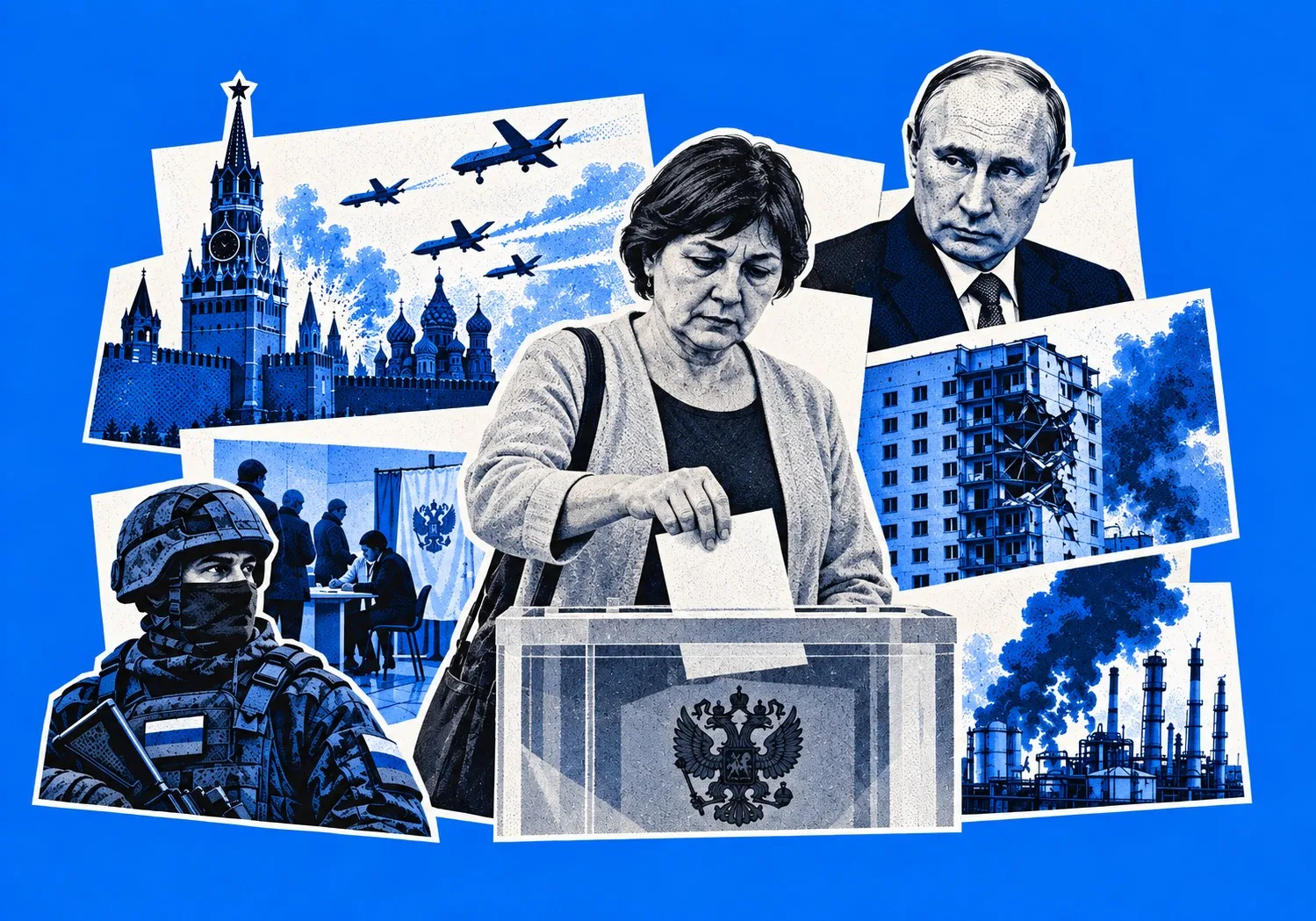
A major drone strike—which Russian authorities blamed on Ukraine—set fire to a primary oil refinery in Moscow on 20 September, casting a shadow over the final day of Russia’s State Duma elections. Hundreds of drones targeted the capital and its surrounding region, killing at least two people and damaging the facility, officials said on Sunday. Moscow Mayor Sergey Sobyanin claimed that air defences intercepted more than 1,600 drones, 450 of which were aimed directly at Moscow, calling the raid an attempt to disrupt the vote. Ukrainian officials have not commented on the attack. The strike on the Kapotnya facility—which supplies 40 per cent of the capital’s petrol—brought the physical impact of the war directly into the Russian capital, just as President Vladimir Putin sought to use the three-day parliamentary vote to demonstrate total domestic unity behind his military campaign.
By dawn, municipal fire crews were working through smoke at the site. Air defence fragments struck a residential complex near Orekhovy Boulevard, killing two people in the surrounding region.
Moscow Mayor Sergey Sobyanin confirmed the strikes. He called the raid a direct attempt to disrupt the vote.

The Kremlin had spent months preparing the State Duma election. The goal was simple: demonstrate total public backing for Vladimir Putin’s war in Ukraine. An industrial fire inside the capital’s ring road on polling day exposed the limits of that plan.
The election was the first national legislative vote since the invasion of February 2022. Independent media is banned. Key opposition leaders are dead, jailed, or living in exile.
Under these conditions, the presidential administration designed the three-day vote to deliver a solid parliamentary majority for United Russia. Four nominal opposition parties were allowed to share the remaining seats.
Yet the decision to strip minor political groups from the ballot revealed real anxiety inside the Kremlin. Officials feared passive war fatigue among the civilian population.
In August, Russia’s Supreme Court disqualified the liberal Yabloko party from submitting its national candidate list. The court cited technical copyright errors in the party's paperwork.
Yabloko had historically won barely two per cent of the national vote. However, leaked internal polling from the investigative group Faridaily told a different story.
The state's own numbers showed Yabloko’s ceasefire platform reaching between 5.5 and 9.4 per cent in key municipal districts. Kremlin strategists realised that a legal anti-war candidate list could collect millions of protest votes across major cities.
The court ruling removed that threat.
Senior Yabloko figures faced swift punishment. Lev Shlosberg, the party’s deputy chairman, received an 11-year prison sentence for discrediting the armed forces. Two other senior officials were jailed before polling began.
Anti-war politicians abroad faced similar pressure. Ilya Yashin cancelled a public meeting with voters in Yerevan after receiving warnings about his physical safety.
The purge left ten registered parties on the ballot. All five parliamentary movements had previously voted to endorse the annexation of Ukrainian territory. Voters opposed to the conflict were left with no candidate advocating an end to the fighting.

Managing the vote required total control over physical and digital polling systems.
To guarantee high turnout without relying on foot traffic at polling stations, regional authorities turned to Remote Electronic Voting, known as DEV.
Ella Pamfilova, chairwoman of the Central Election Commission, reported nationwide turnout at 44.38 per cent by the evening of 19 September. She noted that over 4.6 million people voted early. Remote electronic platforms reported an 80 per cent participation rate.
These electronic voting systems operated without independent oversight.
Public-sector workers across several regions reported heavy pressure from employers. In Kamchatka, workers received numbered lottery tickets. Workplace coordinators checked these numbers against employee lists at local polling stations.
Voting ceased to be a civic choice. It became a monitored duty of employment.
At physical polling stations, independent observers were systematically cleared out. Election analyst Ivan Shukshin identified clear mathematical anomalies in official turnout data. He pointed to artificial turnout spikes in Dagestan, Ivanovo, and Kabardino-Balkaria.
At Precinct 1919 in St Petersburg, police beat a Yabloko observer unconscious. They then charged him with disobeying law enforcement orders.
In Precinct 60 in the same city, an observer counted 387 voters dropping ballots into boxes. The official report entered into the state’s GAS Vybory digital registry listed 936 voters. In Perm, observers were turned away because officials claimed there were no spare chairs in the room.
Moscow also used the election to assert authority across disputed international borders.
Russian officials opened 15 polling stations in Transnistria, Moldova’s breakaway region, for roughly 220,000 Russian passport holders living there. The Moldovan government in Chisinau issued formal diplomatic protests, calling the move a violation of its sovereignty.
Similar voting operations took place across occupied Ukrainian territories. The state used domestic electoral machinery to enforce contested land claims.
While officials managed the vote, digital and physical infrastructure failed elsewhere. Pamfilova claimed central servers repelled constant cyberattacks throughout 19 September.
In the Far East, the Ministry of Digital Development reported physical fiber-optic cable sabotage. The damage cut internet access across Sakhalin, Magadan, Kamchatka, and Chukotka before engineers repaired the lines.
The drone strike on the Kapotnya refinery brought these disruptions directly to the capital.
Operated by Gazprom Neft, the refinery processes 11 million tonnes of crude oil a year. It supplies 40 per cent of Moscow’s petrol and aviation fuel.
Long-range strike drones bypassed regional air defences to hit the facility's primary crude distillation unit, known as ELOU-AVT-6.
At the same time, drones set fire to warehouses at the Sofyino logistics park in the Ramensky district. Emergency services blocked off surrounding roads while voters walked to local polling stations.
The new State Duma will deliver the exact numbers the Kremlin planned. United Russia will keep its dominant majority, supported by satellite parties that back military spending and conscription bills.
The new parliament will quickly approve the upcoming defence budget. Military and security operations will swallow over 30 per cent of total federal spending.
Yet the methods used to secure this result show deep structural weakness. By banning minor parties, forcing electronic voting, and arresting observers, the government destroyed the tools it used to measure public opinion.
Inflation is rising. Industrial sites inside Moscow are taking direct hits from long-range drones. The administration has secured total control over parliament, but it can no longer read the mood of its own people.
Digital Voter Control
The shift to remote electronic voting marks a permanent change in Russian governance.
The state no longer needs to persuade voters. It does not even need to stuff ballot boxes at physical precincts. Instead, the Central Election Commission has moved millions of citizens into a digital space managed on state servers.
This change lowers the administrative cost of managing elections. More importantly, it removes the physical evidence that independent observers used to catch fraud.
Pressure to register for electronic voting was intense across state factories, universities, and town halls. Department heads ordered staff to submit screenshots confirming their registration on the state portal Gosuslugi.
On polling days, automated software tracked who had voted. The system sent automatic alerts to managers listing employees who had not yet logged in.
By nine in the evening on 19 September, the electronic platform reached its target figures. Central planners could then adjust physical precinct counts to match the required national total.
Removing physical observers was essential to protect this dual system.
The state had already labeled independent monitoring groups like Golos as undesirable organisations, making their work illegal. Individual volunteers who tried to monitor precincts for Yabloko or the Communist Party were quickly removed.
In the Leningrad region, police detained observers in patrol cars outside voting halls. In St Petersburg, precinct chairmen destroyed paper ballots while moving them to sealed bags, preventing manual recounts from exposing discrepancies in the digital system.
This administrative machine works well under controlled conditions. However, it creates a dangerous blind spot for senior officials.
When local governors alter turnout data to hit targets, Moscow receives false information about public loyalty. By silencing independent observers, the state loses its ability to spot regions where public anger is rising.
Border Operations and Extraterritorial Claims
The Kremlin ran this election well beyond the legal borders of the Russian Federation.
By holding votes in Transnistria, occupied Ukrainian regions, and disputed border zones, Moscow used electoral law to cement its territorial claims.
In Moldova, opening 15 polling stations in Transnistria was a clear challenge to President Maia Sandu. Chisinau had issued explicit diplomatic notes banning polling sites outside the Russian embassy.
Local authorities in Tiraspol ignored the ban. They worked directly with Moscow to open voting centres.
More than 200,000 Russian passport holders were directed through these precincts under the eyes of local security forces. The operation reassured pro-Russian groups in Transnistria while proving that Chisinau could not enforce its laws in the breakaway territory.
In occupied Donetsk, Luhansk, Zaporizhzhia, and Kherson, mobile voting units moved under armed escort. Election workers carried ballot boxes from house to house, accompanied by soldiers in combat gear.

Residents had to show identity documents and mark their ballots in front of troops. Unsurprisingly, official turnout in these regions reached near-total levels. The Kremlin used these numbers to claim that occupied populations actively support integration into Russia.
These extraterritorial votes serve two main purposes.
Internationally, they create administrative changes on the ground that Moscow claims are permanent. Domestically, they force all parliamentary parties to endorse the war effort.
Every delegate taking a seat in the State Duma now operates under a legal structure that treats occupied Ukrainian territory as part of the Russian state.
Economic Cost of Infrastructure Strikes
The strikes on Kapotnya and the Sofyino logistics park exposed the vulnerability of Moscow's industrial core.
The Kapotnya refinery is the main fuel engine for the capital's transport network. The ELOU-AVT-6 unit damaged in the attack performs the initial separation of crude oil into petrol, diesel, and aviation fuel.
Repairing or bypassing this unit forces the state to bring in refined fuel by rail from plants in Nizhny Novgorod or Ryazan.
This rerouting places heavy strain on Russia's railway network, which is already clogged with military hardware moving to the front lines. The economic damage goes far beyond the cost of new equipment. It causes higher transport expenses, local fuel shortages, and rising insurance costs for industrial firms.
The attack on the Sofyino logistics park in the Ramensky district hit supply chains directly.
Logistics hubs surrounding the capital store consumer goods, food, and industrial parts for millions of residents. Striking these sites shows that the economic shield protecting Moscow from the war is breaking down.
State television minimised coverage of the fires, focusing instead on high interception claims from the Defence Ministry. Yet smoke rising over industrial zones was impossible to hide from city residents.
For people in the capital, anti-aircraft fire and industrial blazes shattered the official narrative that the war is a distant conflict contained entirely within Ukraine.
The Reality of the Post-Election Regime
The end of the 2026 Duma election defines the political environment for the Kremlin’s long-term plans.
With a totally compliant parliament locked in for five years, the executive branch has complete freedom to run conscription drives, raise taxes, and funnel national wealth into arms factories.
The State Duma will pass future budgets without debate. Military spending already accounts for more than six per cent of gross domestic product and over 30 per cent of federal outlays.
The government can easily expand this budget by cutting funds for hospitals, schools, and regional roads. Systemic opposition parties will play their assigned role, offering minor complaints about social policy while voting for every military bill put before them.
However, winning this election through total administrative force creates serious long-term risks for the regime.
By banning peace platforms and locking up moderate politicians, the state has removed every legal channel for handling domestic discontent. Rising prices, public fatigue, and damaged infrastructure cannot be managed through parliamentary debate because the political system no longer allows competing views to exist.
Russia’s transition to a rigid wartime state is now complete. The political system can generate perfect turnout numbers, arrest protesters, and enforce online voting. What it cannot do is protect its own capital from the physical reality of the war it started.
Sources: Reuters, Euractiv, Meduza, The Guardian