
Jordan Bardella’s Antisemitism Scandal: Has France’s Rassemblement National Really Changed?

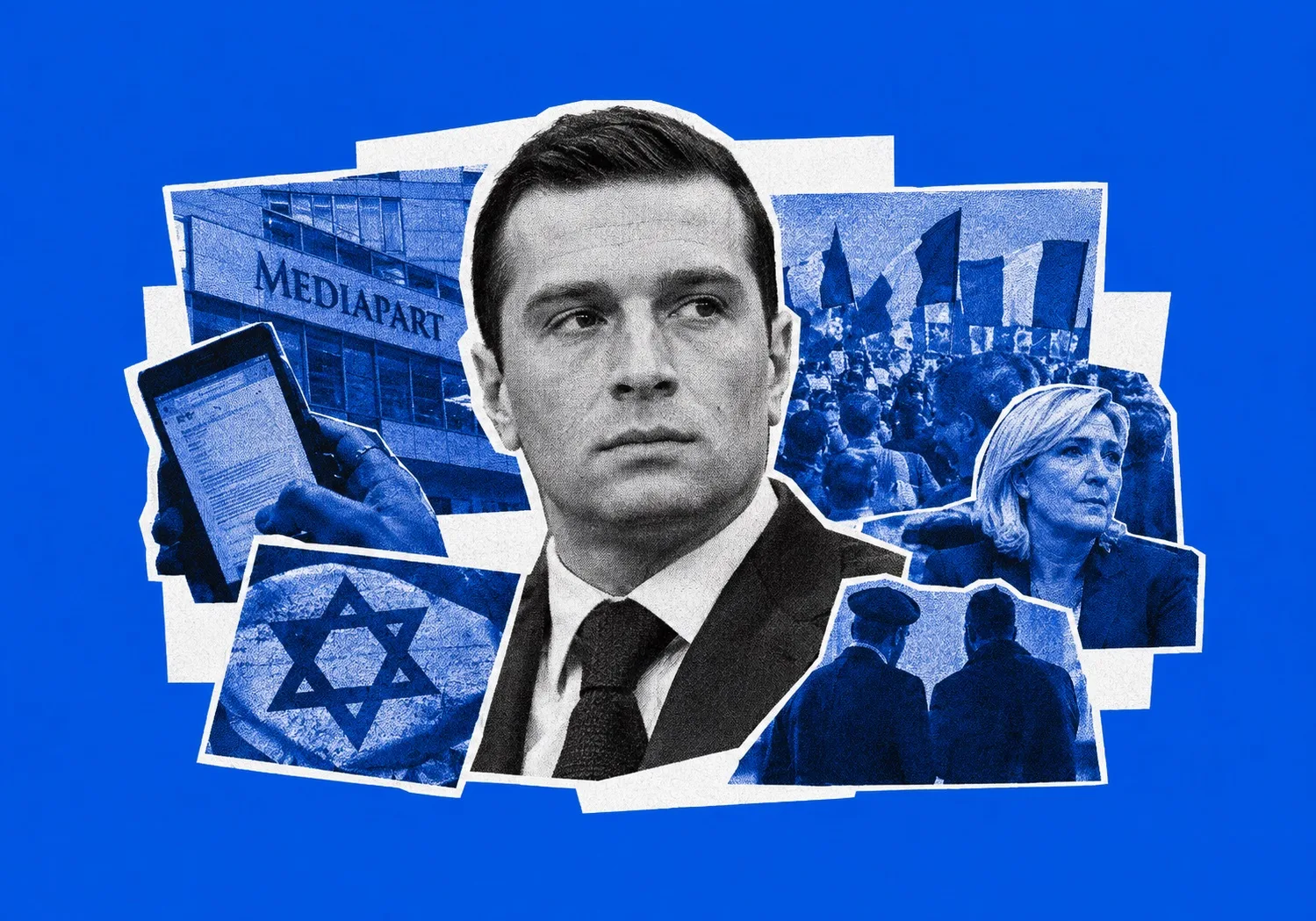
An investigation by Mediapart exposing alleged private anti-Semitic messages by Jordan Bardella has shattered the Rassemblement National’s carefully polished image. As Marine Le Pen’s designated prime minister candidate for 2027 faces scrutiny over his early political roots, the scandal raises a decisive question for French democracy: did the far-right party genuinely abandon its radical past, or merely master the art of political communication?
The allegations are striking in their specificity. In messages cited by Mediapart, Bardella allegedly claimed that all banks were owned by Jews and that Jews sought to dominate other peoples. Other passages reportedly accused French politicians, among them Laurent Fabius, Pierre Moscovici and Manuel Valls, of putting Israeli or financial interests ahead of France.
The outlet also attributes conspiracy theories about the September 11 attacks to Bardella, including speculation about Mossad, and reports that he feared Marine Le Pen could be assassinated or targeted in an engineered attack if she tried to take control of the central bank.
These are allegations about private communications, not established findings of a court. But their content goes to the heart of the RN's political reinvention. The idea that Jews secretly control banks and governments belongs to a long tradition of anti-Semitic conspiracy theory. It is not equivalent to opposing Israeli policy or criticising the influence of financial institutions.
That distinction matters because the RN has spent years trying to persuade French voters that it has left such attitudes behind.
Marine Le Pen took control of the Front National in 2011 and set about making it electable beyond its traditional constituency. Her father, Jean-Marie Le Pen, had repeatedly been convicted over anti-Semitic remarks and Holocaust denial. In 2015, she expelled him from the party. In 2018, the Front National became the Rassemblement National.
The changes were intended to be more than cosmetic. The party wanted voters to judge it on its programme rather than on the record of its founder. Bardella, who joined as a teenager, became an embodiment of that ambition. His age and carefully controlled public image offered a way to present the RN as a party moving beyond its origins.
The difficulty is that a new generation does not automatically mean a new political culture.

What Bardella thought the party was doing
One passage in the investigation could prove more damaging than the individual messages. In a communication from the summer of 2013, Bardella reportedly noted that new members received a charter under Marine Le Pen's leadership. He then remarked that politics was all about communication, while suggesting that the party's fundamental ideology, established in 1972, had not changed.
If authentic, the exchange raises a question about how he understood the transformation taking place around him. Was the RN changing its beliefs, or learning to present them in a way that made electoral success more likely?
That question cannot be answered by one message alone. Political parties evolve unevenly. Public positions change, internal disagreements develop and individual politicians sometimes leave behind the views they held when younger. Nor does a politician's private message necessarily provide a complete account of his beliefs.
Still, the reported comment sits awkwardly beside the RN's public claim to have made a decisive break with its past. The party has presented dédiabolisation as a process of political normalisation. The message attributed to Bardella suggests that, at least in his understanding at the time, the distinction between ideological change and communications strategy was much less clear.
This is where the affair becomes an institutional problem for the RN rather than simply a personal embarrassment for its chairman. Bardella's rise has been used to demonstrate that the party can renew itself. If his formative political environment remained steeped in the ideas the RN now rejects, his career becomes evidence of a more complicated story.
The argument over authenticity
Bardella has dismissed the documents as crude fakes and described their publication as a dirty-tricks operation. On 2 October, Mediapart published details of its verification process.
According to the outlet, two independent sources supplied material. One source requested an official archive of their Meta account data, which was extracted and authenticated by a French commissaire de justice. The newsroom also checked timestamps, biographical details and contextual information against established historical facts.
That is a substantive account of how the material was examined. It is not the same as a judicial determination that Bardella wrote the messages. The distinction remains important, particularly because he has threatened legal action over the allegations.
His own account of his early political career has also attracted scrutiny. Bardella argued that he was not an active Front National campaigner in the summer of 2013 and was still a minor. Yet his 2024 autobiography, Ce que je cherche, and a 2025 interview with Le Parisien state that he joined the party in early 2012, at the age of 16.
The two statements do not necessarily contradict each other in every respect: joining a party is not the same as campaigning actively. But the earlier accounts establish that he was already a member during the period in question. They make it harder to dismiss the episode as unrelated to his political beginnings.
For now, the dispute has two distinct elements. There is the factual question of whether the messages are authentic, and there is the political question of what they would mean if they are. The second cannot be settled simply by pointing to the first.
The networks behind the rise
The investigation also looks at the people and ideas surrounding Bardella during his early years. Former party officials and advisers cited by Mediapart described the influence of Alain Soral, an anti-Semitic essayist and founder of Égalité & Réconciliation, and comedian Dieudonné M'bala M'bala. Soral has been repeatedly convicted in France in cases involving racial defamation, incitement to hatred and Holocaust denial.
The outlet reported that Bardella kept The Secrets of the Federal Reserve, a book by Holocaust denier Eustace Mullins, at his bedside. On its own, that detail says little about a person's beliefs. In the context of the alleged messages and accounts of his political formation, however, it forms part of the picture the investigation is trying to establish.
There are also connections between figures from the RN's earlier political environment and its present-day operation. François Paradol, Bardella's chief of staff, previously served as treasurer of Banlieues Patriotes, an organisation with historical links to Soralist networks. Frédéric Chatillon, a former leader of the far-right student group Groupe Union Défense, has longstanding ties to Marine Le Pen and has worked as a contractor for the party's election campaigns.
The communications agency e-Politic, headed by Paul-Alexandre Martin, has received contracts from the RN and its European Parliament group, Patriots for Europe. The group awarded the agency more than €340,000 in contracts in 2025.
These links do not establish that the people involved share the same ideology, and commercial relationships are not evidence of wrongdoing in themselves. Their significance lies elsewhere: the RN's transformation has not necessarily displaced every network associated with its earlier radical environment. Some relationships have survived the change of name and public presentation.
A party's internal culture is shaped by more than its official programme. The people who advise its leaders, manage its communications and maintain its political infrastructure also help determine how it operates. That makes continuity among personnel and networks relevant to any assessment of how far the RN has really changed.
A foreign policy shift under scrutiny
Bardella's alleged messages also threaten the party's effort to improve relations with Jewish voters and Israel. He visited Jerusalem in March 2025 and met Israeli minister Amichai Chikli. The RN also participated in the Paris march against anti-Semitism in November 2023.
These moves were intended to establish the party as a more conventional political actor, particularly on security and foreign policy. The allegations now invite a difficult question about the relationship between those public gestures and the beliefs attributed to its leader during his formative years.
The RN can argue that Bardella has changed since 2013. There is nothing inherently unreasonable about judging a politician's current positions separately from views expressed when younger. But the party has made his personal image central to its claim that it has moved beyond the Front National's history. That makes the allegations harder to contain.
Marine Le Pen and the party leadership have backed Bardella, portraying the investigation as an attempt to destabilise their preparations for 2027. Their position avoids a damaging internal split, but it also leaves them defending the credibility of the man chosen to represent the RN's future.
Bardella's political value has always rested partly on the impression that the party could retain its electoral appeal while leaving its old controversies behind. The investigation has made that proposition harder to sustain. The question facing the RN is no longer simply whether its chairman can disprove the allegations, but whether the party can explain what, beyond its public language, has changed since the days of the Front National.
Sources: Mediapart, Reuters, AFP, Le Monde