
Marine Le Pen Can Run in 2027, But Her Campaign Is Bound

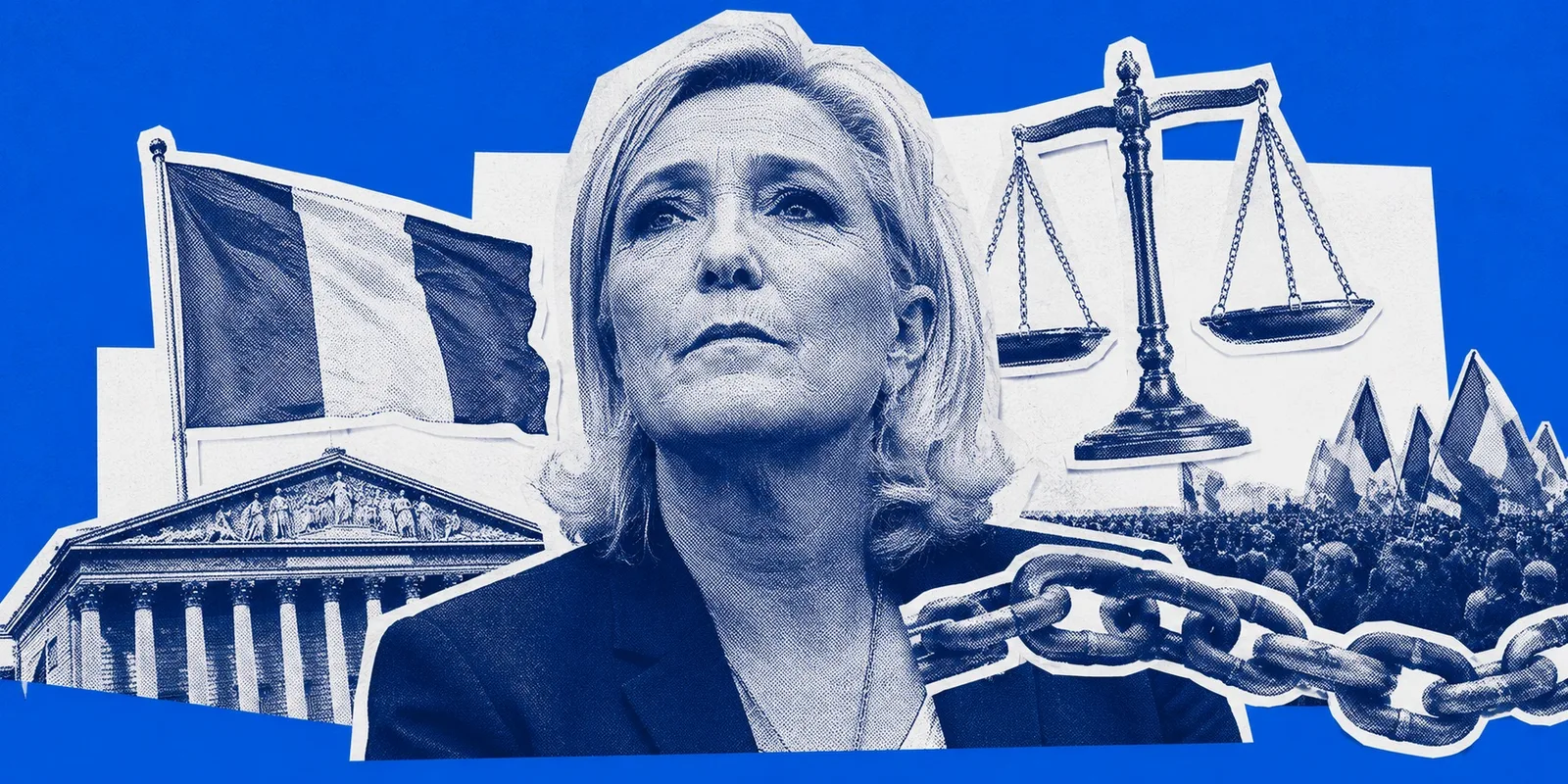
The Paris Court of Appeal has cleared Marine Le Pen to run in France’s 2027 presidential election, but a mandatory electronic bracelet sentence threatens to cripple her campaign. By upholding her conviction for embezzling €4 million in EU funds while reducing her ineligibility ban to time served, the court removed the absolute legal barrier to her candidacy - only to replace it with severe physical restrictions. For the National Rally, the ruling transforms a legal battle into a stark operational choice between its longtime leader and her rising deputy, Jordan Bardella.
The court confirmed the essential findings of the first-instance judgment of March 31, 2025. Le Pen and 10 co-defendants were found guilty in a case concerning European Parliament assistants whose work, prosecutors argued, was diverted toward national party operations rather than parliamentary duties. The arrangement lasted more than 11 years, from 2004 to 2016, and involved more than €4 million.
Presiding Judge Michèle Agi stressed the duration of the scheme, the amount involved, and the breach of public trust associated with elected officials misusing public money. The court did not need to establish that Le Pen personally enriched herself. The offence lay in the diversion of funds and the institutional responsibilities attached to them.

The sentence was adjusted. Le Pen received three years in prison, two suspended and one to be served under electronic monitoring, while the €100,000 fine was maintained. Her five-year ban on seeking public office was replaced by a 45-month ban, of which 30 months were suspended. Fifteen months already elapsed since the original verdict were credited as time served.
That calculation is politically decisive.
The absolute barrier has gone.
Le Pen can, in legal terms, still seek the presidency in 2027. Yet the court has not restored her political position to what it was before the conviction. It has replaced a simple prohibition with a far more awkward constraint: the candidate may be eligible, but her movements may be limited during a period in which France's political system will be preparing for a presidential election.
The distinction is not technical. It is the entire story.
A campaign cannot easily be conducted from house arrest
A French presidential campaign is not simply a matter of appearing on a ballot. It involves travel across the country, rallies, meetings with local officials, party events, media appearances, and the physical performance of political leadership.
Le Pen herself has repeatedly argued that an electronic bracelet would restrict her freedom of movement and make a normal presidential campaign impossible. The court has now produced a situation in which that argument can no longer be dismissed as a hypothetical complaint.
The exact practical arrangements will matter. But the political problem is already clear. A candidate under house arrest cannot move through the country with the same freedom as a rival. Every public appearance becomes subject to the restrictions of the sentence. Every journey must be compatible with the conditions of electronic monitoring. The campaign is no longer simply a contest between candidates and platforms; the judicial sentence becomes part of the candidate's operating environment.
That is an unusual position for a politician who has spent years building a national political machine around personal visibility.
Le Pen has been the central figure of the National Rally for more than a decade and has run for the presidency three times. Her political strength has always depended partly on the transformation of the party from a marginal protest force into a major national contender. The case now raises the possibility that the party could enter the next presidential cycle with its most experienced candidate legally entitled to run but practically constrained from performing the role.
This is where Jordan Bardella gains leverage.
The National Rally's succession dilemma
Bardella does not need Le Pen to be permanently disqualified in order to become the alternative. He only needs the party to decide that a restricted campaign is too risky.
That decision would carry enormous consequences. The National Rally has spent years managing the question of succession without fully resolving it. Le Pen remains the movement's dominant political figure, while Bardella represents the next generation and has become the obvious alternative should she be unable to run.
The appeal ruling gives both sides an argument.

Le Pen can say that the court has preserved her legal right to stand before voters. The party can argue that removing her from the race would amount to allowing a judicial sentence to determine the outcome of an election. Her supporters can also point to the fact that the court did not find personal financial enrichment at the centre of the case.
Bardella's supporters, by contrast, can point to the realities of campaigning. A presidential election is not won by legal eligibility alone. If the candidate cannot travel freely or maintain the physical rhythm of a national campaign, the party may have to consider whether symbolic loyalty to Le Pen is worth the operational risk.
The court has therefore avoided making the succession decision itself.
It has left that decision to the party.
That may prove more politically disruptive than an outright ban. A clear disqualification would have forced the National Rally to move immediately. The July ruling instead creates a period of uncertainty in which Le Pen remains the legitimate candidate in principle while Bardella becomes increasingly credible as the practical solution.
The deeper conflict is about anti-system politics and institutional rules
The case reaches beyond the French far right.
For years, populist and eurosceptic parties have sought to use European institutions while challenging the legitimacy, priorities or authority of those same institutions. The European Parliament has been both a source of political resources and a target of national political criticism.
The Le Pen case exposes the tension at the centre of that relationship. European funds are governed by institutional rules. Parliamentary assistants are expected to perform parliamentary work. National party activity cannot simply be financed through European Parliament budgets because the politicians involved are also national political actors.
The legal principle is straightforward. Its political consequences are not.
Le Pen's supporters and other European right-wing figures, including Viktor Orbán and Matteo Salvini, have portrayed the case as evidence of political interference. Russian state media have used similar claims to argue that Western democracies suppress their strongest opposition figures.
The appeal ruling weakens the cleanest version of that narrative. Le Pen has not been permanently prevented from standing for office. The court has not erased her from the ballot by judicial decree.
Yet the broader argument will not disappear. The fact that a court sentence can shape the practical conditions under which a leading candidate campaigns creates a new political battlefield. Judicial independence and electoral freedom may both be invoked by opposing sides, each claiming to defend democracy.
That is precisely why the case is so consequential.
A new boundary for political accountability
The ruling marks a wider change in the relationship between political power and legal accountability. The old assumption that major political figures could operate in a special zone of institutional tolerance is becoming harder to sustain.
The court did not treat Le Pen's political importance as a reason to exempt her from the rules governing public funds. Nor did it treat the potential electoral consequences as a reason to disregard the seriousness of an 11-year scheme involving millions of euros.
That approach has obvious institutional advantages. EU budget oversight cannot function if political prominence creates immunity from financial rules. The European Parliament, as the victim entity in the case, has an interest in ensuring that funds allocated for parliamentary work are not redirected toward national party structures.

But enforcement also produces consequences that extend beyond accounting.
Once a court can impose restrictions affecting the physical operation of a political campaign, the boundary between legal accountability and electoral politics becomes impossible to ignore. The judiciary may be applying a sentence rather than choosing a candidate, but the sentence can still alter the field on which the election is fought.
The issue will become even more complicated if Le Pen's defence pursues further legal options before the Court of Cassation. The prosecution also retains the right to appeal. Any further proceedings could affect the timetable or implementation of the sentence, though the political uncertainty has already begun.
For the National Rally, waiting carries its own cost.
The party now has to choose between loyalty and logistics
The political calculation is stark. Running Le Pen would preserve the party's established candidate and allow her to argue that voters, rather than judges, should decide her political future. But it would also require the National Rally to build a campaign around a candidate whose movement is restricted for a year.
Choosing Bardella would solve the logistical problem and accelerate a generational transition that the party has long had to contemplate. It could also expose a different vulnerability: whether Bardella can convert the party's existing strength into a presidential campaign without Le Pen's authority and electoral experience.
The court has not answered that question.
It has made it unavoidable.
The most important shift in Paris on July 7 was not that Marine Le Pen was banned from politics. She was not. Nor was it that the judiciary simply cleared the way for her 2027 campaign. It did not.
Instead, the ruling created a candidate who may legally seek the presidency while facing restrictions that could make the physical practice of seeking it exceptionally difficult. For France's far right, the next battle is no longer only against the courts or the European institutions that enforced the financial rules.
It is inside the party itself, where the question is whether the movement's future should remain attached to the leader who can still run - or move to the successor who can actually campaign.
Read also:
- Elon Musk’s public endorsement of Marine Le Pen’s presidential campaign has sent shockwaves through the French political establishment, raising urgent alarms over foreign interference and the weaponization of social media platforms in elections.
- The leader of France's far-right National Rally, Marine Le Pen, said she would run for president next year.
Sources: The Guardian.