
France and Spain Wildfire Crisis: How Mass Evacuations and Military Deployments Are Reshaping European Security

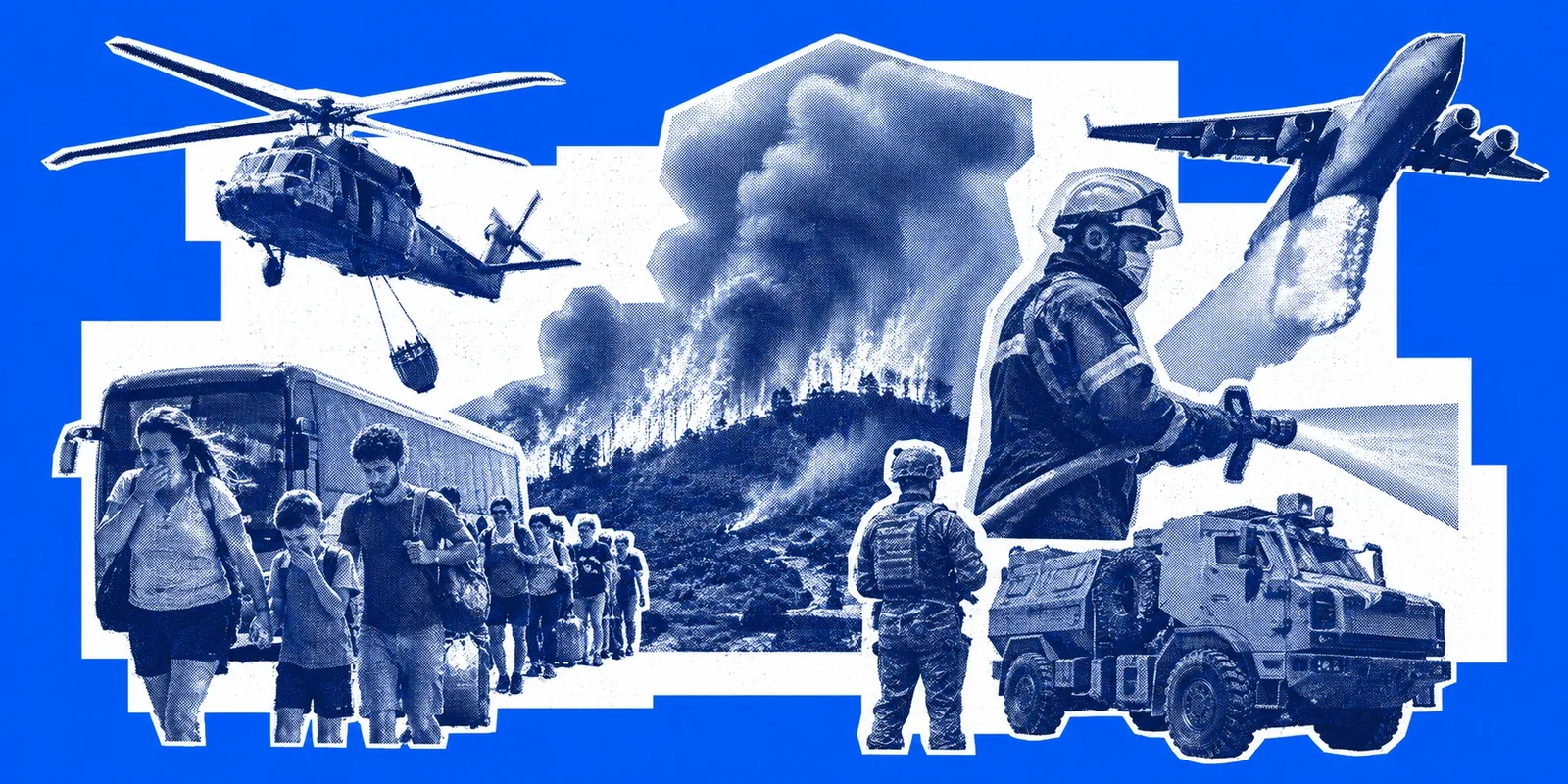
As unprecedented wildfires consume tens of thousands of hectares across France and Spain, forcing over 130,000 evacuations near Bordeaux and Madrid, national governments are treating the disaster as a national security threat. With the French military mobilized, Spain declaring states of emergency, and the EU deploying emergency aircraft, Europe’s climate disaster response is fundamentally shifting from local firefighting to centralized state power.
This is the immediate story. The more important one is what these fires are doing to the architecture of European government.
A wildfire that threatens a village is a civil protection emergency. A series of fires that forces mass evacuations, threatens a major metropolitan region, overwhelms local authorities and requires armed forces and European aircraft is something different. It becomes a test of national resilience.
When climate risk enters the security chain
The meteorological ingredients are familiar: extreme heat, dry vegetation and powerful winds. In Gironde, gusts reached 80 km/h while dry thunderstorms complicated containment. In Spain, separate fire fronts merged into a single uncontrolled disaster.
What has changed is the scale at which these conditions interact with modern infrastructure and population patterns.
A fire no longer needs to reach a capital city to disrupt the functions of a state. It needs to threaten the systems around it: transport, energy, telecommunications, housing, tourism and insurance. The approach of fire toward Bordeaux and the visibility of smoke from Madrid turned a regional environmental disaster into a metropolitan security concern.
The distinction matters because national governments are organized differently for different kinds of emergencies.
Local authorities are expected to manage fires. Interior ministries coordinate public safety. Health systems prepare for mass displacement. Defence ministries provide capabilities that civilian agencies do not possess. Economic ministries deal with the consequences.
The July crisis has forced all of these functions into the same command structure.

France's emergency response brought together the interior, defence, health, transport and environment portfolios. Spain's deployment of the UME placed a military organization created specifically for major disasters at the center of the response. The armed forces are not replacing firefighters. They are being used because the scale of the emergency has exceeded the assumptions under which ordinary civil protection operates.
That is the structural shift.
Climate adaptation is moving into the same institutional space as homeland security.
The limits of national self-sufficiency
The EU Civil Protection Mechanism exists precisely for the moment when a national response is no longer enough. Coordinated through the Emergency Response Coordination Centre, it allows member states to pool assets such as firefighting aircraft and other emergency capabilities.
The simultaneous requests from France and Spain expose both the value and the vulnerability of that system.
European solidarity can provide additional aircraft when a country is under pressure. But the system is still based on pooled capacity. If several major member states face catastrophic fires at the same time, the question is no longer whether Europe can assist. It is whether the available assistance is sufficient for simultaneous emergencies.
That distinction will become increasingly important.
The European Union has spent years building mechanisms for financial and political solidarity after disasters. The EU Solidarity Fund can support public recovery and emergency operations when damage crosses defined thresholds. But it is not designed to absorb every consequence of a climate catastrophe. Private insurance losses are outside its core function. Regional businesses still face interruption. Local administrations must continue paying for emergency operations before long-term European support arrives.

The fund is therefore part of a broader problem: Europe has mechanisms for responding to disaster, but the scale and frequency of disaster may be moving faster than the financial architecture built to absorb it.
The bill arrives before the recovery
The immediate cost of a major wildfire is visible in destroyed homes and burned forests. The deeper bill is distributed across sectors.
Tourism loses operating capacity. Agriculture loses land and production. Transport networks face disruption. Energy and telecommunications infrastructure become exposed. Insurance companies face rising claims and higher future liabilities. Municipal and regional administrations must finance emergency operations while their local tax bases are weakened.
Macron's promise of government assistance for tourism, energy, telecommunications and insurance sectors acknowledges that the crisis cannot be treated simply as a forestry problem. The economic damage spreads through networks that are much larger than the burned area.
That creates a difficult question for governments: who pays when climate risk becomes a recurring structural cost?
The answer is likely to remain divided between private insurers, national budgets and European funds. But each has limits.
Insurance becomes more expensive or less available in areas where extreme risk becomes permanent. National governments can provide emergency support, but repeated disasters compete with every other demand on public finances. European mechanisms can help, but they were not designed to replace national fiscal capacity.
The pressure will not necessarily appear as one dramatic financial shock. It can emerge through higher premiums, reduced investment, municipal debt, public reconstruction bills and repeated emergency spending.
For regional administrations, this is a particularly dangerous model. They are often closest to the disaster and least able to absorb its costs.
Europe is fighting the fire while rewriting its economic system
The wildfire crisis is unfolding alongside a much larger European policy transformation.
The EU Emissions Trading System, operating since 2005, has already cut emissions in covered sectors by more than half and generated more than €270 billion in auction revenues since 2013. Its next phase is designed to make carbon pricing a much more powerful engine of industrial transformation.
The planned reforms would adjust the pace of cap reductions, establish a €100 billion Industrial Decarbonisation Bank, expand support through the Innovation Fund and Modernisation Fund, require member states to direct half of national ETS revenues toward decarbonisation, integrate carbon removals and introduce the ETS2 carbon market for transport and buildings in 2028.
This is the long-term response to the forces producing the short-term emergency.
But the political economy is becoming harder. Governments are now expected to finance immediate adaptation while accelerating the industrial transition intended to reduce future climate risks. They must rebuild after fires, protect vulnerable regions and maintain competitiveness while imposing greater costs on emissions-intensive industries.
The same state is being asked to do all three things at once.
The new carbon framework also reveals where political pressure will fall. The system includes transitional protections, including additional free allowances and a delayed phase-out of some allowances under the Carbon Border Adjustment Mechanism. Those concessions reflect the reality that decarbonisation is not occurring in an economy insulated from geopolitical and climate shocks.

The European transition is therefore no longer a simple story of regulation becoming stricter over time. It is becoming a negotiation between the cost of preventing future damage and the cost of surviving damage already arriving.
The permanent emergency
The most consequential change may take place inside national administrations.
France and Spain are already showing the model: executive crisis meetings, interministerial command, military deployment and European operational assistance. Forest management, emergency planning and defence capabilities are beginning to occupy the same policy space.
That does not mean every wildfire will become a military operation. It means the threshold at which governments activate national security tools is falling.
The reason is practical. Climate disasters are increasingly capable of producing several emergencies at once. A fire can become a mass evacuation, an infrastructure crisis, a public health event and an economic shock within hours. Traditional administrative boundaries become obstacles when the crisis itself ignores them.
The European response will therefore depend on more than buying additional firefighting aircraft. France and Spain will have to reconsider how forests are managed, how evacuation systems are designed and how regional governments are financed for repeated disasters. The EU will have to decide whether pooled emergency assets are adequate for a continent where multiple countries may need them simultaneously.
The contradiction is becoming impossible to avoid.
Europe is building financial and regulatory machinery for a decades-long industrial transition while its governments are already paying the price of a climate environment that no longer behaves like the one in which much of that machinery was designed.
The fire is no longer only at the edge of the forest. It is inside the state budget, the military command structure and the European policy system.
Read also:
- A fast-moving wildfire near Bordeaux and Arcachon Bay has forced more than 10,000 evacuations, scorching 2,000 hectares of forest in southwestern France. As 500 firefighters battle the blaze amidst record heatwaves, nuclear power cuts, and transit shutdowns, the overnight emergency in Gironde reveals a deeper crisis: France’s system of civil protection is being pushed to its absolute limits.
- In the early morning hours of Monday, July 27, 2026, French President Emmanuel Macron convened an emergency inter-ministerial crisis meeting at the Ministry of the Interior in Paris. The urgent session was called to address the catastrophic series of wildfires raging across southwestern France, particularly within the Gironde department. With the situation labeled a national priority, the president canceled scheduled high-level luncheons and political engagements to lead a government-wide response alongside Interior Minister Laurent Nuñez and regional emergency coordinators.
Sources: France24, Le Figaro, European Commission.