
France and Canada Deepen EU Defence and Trade Links at Atlantic Summit

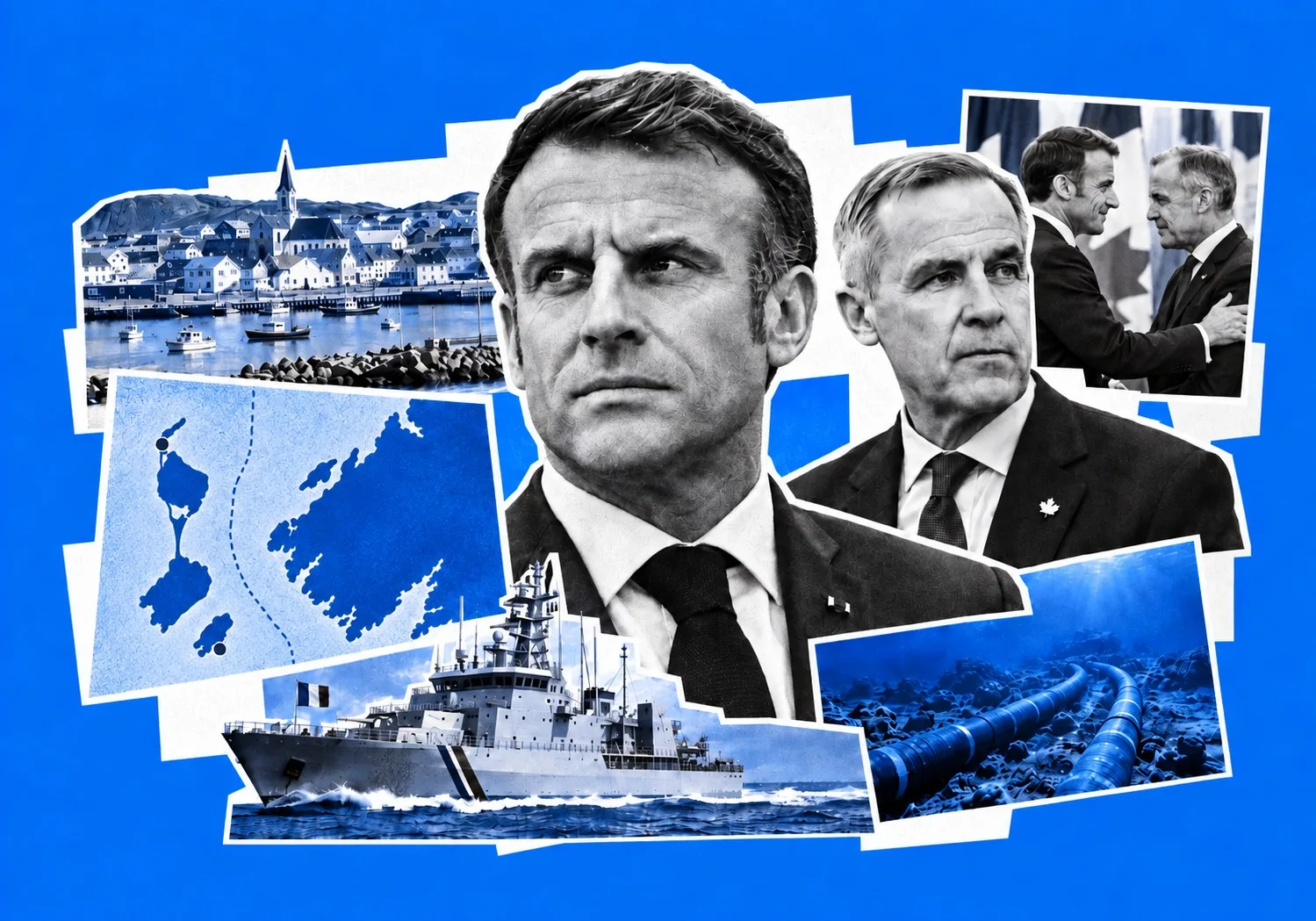
French President Emmanuel Macron and Canadian Prime Minister Mark Carney met on Saint-Pierre-et-Miquelon on Sunday to sign agreements on defence procurement, mineral access, and technology sharing. The talks provide a administrative framework for Canada’s technical integration with European Union regulatory systems, following proposals from Brussels regarding Canadian associate EU status.

The public statements focused on trade and industrial cooperation. The immediate driver, however, is protective. With Washington threatening new tariffs and unpredictable policy changes, Ottawa and Paris are constructing alternative trade infrastructure. They are using the French archipelago to anchor an industrial strategy focused on joint defence tenders and shared technology standards.
The math is straightforward.
Both leaders left Saint-Pierre-et-Miquelon on Sunday afternoon for New York to attend the United Nations General Assembly. But the summit venue itself carried specific political weight. Saint-Pierre-et-Miquelon sits 20 kilometres off Newfoundland, giving France an Exclusive Economic Zone in North American coastal waters. It is sovereign European territory patrolled by the French naval vessel Fulmar.

The Trade Numbers Behind the Summit
Bilateral goods trade between Canada and France reached $15.2 billion in 2025, an increase of nearly two-thirds over the past decade. France ranks as Canada’s third-largest export market inside the European Union. Canadian sales to France totalled $5.0 billion last year, while French shipments to Canada reached $10.2 billion.
The summit followed European Commission President Ursula von der Leyen’s State of the Union address on 16 September 2026, where she proposed offering Canada associate member status within the EU. Addressing the European Parliament in Strasbourg the following day, Carney accepted the initiative, committing Ottawa to align Canadian technical standards with European regulations.
This is a clear break with historic policy. The post-war framework, where Canada relied on an American security umbrella and open access to US buyers, no longer provides stability. US tariff threats forced Ottawa to seek formal institutional ties elsewhere.
The economic core of this shift rests on the EU-Canada Comprehensive Economic and Trade Agreement. Provisionally applied since September 2017, CETA increased trade volumes, yet full ratification remains blocked in several European parliaments, including the French National Assembly.
French cattle farmers continue to block the agreement over concerns regarding Canadian beef imports. By focusing on critical minerals, satellite systems, and heavy industry, Macron and Carney are bypassing those agricultural disputes. They are building industrial ties that function independently of the main treaty's ratification status.
French factories need Canadian raw materials for battery production. Canadian officials, meanwhile, view European regulations as a buffer against sudden policy changes in Washington.

Defence Procurement and the SAFE Framework
Macron’s team views the Canadian deal as a test case for European industrial strategy. France wants to build a self-reliant European defence base, but it needs external partners for raw inputs. The main mechanism here is Canada's entry into the European Union’s Security Action for Europe defence procurement framework.
SAFE alignment lets Canadian defence contractors bid on European manufacturing contracts, cutting historical dependence on US suppliers. Joint North Atlantic operations will now feature shared procurement. Initial contracts focus on maritime patrol aircraft, ocean-floor sensor arrays, and subsea cable protection.
The tech agreements target hardware. Rather than buying American software platforms, France and Canada are funding joint projects in quantum processing, computing clusters, and satellite hardware. Canadian mining firms provide raw cobalt and lithium, while French industrial plants handle chemical processing.
The meeting also covered local administration on the island. Over lunch, Macron and Carney discussed regional ferry routes to Newfoundland, air transit links, fishing quotas, and the relocation of Miquelon-Langlade due to shoreline erosion.
The Free French Precedent
The choice of location was deliberate. Macron and Carney laid a wreath at a monument for Free French forces who took Saint-Pierre-et-Miquelon from Vichy administrators in December 1941.
Admiral Émile Muselier ran that operation under Charles de Gaulle’s direct command. He acted against explicit orders from US President Franklin D. Roosevelt, who wanted to preserve relations with the Vichy regime and viewed the landings as an unnecessary complication. De Gaulle ignored Washington and took the island anyway.
Roosevelt was furious.
Eighty-five years later, the island is again being used to demonstrate policy independence from Washington. Macron and Carney are using the same geography to show they can build trade and defence structures without American approval.
Macron’s visit was the first by a French president since François Hollande in 2014. Carney is the first sitting Canadian prime minister to set foot on the archipelago.
Regulatory Hurdles in Brussels
Creating alternative trade corridors is slow work. What is emerging is a network of bilateral deals designed to operate alongside traditional transatlantic arrangements. Canada’s approach offers a model for other middle powers trying to manage US trade exposure.
The practical difficulties are substantial. Full alignment requires navigating European Commission rules, managing farm subsidies in national parliaments, and handling political complaints from Washington. Yet the threat of sudden US trade actions has forced policymakers in Ottawa and Paris to accept these administrative costs.
Expanding EU framework access to non-members requires formal agreement from all 27 member states. Several governments in Eastern and Southern Europe remain cautious about opening procurement markets to non-EU companies without full adherence to EU budget contributions.
The success of the summit depends entirely on technical talks scheduled for late 2026.
Critical Minerals and Supply Rules
Civil servants from both capitals must now convert the summit statements into binding regulations and capital commitments. Critical mineral supply chains are the top priority. Canada holds undeveloped deposits of lithium, nickel, cobalt, and heavy rare earths needed for European industrial plants.
France needs these materials for battery plants in Nord-Pas-de-Calais and aerospace assembly lines in Toulouse. Canadian mining projects, particularly in northern Quebec and Labrador, need long-term supply contracts to secure private bank financing for local road and rail construction.
Quantum computing and secure communications represent a second operational track. By connecting Canadian research labs with French defence contractors like Thales and Airbus, both governments plan to build satellite encryption networks outside US control. Independent digital links are treated as essential infrastructure for Atlantic shipping lanes.
Defence integration under the SAFE framework will move through fixed bidding cycles. Canadian suppliers will gain access to European naval tenders, while French shipbuilders like Naval Group will bid on Canadian patrol vessel contracts.
Joint committees established during the summit will submit their first operational report before the EU-Canada summit in early 2027.
Washington Reactions and European Trade Policy
The summit shifts political calculations in several capitals. Foreign policy staff in Washington are tracking evidence that tariff threats are driving traditional allies to establish parallel trade systems.
The United States remains the dominant military power in North America, but an independent European-Canadian trade channel reduces US economic leverage. Coercive trade policy is actively encouraging allies to fund alternative supply routes.
In Brussels, the agreement strengthens the European Commission’s regulatory reach. Demonstrating that non-EU countries are willing to adopt European standards reinforces the EU's role as a global market regulator.
European leaders still face internal domestic resistance. The French National Assembly’s refusal to ratify CETA shows how sensitive voters remain to agricultural competition. French farm unions remain organized, creating domestic political risks for Macron if Canadian agricultural imports increase.
US Congressional leaders have issued no formal statement on the Saint-Pierre summit. However, State Department staff confirmed they are reviewing the defence procurement details for potential conflicts with existing North American aerospace agreements.
Coastal Adaptation and Local Transit
The talks also covered environmental management in the North Atlantic. Saint-Pierre-et-Miquelon faces heavy winter storms, and rising water levels threaten municipal infrastructure along the coast.
The relocation of Miquelon-Langlade is one of the first planned climate moves for a European territory in North America. Engineering plans and regional funding discussed at the summit will help move 600 residents and public buildings to higher ground inland.
Local transport links between the French island and Atlantic Canada will be updated. Adjusted ferry schedules, expanded runway facilities at Saint-Pierre airport, and streamlined customs checks are intended to increase local trade with Newfoundland and Nova Scotia.
Joint marine research projects will expand under agreements between French and Canadian universities, focusing on cold-water navigation and subsea geology. These regional programs give practical administrative backing to the broader diplomatic framework.
The archipelago’s governing council confirmed that technical teams from Ottawa and regional planners from Paris will arrive in Saint-Pierre in November. They will start surveying construction sites for the Miquelon relocation and assessing port upgrades needed for heavier cargo traffic.
Middle-Power Trade Strategies
The Saint-Pierre-et-Miquelon summit shows how middle powers adapt when international trade rules break down. Instead of relying on global trade treaties or broad security promises, governments are writing specific contracts for targeted industrial goals.PBy aligning technical standards, trade rules, and military purchases, Canada and France are building institutional scale. This gives their domestic industries some protection against sudden policy shifts in larger economies.
Maintaining this strategy requires consistent political attention across multiple election cycles. A change of government in Ottawa or Paris could shift priorities, especially if domestic economic pressure encourages a return to standard US-focused trade patterns.
The agreements signed off Newfoundland mark a practical change in Atlantic relations. Combining Canadian natural resources with European regulatory authority creates an administrative network designed to keep trade moving regardless of who occupies the White House.
Canadian officials confirmed that follow-up technical meetings on quantum encryption and satellite hardware will take place next month in Paris at the Franco-Canadian Intergovernmental Committee.
Sources: Le Monde, The New York Times, Euronews, France24, Reuters