
Canada as an EU Associate Member: Inside von der Leyen’s Strasbourg Proposal

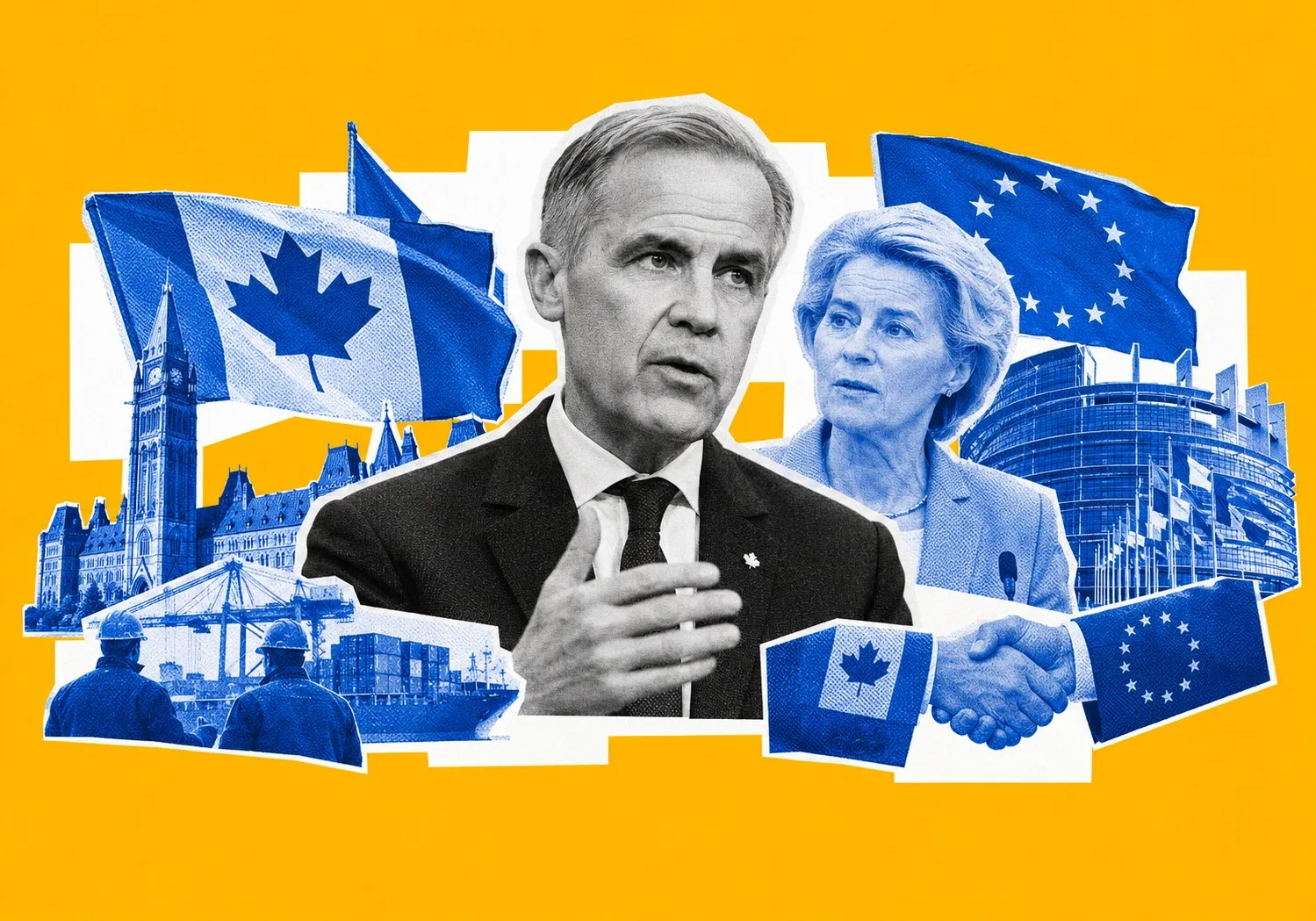
European Commission President Ursula von der Leyen has formally proposed offering Canada "associate member" status within the European Union, inviting Prime Minister Mark Carney to build an "Alliance for the Future" as both sides seek shelter from escalating U.S. trade tariffs. Speaking in Strasbourg during her annual State of the European Union address, von der Leyen's proposal signals a shift in transatlantic policy—even as treaty limitations and stalled CETA ratifications in national capitals threaten to block its legal implementation.
Behind the parliamentary applause lies a trade calculation. Driven to defensive measures by retaliatory trade disputes and tariffs from U.S. President Donald Trump, two major G7 bases are attempting to construct a formal economic axis without Washington.
What is taking shape between Strasbourg, Brussels, and Ottawa is an effort to broaden institutional ties by linking Canadian critical mineral reserves directly to European industrial supply chains.

A Strategic Hedge Against Washington
The immediate engine of the Strasbourg proposal sits on the other side of the Atlantic. Following the collapse of bilateral trade negotiations between Ottawa and Washington, Carney broke off formal trade talks with President Trump, introducing retaliatory tariffs on American imports.
For Canada, an economy bound to the American industrial base, the collapse of talks ended assumptions regarding bilateral market stability. For Europe, facing direct exposure to American trade penalties, the takeaway was identical.
The framework outlined by von der Leyen and Carney extends beyond the 2016 Comprehensive Economic and Trade Agreement (CETA). The proposed "Alliance for the Future" targets supply chains in lithium, nickel, cobalt, and rare earths, alongside joint initiatives in artificial intelligence, quantum computing, cybersecurity, and defence production.
The initiative also seeks to link defence manufacturing by expanding Canada’s participation in the EU’s Security Action for Europe (SAFE) military procurement framework, alongside agreements on Arctic research and financial settlement networks.
Carney’s approach, outlined previously at the World Economic Forum in Davos, rests on a simple premise: middle-tier economies must pool energy, industrial capacity, and raw materials to maintain trade leverage against the United States and China.
CETA, Raw Materials, and the Limits of Commerce
Underneath the rhetoric of von der Leyen’s address lies a practical push to bypass current political blockages.
The existing trade agreement, CETA, has been provisionally active since 2017. Nine years later, ten EU national parliaments—including France, Italy, and Poland—have failed to ratify the treaty due to agricultural opposition and domestic legislative delays.
Carney’s policy relies on material leverage. Canada offers Europe preferential supply contracts for critical minerals needed for electric vehicles and energy infrastructure, reducing European industrial dependence on Chinese refining capacity. In exchange, Canadian firms gain broader access to European capital markets and defence tenders.
The political fallout extends to London and Washington. For post-Brexit Britain, the potential creation of a tailored EU partnership for a non-European nation demonstrates how European commercial policy adapts under pressure. For Washington, the Ottawa-Brussels talks represent a direct structural consequence of unilateral trade tariffs.
CETA, Member Capitals and the Treaty Limits
National governments across the bloc have received von der Leyen’s proposal with explicit legal reservations.
EU treaties contain no statutory definition, legal basis, or mechanism for an "associate member." The Union’s constitutional framework recognises only full member states, European Economic Area (EEA) members like Norway, bilateral partners like Switzerland, and standard trade signatories.
Officials in several EU capitals have warned that granting Canada sector-specific entry into the internal market violates single-market rules regarding the indivisibility of the four freedoms: goods, services, capital, and people.
Allowing a non-European state selective access to single-market programmes without requiring free movement of labor, European Court of Justice oversight, or budget contributions creates immediate precedents for other third countries.
Furthermore, if national legislatures in ten member states have declined to ratify a standard trade treaty like CETA, expecting those same parliaments to ratify a novel structural arrangement remains politically improbable.
The New Logic of Strategic Blocs
Despite legal barriers, the negotiations between Ottawa and Strasbourg highlight how industrial democracies are reshaping alliance structures.
For decades, international commerce operated on multilateral tariff reductions and global supply networks backed by American security commitments. The expansion of industrial protectionism has curtailed that model. Statecraft is now oriented around defensive trade blocs designed to secure critical resources and insulate domestic markets from external penalties.
National governments in major European capitals are already signaling limits to the Commission's plan, asserting that executive arrangements cannot bypass statutory treaty procedures.
If Canada receives custom integration without accepting full internal market obligations, the UK’s post-Brexit status looks disproportionately restrictive, while Switzerland’s bilateral bilateral framework appears unnecessarily rigid. EU member states will not permit the European Commission to compromise treaty mechanisms for a political declaration in Strasbourg.
What Ottawa Actually Secures
This leaves both sides managing the gap between political announcements and statutory execution.
Carney leaves Strasbourg with a clear domestic narrative. He can demonstrate to Canadian voters that Ottawa has structural alternatives to the U.S. market, countering trade pressure from Washington. Von der Leyen can point to an expanded global footprint for European industrial policy.
In practice, Canada will not acquire formal associate membership in any constitutional sense. EU treaties will not be amended to accommodate Ottawa.
Instead, the two sides will pursue incremental agreements. Canada will secure targeted access to critical raw material partnerships, expanded research grants through Horizon Europe, and piecemeal participation in European defence procurement where existing regulations permit.
The structural reality remains unchanged. While Ottawa and Brussels seek mutual protection against tariff pressures, internal EU legal architecture ensures that third-country integration remains capped by Article 8 of the Treaty on European Union.