
EU ‘Associate Member’ Status for Canada: What von der Leyen’s Proposal Means for Global Integration

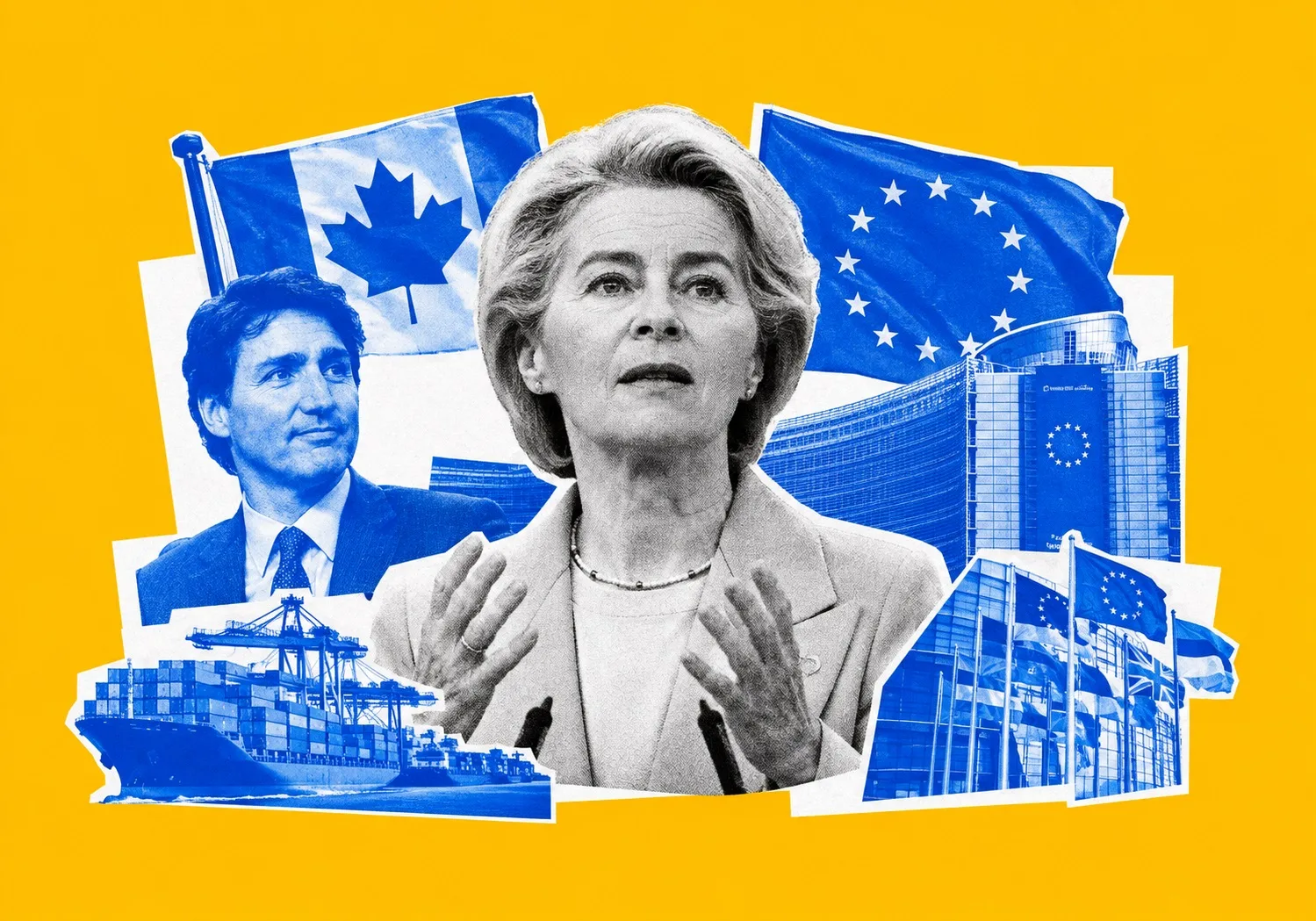
During her State of the European Union address, European Commission President Ursula von der Leyen proposed opening the door for Canada to become the EU’s first “associate member.” As Prime Minister Mark Carney seeks a unique alliance amid U.S. tariff threats, Brussels is testing a new, non-geographic model of integration that could soon extend to Australia and New Zealand.
The significance is less about a new label for Canada than about what Brussels is beginning to imagine the EU could become: not simply a geographically defined political union, but an anchor for economic and security networks extending beyond Europe.
That ambition is already colliding with two hard constraints. The first is EU law. The second is Washington.
A different kind of European integration
The proposed arrangement does not fit neatly into any existing EU category.
The European Economic Area gives Norway, Iceland and Liechtenstein access to the Single Market while requiring them to accept large parts of EU legislation without voting rights. Switzerland operates through a network of bilateral agreements. CETA, the EU-Canada trade agreement, provides another model for deep economic relations without membership. None of these arrangements amounts to the new political and economic tier Brussels is now discussing.
The distinction matters because “associate membership” is not currently recognised by the EU treaties.
Creating such a status within the treaty framework would require amendments approved unanimously by all 27 member states and then ratified domestically. The alternative would be an unprecedented standalone international agreement capable of reproducing at least part of the intended architecture without formally changing the treaties.
That leaves the proposal suspended between political ambition and institutional engineering.
Europe has already seen how difficult that engineering can be. CETA entered provisional force in 2017, yet more than a decade after negotiations concluded, several EU member states have still not completed domestic ratification. A new framework combining trade, technology, defence industry, energy and strategic resources would be considerably more complicated.
The legal problem is therefore not an afterthought. It may determine what “associate membership” eventually means.
Canada is looking beyond its traditional market
For Ottawa, the timing is hardly incidental.
Canada is facing intensifying economic pressure from the United States. Trump has imposed high tariffs on Canadian imports and repeatedly challenged Canada's trade posture and sovereignty. Carney has responded by seeking a “unique alliance” with Europe while making clear that Canada is not asking to join the EU.
That distinction is politically important. Canada is not seeking to become European. It is looking for additional strategic room.
Europe offers precisely the sort of room that a country exposed to pressure from a much larger neighbour might want: access to another major market, closer industrial relationships, cooperation in technology and defence production, and partnerships around energy and critical minerals.
The proposal also fits Canada's geography. The Arctic is explicitly included in the proposed common space, alongside sectors where European governments are increasingly concerned about supply-chain resilience.
The model would allow Canada to deepen those links without taking on the political obligations of EU accession.
That is precisely what makes the initiative different from conventional enlargement.
The EU is separating integration from geography
For decades, the EU's most consequential mechanism for extending its influence was enlargement. Countries became part of the institutional system by becoming members, while countries outside it negotiated progressively closer forms of association.
The proposed Canadian model reverses that logic.
It starts with the functions the participants want to integrate — industrial supply chains, technology, defence production, energy and strategic resources — rather than with geography or eventual political membership.
The possible expansion of the idea to Australia and New Zealand makes that shift much more consequential. European officials and media have also floated Singapore and Japan as potential participants. At the same time, European candidate states including Ukraine, Moldova and Georgia, as well as Norway and the UK, are explicitly outside this particular framework.
That is an unusual division.
Norway already has deep Single Market integration through the EEA. The UK has its post-Brexit Trade and Cooperation Agreement. Candidate countries are pursuing a fundamentally different route towards eventual EU membership. The new concept is therefore not simply a replacement for existing relationships.
It is a possible new layer between partnership and membership, designed for countries that are politically outside the EU but strategically close enough to participate in selected areas of integration.
The rule-taker problem
There is, however, a question Brussels cannot avoid: how much EU regulation would associate members have to accept?
The EEA provides the clearest warning. Its participants gain access to the Single Market but have no voting rights over the EU rules they implement. That asymmetry is manageable for countries prepared to accept it. It is less obvious that Canada, Australia or Japan would want to reproduce it across a much wider economic relationship.
The political attraction of the proposed model partly comes from its flexibility. But flexibility works in both directions. If an associate member receives preferential access without accepting the full body of EU rules, the arrangement must establish a different mechanism for regulatory alignment. If it does accept those rules, Brussels will have to address why major non-European economies should accept obligations without institutional representation.
The old debate over associate membership for Ukraine illustrates the problem. Germany previously suggested an associate tier as an interim stage towards Ukrainian accession. Kyiv rejected the idea as unfair because it offered participation without voting rights, and the proposal failed to gain traction among EU capitals.
The same institutional imbalance could look very different when offered to Canada as a strategic partnership rather than to a country seeking eventual accession. But the underlying question remains: who writes the rules, and who accepts them?
Washington turns a European experiment into a geopolitical test
Trump's reaction has already given the proposal a dimension that its institutional design alone could not provide.
He called the idea “ridiculous” and warned that Washington could regard it as a “hostile act” if pursued with “bad intentions”. He threatened “very serious” retaliatory tariffs and even the possibility of ending trade with significant parts of the EU.
Carney and the European Commission have insisted that the initiative is not directed against any third country. That position is understandable. The proposed cooperation covers concrete economic and strategic interests, and presenting it as an anti-American bloc would make negotiations with Washington more difficult.
Yet the geopolitical logic does not disappear simply because the participants deny an exclusionary purpose.
A deeper EU-Canada relationship would give Ottawa alternatives at a moment when Washington is using market access as leverage. If Australia and New Zealand joined a similar framework, and Japan or Singapore eventually became participants, the effect would be broader still: major democratic economies could gain more options for trade, industrial cooperation and strategic supply chains without creating a conventional alliance directed at the United States.
That is the structural change Washington appears to be reacting to.
From European bloc to global network
The proposed sectors are revealing. Critical minerals, AI, energy, manufacturing and defence industrial integration are not traditional boundaries of European foreign policy. They are the infrastructure of economic security.
The EU already possesses regulatory power and a large internal market. What it lacks in some strategic sectors is control over supply chains and access to resources. Canada offers raw materials, technology and an industrial base. Australia and New Zealand bring different strategic and economic assets. Japan and Singapore, if the idea ever expands that far, would extend the network into the Indo-Pacific.
The result would not necessarily be a new bloc in the traditional sense. It would be something more modular: countries cooperating where their interests overlap, while retaining full sovereignty and avoiding the institutional obligations of EU membership.
That may be the real innovation.
It would also explain why the proposal is politically easier to imagine than full enlargement, even if it is legally difficult to construct. The EU would gain strategic relationships without adding new member states, new voting arrangements or the fiscal and political commitments associated with accession.
But the same flexibility could create a new institutional tension. A network built around access to European markets and rules would expand the EU's influence without necessarily expanding its democratic decision-making structures. The more important the network became, the harder it would be to sustain the distinction between those who make European rules and those who are expected to live with them.
For Canada, that may be a price worth negotiating. For the EU, it is a question of how far its regulatory power can travel before its institutional architecture has to follow.
And for Washington, the more immediate issue may be whether economic pressure can still prevent its major trading partners from building alternatives - or whether tariff threats are accelerating precisely the diversification they are intended to stop.
Sources: Reuters, BBC, Independent, The Guardian