
Coca-Cola, Nestlé and Danone Face Pressure to Clarify Plastic Recycling Claims

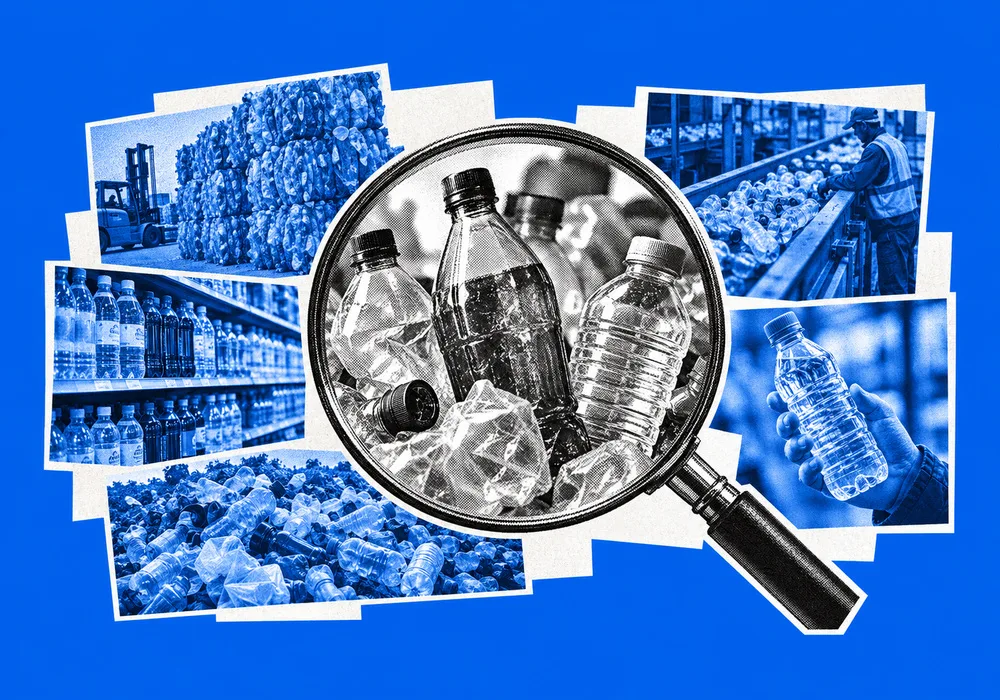
Three major beverage companies have agreed to revise environmental claims on plastic bottles sold in the EU following a consumer protection initiative. The commitments highlight the gap between the promise of a circular plastics economy and the practical limits of recycling.
Coca-Cola, Nestlé Waters and Danone have committed to revising environmental claims on plastic bottles sold across the European Union following discussions with the European Commission and national consumer protection authorities. Announced on 22 October, the commitments aim to prevent labels and advertising from overstating the recycled content of packaging or suggesting that plastic bottles can be recycled indefinitely. The decision follows a complaint filed by European consumer organisations in November 2023 and marks the completion of a process that has placed the environmental marketing practices of three major beverage producers under scrutiny.
The changes concern how companies communicate the composition and recyclability of their packaging. Claims such as “I am a bottle made from 100% recycled plastic” must be accompanied by clear qualifications stating that the cap and label are excluded where the percentage applies only to the bottle body. The clarification must be presented prominently, rather than leaving consumers to assume that every component is made from recycled material. The companies have also agreed to revise slogans such as “Recycle me again”, replacing them with simpler calls to action that encourage appropriate disposal without implying that a bottle has already been recycled or will necessarily become another bottle.
The gap between recycling claims and reality
The dispute reflects a broader problem in the European plastics economy: the distinction between material that can theoretically be recycled, material that is collected for recycling and material that actually returns to production. These are not interchangeable categories. A bottle may contain recycled plastic without all its components having the same composition, while a recyclable design does not guarantee that the packaging will be collected, sorted and processed after use.
The European Consumer Organisation (BEUC), which coordinated the complaint with consumer groups from 13 countries, identified three main concerns: claims that bottles are “100% recyclable”, statements that they are made entirely from recycled plastic, and environmental imagery that may suggest plastic packaging has little or no environmental impact. BEUC estimates that around 55% of PET beverage bottle bodies are recycled in the EU, while the likelihood of a bottle being turned into another bottle is approximately 30%. These figures illustrate the difference between recycling as a technical possibility and a functioning closed-loop system.
The distinction is particularly important for PET, the plastic widely used in beverage bottles. Even where recycling infrastructure exists, the outcome depends on collection rates, sorting efficiency, the quality of recovered material and the availability of suitable processing facilities. Claims about recyclability can therefore create a misleading impression when they omit the conditions required for recycling to take place. The Commission's intervention seeks to ensure that companies communicate the environmental characteristics of their products without implying a level of circularity that the system cannot consistently deliver.
Consumer protection becomes a test for green marketing
The commitments emerged from a complaint submitted to EU authorities by BEUC and its partners, including ClientEarth and the Environmental Coalition on Standards (ECOS), in November 2023. The initiative was coordinated through the EU's Consumer Protection Cooperation network, with the Swedish Consumer Agency and the Hungarian Competition Authority leading the national enforcement work. Coca-Cola and Nestlé had already agreed to changes before the latest announcement, while Danone's commitment completed the process involving all three companies.
The revised claims must apply not only to physical packaging but also to digital marketing on company websites and social media. The overall presentation of a product must not mislead consumers through the combination of recycling statements, environmental symbols and imagery associated with nature. This approach reflects the growing recognition among European regulators that greenwashing does not necessarily depend on a single demonstrably false sentence. An advertisement can also create a misleading impression through the way its individual elements are presented together.
Implementation will take place over different timelines. Packaging changes may take up to 18 months from the acceptance of the respective commitments, while relevant digital marketing updates are subject to shorter deadlines. Coca-Cola and Nestlé have already implemented some changes, particularly in digital campaigns. National consumer protection authorities will monitor compliance and may take enforcement measures if the companies fail to fulfil their commitments.
The outcome should not be interpreted as a fine or a court ruling establishing that the companies violated consumer law. The commitments are intended to bring the specified claims into line with EU consumer protection requirements, and the companies have not admitted past non-compliance. The regulatory significance lies in the requirement to substantiate environmental messages and communicate their scope clearly.
Implications for Europe's circular economy
The case demonstrates the growing importance of consumer protection rules in the EU's environmental transition. As sustainability claims become an increasingly prominent part of product marketing, regulators face the challenge of distinguishing measurable improvements from messaging that exaggerates environmental benefits. The EU's Directive on empowering consumers for the green transition, whose rules began applying on 27 September 2026, reinforces the wider regulatory framework against misleading environmental claims.
For beverage producers, the implications extend beyond the wording of individual labels. Companies operating across the single market must align packaging, advertising and digital communications with increasingly explicit expectations for environmental transparency. The European Commission and the CPC network have also indicated that they may engage with industry associations and assess the practices of other major bottlers, potentially extending the impact beyond the three companies involved in the current commitments.
The episode also exposes a structural limit of relying on recycling claims to establish the environmental credentials of disposable packaging. More accurate labels can help consumers understand what they are buying, but they cannot by themselves increase collection rates, improve sorting infrastructure or guarantee that recovered plastic will be converted into new bottles. Those outcomes depend on the wider waste-management system and the economics of material recovery.
The immediate result is a narrower scope for ambiguous environmental messaging on plastic bottles sold in Europe. The longer-term test will be whether clearer claims are accompanied by measurable improvements in packaging design, collection and reuse. For EU policymakers, the case offers a concrete example of how consumer law can support environmental objectives, while also underlining the difference between making sustainability claims more accurate and making the underlying production system more sustainable.
Sources: European Commission, BEUC, Agence Europe