
EU ETS Reform: Brussels Eases Carbon Cap Reductions and Extends Free Allowances to 2038

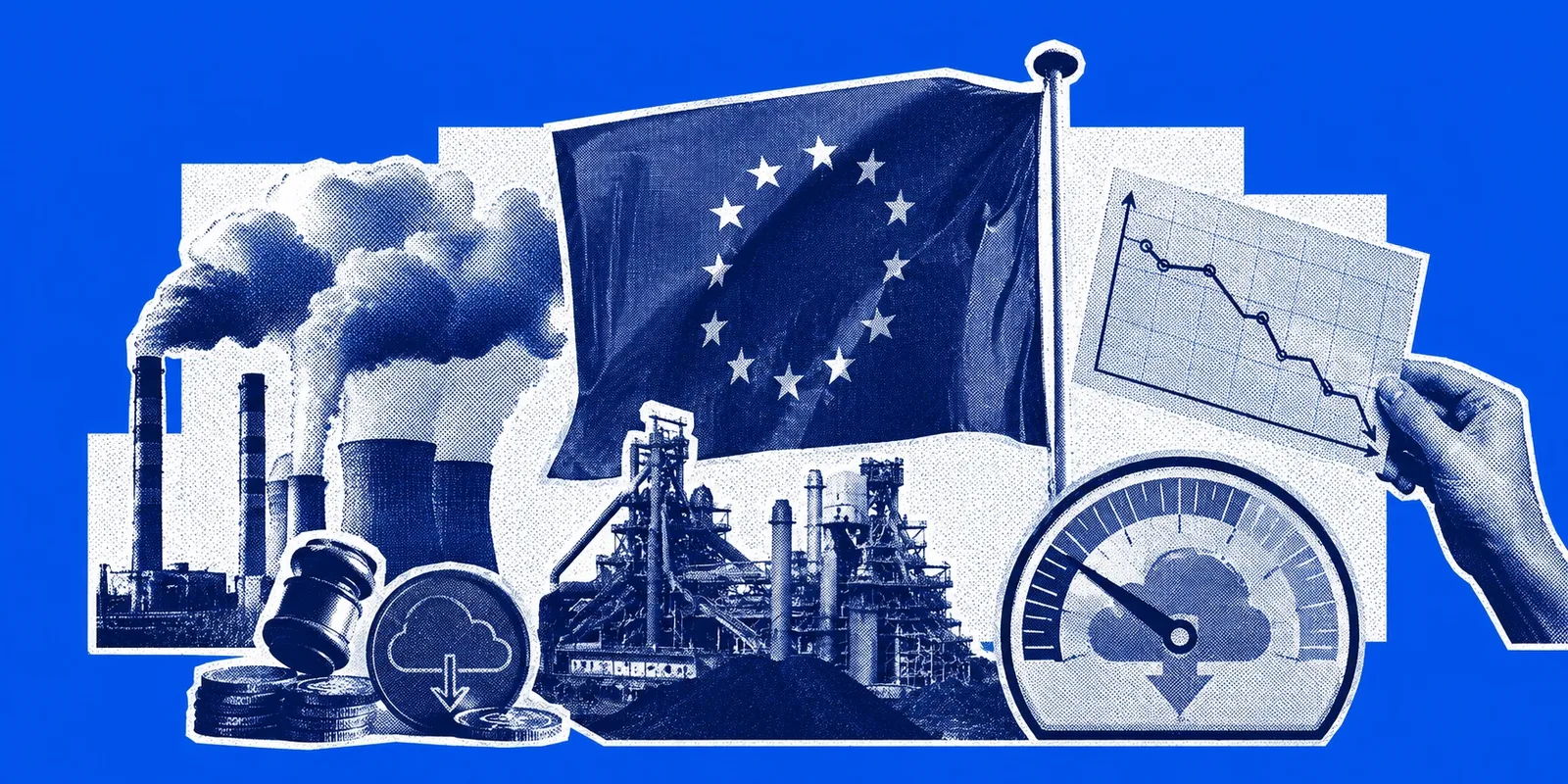
The European Commission has proposed a major overhaul of the EU Emissions Trading System (EU ETS), slowing the annual reduction of carbon caps and extending free emissions permits for heavy industry until 2038. Presented on July 17, the proposal defers the full implementation of the Carbon Border Adjustment Mechanism (CBAM) to 2038 and introduces strict 80/20 investment conditions for manufacturers, signaling a pivotal shift toward domestic industrial protectionism.
For the first time, Brussels is not tightening the central market mechanism of its climate policy. It is slowing it down.
The most important change is not simply that the EU will allow industry to emit more for longer. It is the condition attached to that relief.
Under the Commission's proposal, companies seeking free carbon permits would receive 80% of their allocation upfront after submitting a binding plan to decarbonise their European operations. The remaining 20% would only be released after the promised investments had been verified. Failure to carry out the plan could lead to the withdrawal of the benefit.
That is a major departure from the old logic of the ETS.
The system was designed around scarcity. The number of permits would fall, carbon would become more expensive and companies would have a financial reason to invest in cleaner production. The market was expected to do much of the work.
The new model is more interventionist. Brussels is effectively saying that carbon relief can be used as an industrial subsidy, but only if the recipient commits capital to European facilities.
The distinction matters. A free allowance that simply lowers a company's costs can become a passive subsidy. A free allowance tied to a binding investment plan is intended to become a lever for keeping factories, equipment and technological expertise in Europe.
The Commission also wants national governments to direct 50% of their ETS revenues to industrial decarbonisation. Since 2013, the system has generated €260 billion for member states. The new requirement seeks to make sure that a much larger share of that money returns to the industrial base that is expected to carry the cost of the transition.
This is the point where the ETS starts to look less like a pure carbon market and more like a system of directed capital allocation.
The numbers reveal the retreat
The proposal would reduce the annual rate at which the emissions cap falls from 4.3% to 3.7% between 2031 and 2035, and then to 1.7% between 2036 and 2040.
That change is designed to prevent the current trajectory from effectively exhausting allowable industrial emissions by 2039. The political message is clear: the EU no longer believes that the existing pace can be maintained without putting too much pressure on its manufacturing base.
Heavy industry has been operating under a difficult combination of high energy costs, geopolitical instability and intense competition from countries with far more aggressive state support. Since the energy crisis that followed Russia's invasion of Ukraine, European manufacturers have faced a structural disadvantage in electricity and gas prices compared with many American and Asian competitors.
A carbon price that rises steadily can accelerate investment in clean technology. It can also accelerate the movement of factories and capital elsewhere.
Brussels is now acting on the second risk.
The proposal would provide an estimated €6 billion in additional free permits to energy-intensive industries between 2026 and 2030 through technical changes to heat and fuel-use benchmarks. Free allowances for sectors such as steel, cement, glass, ceramics and building materials would then continue until 2038 rather than ending in 2034.
The policy is no longer built around forcing the transition as quickly as possible. It is built around preventing the transition from destroying the industrial capacity needed to complete it.
The 80/20 rule is the political centre of the proposal
The conditionality mechanism is an attempt to solve the problem that has long haunted European climate policy: how to protect companies from global competition without simply paying them not to change.
The answer is the 80/20 structure.
Companies receive most of the benefit only after presenting a binding plan, but they do not receive the entire benefit without proving that the plan has been executed. The final 20% becomes a form of leverage. It gives Brussels a mechanism to punish companies that promise to decarbonise and then delay the investment.
The principle is straightforward: if Europe is going to sacrifice some of the pressure created by carbon pricing, companies must compensate by putting money into actual industrial transformation.
That may also create a guaranteed market for European equipment and clean-technology suppliers. A steelmaker modernising a plant, a cement producer replacing fuel systems or an industrial company electrifying production will need equipment, infrastructure and engineering capacity. The free allowance is therefore designed to circulate through the European economy rather than simply improve corporate balance sheets.
Whether this will be enough to keep capital in Europe is a much harder question.
Companies do not invest only because subsidies exist. They invest where energy is affordable, infrastructure is reliable and long-term regulation is predictable. The Commission can make carbon relief conditional, but it cannot by itself eliminate the cost gap with the United States or Asia.
The green camp is now divided against industrial reality
The political conflict will intensify as the proposal moves to the European Parliament and the Council.
Poland has already described the shift as a major success, while making clear that it wants further concessions. Italy and the Czech Republic are also expected to push for looser conditions and lower costs for domestic industry. For Central and Eastern European countries with large carbon-intensive industrial bases, the Commission's proposal offers both financial relief and political recognition.
The old argument that the carbon price should rise until companies change behaviour has become increasingly difficult to defend when the same companies are deciding whether their next factory should be built in Europe, the United States or China.
Yet the proposal has created another problem: it undermines the expectations of companies that invested early on the assumption that carbon would become steadily more expensive.
Utilities and early green investors have made long-term decisions based on a particular policy signal. Annika Ramsköld of Vattenfall has warned that slowing the central climate policy threatens the regulatory stability required for major energy-transition investments.
That criticism is not merely ideological.
A high and predictable carbon price can make a zero-emission project economically attractive. If governments later decide that the price must be suppressed to protect existing industry, companies that invested early may find themselves competing against firms that delayed and then received protection.
The EU may be saving factories that are struggling today while making the business case for some future clean investments less certain.
Spain is among the countries resisting a weakening of the scheme. That divide is likely to become sharper in negotiations. The dispute is no longer simply between climate advocates and industrial lobbies. It is increasingly a conflict between different industrial strategies.
One side wants to preserve manufacturing by reducing the pressure of the carbon market. The other argues that weakening the market will undermine the investments needed to build the industries of the future.
Both arguments have economic logic.
CBAM's delay changes the trade equation
The postponement of the full CBAM phase-in from 2034 to 2038 is perhaps the proposal's most consequential international element.
The original logic was simple: as free allowances for European producers disappeared, foreign exporters would face a carbon adjustment when selling into the EU. The mechanism was meant to prevent European companies from being penalised for operating under stricter climate rules while imports escaped comparable costs.
By extending free allowances, the Commission necessarily delays the moment when CBAM becomes fully effective.
That gives European industry more time. It also gives foreign producers more time to adapt to the EU's carbon rules. For companies outside the bloc that had been preparing for a clearer 2034 deadline, the delay creates another period of uncertainty.
The trade message is also less aggressive. The EU is hesitating to fully expose its own manufacturers to international competition under a carbon regime while their domestic cost base remains fragile.
The result is an uncomfortable compromise: Europe wants the power to impose carbon standards on global trade, but it is not yet prepared to apply the full force of those standards to its own industry.
The 2040 target now carries a different political meaning
The EU still aims to reduce net emissions by 90% by 2040. The Commission's proposal does not formally abandon that objective.
But achieving it will now depend less on the carbon market alone.
The plan to double electricity's share of total EU energy consumption by 2040 points toward a much larger role for electrification and direct industrial investment. The expansion of the ETS to waste incineration, smaller maritime vessels and additional international aviation routes also broadens the system's reach.
The contradiction is obvious. The EU is slowing the rate at which one of its main climate instruments tightens while expanding the number of activities it covers.
That is not necessarily a failure of policy. It is evidence of a changing strategy.
Europe has discovered that decarbonisation is also a contest over factories, supply chains and strategic autonomy. A carbon market can force companies to change. It cannot guarantee that they will change in Europe.
The new ETS proposal is an attempt to solve that problem through conditional protection: less pressure today, more obligations to invest at home.
Whether the formula works will depend on what happens next. If companies use the breathing space to modernise, Brussels may have found a way to reconcile climate ambition with industrial survival. If the concessions become permanent and investment conditions are weakened in negotiations, the EU will have exchanged a powerful market signal for a system of subsidies with fewer guarantees.
The most revealing feature of the proposal is that Europe is no longer asking whether industry can survive the green transition. It is now trying to decide how much of the transition must be postponed to make sure industry survives at all.
Sources: Reuters.