Top news

Aug 16, 2026, 06:00 AM UTC

← Latest news

01
ContinuingAI-generated
Deadly Russian strikes hit Kyiv as North Korean missile unit deploys to Voronezh

Deadly Russian strikes hit Kyiv as North Korean missile unit deploys to Voronezh

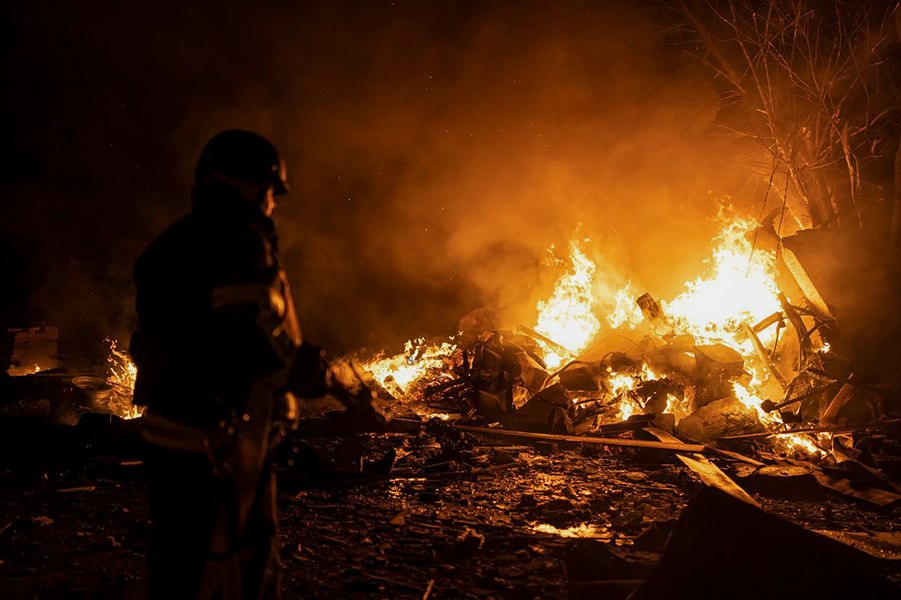
Russian missile and drone strikes hit Kyiv and surrounding areas, leaving up to 17 dead, as North Korean missile units deploy in Voronezh and frontline clashes continue.

A major overnight barrage of Russian ballistic missiles and drones struck Kyiv and surrounding districts, inflicting severe structural damage and heavy casualties. Local authorities and monitoring reports presented differing casualty figures, estimating between 15 and 17 fatalities and between 44 and 51 people injured. Storage facilities and transport infrastructure in the Bucha district also sustained damage.

Concurrently, Ukrainian military intelligence indicated that a North Korean missile detachment has begun deploying mobile launch systems and ballistic missiles in Russia's Voronezh region to assist Moscow's strike capabilities.

On the front lines, Ukrainian troops conducted operations against entrenched Russian soldiers in Kupyansk and captured personnel near Oleksiievo-Druzhkivka. In Moscow, President Vladimir Putin signaled upcoming leadership changes within the Russian armed forces and the Ministry of Defense.

Sources: Mediazona, Point, The Insider, Радіо Свобода, Українська правда.
Read more
02
ContinuingAI-generated
Russian missile and drone strikes hit Kryvyi Rih and Kyiv

Russian missile and drone strikes hit Kryvyi Rih and Kyiv

Russian missile and drone strikes targeted Kyiv and Kryvyi Rih overnight, hitting industrial facilities, sparking fires, and causing fresh casualties.

Russian forces launched an overnight barrage of missiles and drones across several Ukrainian regions, inflicting fresh casualties and causing infrastructure damage.

In Kryvyi Rih, regional authorities reported that a strike targeting industrial facilities killed at least one person and injured six others. The overnight assault also sparked fires in Kyiv, alongside persistent shelling and drone incursions across the broader Dnipropetrovsk region, including the Kamianske and Pavlohrad districts.

The strikes follow intense aerial activity across Ukraine, where officials registered waves of approximately 180 drones targeting Odesa, Sumy, Zaporizhzhia, and Dnipropetrovsk. Emergency crews and municipal services continue rescue and containment efforts at impacted industrial and civilian sites.

Sources: Adevărul, Moldova1, Ziarul de Gardă

Read more
03
ContinuingAI-generated
Ukrainian military and political analysts outline conditions for strategic victory

Ukrainian military and political analysts outline conditions for strategic victory

Ukrainian military commanders and political analysts have detailed strategic requirements and long-term priorities aimed at degrading Russian operational capabilities.

Ukrainian military officials and strategic analysts continue to define key requirements for altering the course of the ongoing war with Russia. Frontline drone commanders have outlined strategic conditions necessary to dismantle Russian operational capabilities, focusing on targeted strikes against critical infrastructure, supply lines, and command hubs.

At the same time, discussions among political observers in Kyiv point to shifts in broader wartime planning, balancing immediate battlefield defense with long-term resilience and strategic deterrence. Ukrainian leadership continues to stress that Russian territorial ambitions extend beyond Ukraine, arguing that coordinated defensive pressure and systematic strikes on logistical networks remain essential to constraining Moscow's offensive capacity across the region.

Sources: 15min.

Read more
04
ContinuingAI-generated
Artificial intelligence and tech integration drive shifts in modern warfare doctrine

Artificial intelligence and tech integration drive shifts in modern warfare doctrine

Military doctrines and hardware are transforming rapidly as artificial intelligence, uncrewed systems, and commercial technologies reshape operational strategies worldwide.

The rapid adoption of artificial intelligence and uncrewed systems is reshaping military doctrine and tactical capabilities across global armed forces.

In Ukraine, frontline operations have accelerated the integration of autonomous technologies, with industry observers noting a shift away from traditional heavy-armour doctrines toward agile, tech-driven combat. Ukrainian diplomat and former military chief Valerii Zaluzhny warned that Western militaries risk falling behind current operational realities if they rely on legacy frameworks rather than the advanced drone warfare developed during the conflict.

Meanwhile, Ukrainian intelligence reported finding United States-manufactured microchips in newly produced Russian missiles, suggesting expanding AI applications in adversarial targeting systems. Beyond the European theatre, China’s military is deploying dedicated AI platforms to coordinate large-scale automated airstrikes. At the same time, restrictions on commercial technologies, such as satellite communication networks, continue to present operational friction in cross-border engagements.

Sources: Liga net, NEXTA, NV, Point, The Insider

Read more
05
Romania's power grid faces strain amid drought and infrastructure gaps, analysis finds

Romania's power grid faces strain amid drought and infrastructure gaps, analysis finds

An Energy Policy Group analysis warns that severe drought, storage deficits, and delayed grid upgrades leave Romania generating far below its 19 GW installed power capacity.

Romania's national power grid has faced intense operational pressure amid severe drought conditions, exposing long-standing structural vulnerabilities, according to an Energy Policy Group analysis.

While the country boasts an installed capacity of nearly 19 gigawatts, actual output on certain days falls to roughly one-third of that total. The shortfall stems primarily from hydrological deficits that have substantially diminished water levels along key waterways such as the Danube, sharply curbing hydroelectric generation.

The analysis also underscores that the rapid expansion of renewable energy sources has outpaced electricity grid upgrades. A lack of dedicated energy storage capacity and delayed capital investments have further compounded systemic fragility during periods of extreme weather.

Sources: G4Media.

Read more
Share